
Lobular Breast Cancer: Differences from Ductal Cancer, Diagnosis, and Innovations in Treatment – 2026
In this article
Same Label, Different Disease: What Sets Lobular Breast Cancer Apart from Ductal Cancer?
Invasive lobular breast cancer accounts for 10–15% of breast cancers and is the second most common type. Because the pathology report usually reads "hormone receptor-positive, HER2-negative," it is treated the same way as ductal cancer. Yet genetic and clinical studies over the past decade have shown that lobular cancer grows differently, spreads to different sites, can recur many years later, and may respond differently to endocrine therapy. Building on a review piece from the European Society for Medical Oncology (ESMO), we have summarized what is known about lobular cancer, from diagnosis to treatment, as of October 2026. We previously covered genomic recurrence score tests in lobular cancer and the stages and treatment of breast cancer.
- Different biology: The hallmark of lobular cancer is loss of E-cadherin (CDH1 gene), the protein that holds cells together. Because cells grow in a scattered, single-file pattern, they may not form a mass and can be missed on mammography and FDG-PET.
- Different timing of recurrence: In node-positive patients, recurrence is less frequent than in ductal cancer during the first 5 years but about 30% more frequent after year 5 (NSABP analysis). Spread more often involves the peritoneum, gastrointestinal tract, and ovaries.
- Response to endocrine therapy may differ: In BIG 1-98, letrozole raised 8-year disease-free survival in lobular cancer from 66% to 82% compared with tamoxifen; in ductal cancer the difference was smaller (75% vs 82%). Window-of-opportunity trials also suggest that tamoxifen may be less effective in lobular cancer.
- In practice: There is no drug approved specifically for lobular cancer; treatment is largely the same as for other hormone receptor-positive cancers. However, preferring an aromatase inhibitor after menopause, recognizing the limited response to preoperative chemotherapy, extended follow-up, and attention to atypical sites of spread become important.
Why does this matter?
Most breast cancers are "invasive ductal carcinoma," or, in current terminology, "invasive carcinoma of no special type," arising from the milk ducts. Lobular cancer, by contrast, originates from cells of the milk-producing lobules and holds a distinct place among types of carcinoma. Given that about 2.3 million women worldwide are diagnosed with breast cancer each year, lobular cancer on its own is more common than many other cancer types.
Most lobular cancers are strongly hormone receptor-positive, HER2-negative, and low-to-intermediate grade. Despite this "favorable biology," the disease is often larger and more advanced at diagnosis. Treating lobular and ductal cancer as the same based solely on hormone receptors in the pathology report can affect diagnostic delays, missed sites of spread, and the choice of endocrine therapy. For this reason, international research groups (such as the European Lobular Breast Cancer Consortium) have been conducting lobular-specific studies in recent years.
No, but it has gained clear momentum in recent years:
- 1941: Foote and Stewart described the in situ form of lobular carcinoma of the breast as a distinct entity.
- 2015: The Cancer Genome Atlas (TCGA) published the genetic map of lobular cancer; in the same year, a BIG 1-98 analysis showed that the advantage of letrozole over tamoxifen was more pronounced in lobular cancer.
- 2024–2025: The TEXT/SOFT, PELOPS, and TBCRC 037 studies supported a different response to endocrine therapy in lobular cancer; the first lobular-specific targeted therapy trials (ROS1 inhibitors), however, were negative.
- 2026: Capivasertib (LOBSTER) and neratinib trials enrolling only patients with lobular cancer are ongoing.
- Not yet available: A drug approved specifically for lobular cancer, or a randomized phase 3 trial that changes treatment based on lobular histology.
What is lobular breast cancer?
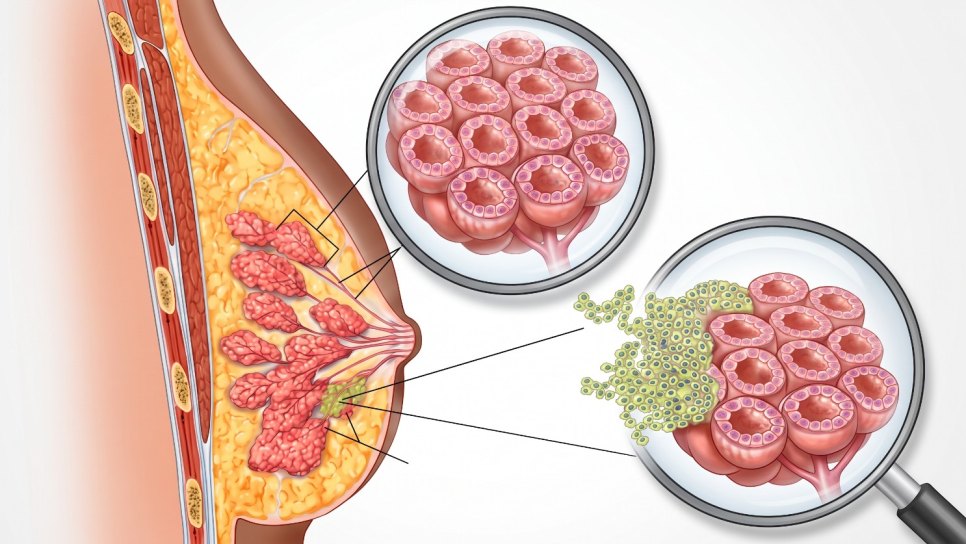
Invasive lobular breast cancer is a type of breast cancer that arises from the milk-producing lobules of the breast and accounts for 10–15% of breast cancers. Because of the loss of E-cadherin, the protein that holds cells together, it grows in a scattered, single-file pattern; as a result, it may not form a mass and can be hard to detect on imaging. It is usually hormone receptor-positive and HER2-negative, and it tends to recur late.
How it differs from ductal cancer
| Feature | Lobular cancer | Ductal (no special type) cancer |
|---|---|---|
| Frequency | 10–15% | About 70–80% |
| Key molecular feature | Loss of E-cadherin (CDH1) | E-cadherin usually retained |
| Growth pattern | Single-file, scattered; may lack a distinct mass | Usually a distinct mass |
| Hormone receptor positivity | 90–95% | About 70–80% |
| HER2 positivity | About 5% | About 18% |
| High-grade (grade 3) tumor | 11% | 40% |
| Stage 3 at diagnosis | 17% | 8% |
| Tumor in both breasts | More common | Less common |
| Sites of spread | Bone, peritoneum, gastrointestinal tract, ovary, meninges | Bone, lung, liver, brain |
| Timing of recurrence | Substantial even after 5 years | Mostly within the first 5 years |
| Complete response to preoperative chemotherapy | About 6% | About 17% |
Rates: US Great Lakes Breast Cancer Consortium (38,000 patients), NSABP analysis, and pooled German neoadjuvant trials; details in the text.
Subtypes of lobular cancer
- Classic lobular cancer: The most common type; low-to-intermediate grade, hormone receptor-positive, HER2-negative.
- Pleomorphic lobular cancer: Larger, more irregular cells; higher grade, more aggressive course, with HER2 positivity and loss of hormone receptors more common.
- Other variants: Solid, alveolar, and mixed (lobular-ductal) types. In mixed tumors, treatment decisions take both components into account.
"Lobular neoplasia" or "lobular carcinoma in situ" (LCIS) of the breast, on the other hand, is not invasive cancer; it is a risk marker indicating an increased future risk of cancer in both breasts, and some types (such as pleomorphic LCIS) are completely removed surgically.
Why does lobular cancer behave differently?
The defining feature of lobular cancer is the loss of the E-cadherin protein resulting from alterations in the CDH1 gene. E-cadherin acts like a "cellular glue" that holds breast cells together. Without this protein, cancer cells grow detached from one another, in single file (the "Indian file" pattern), infiltrating the surrounding tissue. In pathology, E-cadherin staining (immunohistochemistry) is the most widely used method to distinguish lobular from ductal cancer.
Figure 1 · From E-cadherin loss to the clinical picture
How the molecular hallmark of lobular cancer relates to diagnosis and spread
The genetic map: where it diverges from ductal cancer
The Cancer Genome Atlas study of 127 lobular cancers (Cell, 2015) and subsequent analyses defined the genetic profile of lobular cancer:
- CDH1: Mutated or lost in about two-thirds of lobular cancers.
- FOXA1 and GATA3: These two "pioneer" proteins, which determine which genes the estrogen receptor switches on, are altered differently in lobular cancer: FOXA1 mutations are more common (7–9%), and GATA3 mutations are less common than in ductal cancer. This finding was the first clue that estrogen receptor signaling works differently in lobular cancer.
- PI3K-AKT pathway: 35–60% of patients have alterations in this growth pathway (PIK3CA, PTEN). This makes drugs such as PI3K inhibitors and capivasertib of interest in lobular cancer.
- HER2 mutations: Unlike HER2 amplification, activating mutations in the HER2 gene occur in 4–5% of early-stage and 6–27% of metastatic disease.
- ESR1 mutations: About 10% at diagnosis of metastasis, rising to as high as 60% after progression on endocrine therapy.
- Immune environment: Lobular cancers are mostly immunologically "cold" (median tumor-infiltrating lymphocytes 5%); however, about 18% have a high mutational burden.
The Cancer Genome Atlas divided lobular cancers into three subgroups, "reactive-like," "immune-related," and "proliferative," with the proliferative group having a worse outcome. A spatial transcriptomics study published in PNAS in February 2026 proposed that lobular cancers can also be classified by the structure of the tissue surrounding the tumor (the tumor microenvironment). This suggests the tumor microenvironment may become a therapeutic target in the future.
Why is lobular cancer hard to diagnose?
- It may not form a mass: Because the tumor grows diffusely, instead of a distinct palpable lump it may present as thickening, firmness, or shrinkage of the breast, or nipple retraction (symptoms other than a palpable lump).
- Mammography can miss it: Lobular cancer may not produce a distinct mass or calcifications on mammography, and tumor size may be underestimated. For this reason, guidelines state that breast MRI may be considered to assess the preoperative extent of disease in lobular cancer.
- Care at biopsy: In a core needle biopsy, E-cadherin staining and review by an experienced breast pathologist are important; in difficult cases, a second pathology opinion can be helpful.
- Surgical margins: Because tumor borders are ill-defined, positive surgical margins and the need for re-excision after breast-conserving surgery are more common than in ductal cancer. Even so, in suitable patients breast-conserving surgery yields outcomes similar to mastectomy.
Staging and detecting spread
Standard FDG-PET/CT highlights tumors with high glucose uptake. Because lobular cancer usually grows slowly and takes up little glucose, it is less visible on FDG-PET; some metastases may show no uptake on PET even when they are seen on CT. In a survey of 241 patients with metastatic lobular cancer, 36% reported that at least one imaging method had missed at least one metastatic site at diagnosis.
18F-FES PET (fluoroestradiol PET), which uses a tracer that binds to the estrogen receptor, was approved in the United States in 2020 and can provide information complementary to FDG-PET in estrogen receptor-positive disease, particularly lobular cancer. However, its role in routine staging and its availability are limited.
Where does lobular cancer spread?
Like other breast cancers, lobular cancer spreads most often to bone; however, it involves unusual sites more often than ductal cancer. In autopsy series:
- Peritoneum (lining of the abdomen): 60–90% in lobular cancer vs about 15% in ductal cancer. It may present with fluid buildup in the abdomen, bloating, bowel obstruction, or narrowing of the urinary tract.
- Gastrointestinal tract: Up to 40% in lobular cancer vs about 2% in ductal cancer. Gastric involvement can mimic stomach cancer (linitis plastica); because about half of superficial endoscopic biopsies can come back normal, deep or repeated biopsies may be needed.
- Ovaries: Up to 13%; masses in both ovaries can be mistaken for ovarian cancer.
- Other: The meninges (leptomeningeal metastasis), the area around the eye, and the uterus.
- Persistent indigestion, early satiety, loss of appetite, nausea and vomiting, or unexplained weight loss
- Abdominal swelling, constipation, or a change in bowel habits
- Double vision, swelling around the eye, or a drooping eyelid
- New, persistent bone pain, headache, or neurological symptoms
Most of these symptoms are not caused by cancer; however, in someone with a history of lobular cancer they should be reported to a doctor, even years later.
Does lobular cancer recur late?
Yes. An analysis of 12,482 node-positive patients treated with chemotherapy in four large NSABP trials (JNCI, 2025) compared 1,174 matched patients with lobular cancer and 4,694 with ductal cancer. Median follow-up was 10–15 years.
Risk of recurrence in lobular vs ductal cancer
Hazard ratio (HR). Ductal cancer = 1. Below 1 means fewer recurrences in lobular cancer, above 1 means more. 5,868 matched node-positive patients.
First 5 years: HR 0.80 (95% CI 0.69–0.93); after 5 years: HR 1.30 (95% CI 1.09–1.56). Significant interaction between time period and histology (p<0.001). Source: pooled analysis of NSABP B-22, B-25, B-28, B-30.
In lobular cancer, the risk of recurrence was 20% lower in the first 5 years and 30% higher after year 5. The risk of mortality was also lower in the first 5 years (HR 0.76); after year 5 the difference was not significant (HR 1.04). This tendency toward "late recurrence" explains why extended follow-up and adherence to endocrine therapy matter in lobular cancer. On the other hand, this analysis is retrospective and based on older trials; it does not reflect current treatments with CDK4/6 inhibitors.
Hereditary lobular breast cancer
A small proportion of lobular cancers are associated with an inherited (germline) alteration in the CDH1 gene. These individuals have an increased risk of both hereditary diffuse gastric cancer and lobular breast cancer; in female carriers, the risk of breast cancer by age 80 is estimated at about 40%. Genetic counseling is recommended when there is a family history of diffuse gastric cancer, or of lobular cancer at a young age or in both breasts. Lobular cancer can also occur in carriers of BRCA2, PALB2, and CHEK2 variants (hereditary cancers and their treatment).
Treatment of early-stage lobular cancer
There is currently no separate treatment guideline specific to lobular cancer; decisions on surgery, radiotherapy, and drug therapy are largely based on the same principles as for other hormone receptor-positive breast cancers. However, certain points stand out in lobular cancer.
Chemotherapy: for everyone?
Because its cells divide slowly, lobular cancer is less sensitive to chemotherapy. In a pooled analysis of 9,020 patients from German neoadjuvant trials, the pathological complete response rate after preoperative chemotherapy was markedly lower in lobular cancer.
Pathological complete response to preoperative chemotherapy
Percent. Pooled analysis of German neoadjuvant trials (9,020 patients). Colored bars: lobular cancer; gray bar: non-lobular cancer.
The difference between lobular and non-lobular cancer was significant (p<0.001). Because most lobular cancers are hormone receptor-positive and low-to-intermediate grade, the overall complete response rate is low.
For this reason, when preoperative treatment is needed to shrink the tumor, some centers may prefer preoperative endocrine therapy (neoadjuvant endocrine therapy) instead of chemotherapy for hormone receptor-positive, low-grade lobular cancer. For decisions on postoperative chemotherapy, tumor size, lymph node involvement, and genomic tests are decisive. Most genomic tests return a low risk score in lobular cancer; the role of these tests in lobular cancer is discussed in a separate article (patients who may not need chemotherapy).
Endocrine therapy: aromatase inhibitor or tamoxifen?
Endocrine therapy is the backbone of treatment in lobular cancer. Laboratory studies showed that in lobular cancer, FOXA1 forms a distinct chromatin state with the estrogen receptor that reduces the response to tamoxifen (Cancer Research, 2022). Clinical data point in the same direction:
BIG 1-98: 8-year disease-free survival
Percent. Postmenopausal, hormone receptor-positive, HER2-negative cancer. Colored bars: letrozole; gray bars: tamoxifen.
Compared with tamoxifen, letrozole reduced the risk of recurrence or mortality by 52% in lobular cancer (HR 0.48) and by 20% in ductal cancer (HR 0.80). The histology-by-treatment interaction was significant; however, this is a subgroup analysis.
In the BIG 1-98 trial of 2,923 postmenopausal patients with hormone receptor-positive, HER2-negative disease, the advantage of letrozole over tamoxifen was much more pronounced in lobular cancer: 8-year overall survival was 89% vs 74% in lobular cancer (HR 0.40) and 88% vs 84% in ductal cancer (HR 0.73). However, this is a subgroup analysis; randomization was not stratified by histology.
| Study | Population | Finding | Note |
|---|---|---|---|
| BIG 1-98 (2015) | Postmenopausal, adjuvant | Advantage of letrozole over tamoxifen greater in lobular cancer (HR for DFS 0.48 vs 0.80 in ductal) | Subgroup analysis |
| TEXT and SOFT (2024) | Premenopausal, with ovarian function suppression | In SOFT at 12 years, exemestane + ovarian function suppression vs tamoxifen reduced the risk of recurrence by 68% in lobular and 29% in ductal cancer (HR 0.32 vs 0.71) | 345 lobular patients; wide confidence intervals; interaction not significant |
| Meta-analysis of 3 large trials (2021) | Postmenopausal | Advantage of aromatase inhibitor over tamoxifen did not differ between lobular and ductal cancer | Conflicting data |
| PELOPS (2024) | Preoperative, phase 2 | In lobular cancer, tamoxifen did not suppress cell proliferation while letrozole did; in ductal cancer both did | Biological response, not survival |
| TBCRC 037 (2024) | Preoperative, postmenopausal lobular cancer, 201 patients | After about 4 weeks of treatment, Ki67 decreased more with fulvestrant than with tamoxifen (p=0.04); no significant difference between anastrozole and tamoxifen | Biological response, not survival |
In practice, an aromatase inhibitor (letrozole, anastrozole, exemestane) is the first choice for postmenopausal lobular cancer. In premenopausal patients at high risk of recurrence, an aromatase inhibitor combined with ovarian function suppression is favored. Tamoxifen remains an effective option for patients who cannot tolerate or use an aromatase inhibitor; saying "tamoxifen does not work in lobular cancer" is not correct. The sexual side effects, joint pain, and bone loss associated with aromatase inhibitors should not lead to stopping treatment; there are ways to manage them.
CDK4/6 inhibitors and treatment duration
In node-positive or high-risk patients, abemaciclib and ribociclib added to adjuvant endocrine therapy are used in patients with lobular cancer according to the same rules as in other hormone receptor-positive cancers; there is no separate lobular-specific recommendation. Because of the tendency toward late recurrence, continuing endocrine therapy beyond 5 years is frequently discussed in lobular cancer; however, this decision is based on overall recurrence risk and side effects, not on lobular-specific evidence.
Treatment of metastatic lobular cancer
- First line: Endocrine therapy plus a CDK4/6 inhibitor is standard in lobular cancer as well.
- Later lines: Because PI3K-AKT pathway alterations are common in lobular cancer, genetic testing of the tumor or blood (next-generation sequencing) is important. Newer endocrine therapies such as elacestrant are options for patients with ESR1 mutations, and capivasertib or PI3K inhibitors for those with PI3K pathway alterations.
- HER2-low disease: Most metastatic lobular cancers are HER2-low; trastuzumab deruxtecan is an option for these patients.
- HER2 mutation: Drugs active against HER2 mutations, such as neratinib, are not approved for this indication in breast cancer; they are being evaluated in clinical trials.
- Chemotherapy: Used when resistance to endocrine therapy develops; response rates may be lower than in ductal cancer.
- Immunotherapy: Lobular cancer is mostly immunologically "cold." In the GELATO trial, which tested atezolizumab plus carboplatin in metastatic lobular cancer, the response rate among 21 evaluable patients was 19%; routine use is not recommended.
Lobular-specific targeted therapies: where do we stand?
Laboratory studies in 2018 showed that cells lacking E-cadherin cannot survive when the ROS1 enzyme is blocked (synthetic lethality). This raised hopes for the first lobular-specific targeted therapy; however, the clinical trials were negative:
- ROLo: Crizotinib was added to fulvestrant in previously treated metastatic lobular cancer; the response rate was 4% and median progression-free survival was 1.8 months.
- ROSALINE: Entrectinib was added to preoperative letrozole; none of the 41 evaluable patients achieved minimal residual disease at surgery (RCB 0/I). The response rate on MRI was 49%; 61% of patients required dose reductions.
- REPLOT: The repotrectinib trial was terminated early.
Ongoing trials:
- LOBSTER (GBG, phase 2): In 120 postmenopausal patients with high-risk lobular cancer, 10 weeks of preoperative fulvestrant is being compared with capivasertib + fulvestrant. The primary endpoint is complete cell-cycle arrest in tumor cells (Ki67 below 2.7%). Patients are enrolled regardless of PI3K pathway mutation status.
- Neratinib trial (NCT05919108): 24 weeks of preoperative neratinib plus endocrine therapy is being tested in HER2-mutated stage I–III lobular cancer.
- Tumor microenvironment: Spatial transcriptomics data offer new targets for future studies.
What does this mean in practice?
- Histologic type in the pathology report matters: Terms such as "lobular," "pleomorphic lobular," or "mixed" can affect diagnosis, imaging, and the treatment plan.
- Imaging should be individualized: Consider preoperative breast MRI and keep the limitations of FDG-PET in staging in mind.
- Expectations of chemotherapy should be realistic: Complete response to preoperative chemotherapy is uncommon; chemotherapy decisions should be based on risk and genomic test results.
- Choice of endocrine therapy: An aromatase inhibitor is preferred after menopause; adherence to treatment is critical.
- Long-term follow-up: Because recurrence can occur after 5 years, follow-up should be extended; gastrointestinal and abdominal symptoms should be taken seriously.
- Tissue at diagnosis of metastasis: When involvement of the stomach, bowel, ovary, or peritoneum is suspected, biopsy and stains confirming breast origin prevent misdiagnosis.
E-cadherin staining is widely performed in pathology laboratories in Türkiye, and breast MRI is available at many centers. 18F-FES PET, however, is available at only a limited number of centers; ask your center about access. Letrozole, anastrozole, exemestane, tamoxifen, ovarian suppression drugs, and fulvestrant are licensed. CDK4/6 inhibitors are reimbursed according to SGK (Social Security Institution) criteria. There is no lobular-specific reimbursement rule; reimbursement conditions for genetic tests, PI3K pathway drugs, and HER2-low therapies vary by drug and indication. Lobular-specific clinical trials are limited in Türkiye.
Practical tips for patients and families
- Check whether your pathology report states the tumor type (lobular, ductal, mixed) and the E-cadherin result.
- Talk with your surgeon about whether you need a preoperative breast MRI; the extent of the tumor and the status of the other breast can change the surgical plan.
- Do not stop endocrine therapy on your own because of side effects; most side effects (such as vaginal dryness) can be managed by switching drugs or with supportive treatments.
- Keep up with your follow-up visits even after treatment ends; report any new digestive, abdominal, or eye complaints to your doctor, even years later.
- If there is stomach cancer or early-onset breast cancer in your family, ask for genetic counseling.
- Regular exercise has a positive effect on both side effects and bone health.
Frequently asked questions
- Is lobular breast cancer worse than ductal cancer?
- It cannot simply be called worse. Lobular cancer is usually a hormone receptor-positive, slow-growing tumor, and recurrence is less common in the first 5 years. However, it may be more advanced at diagnosis, and the risk of recurrence after 5 years is higher than in ductal cancer.
- Does lobular cancer show up on mammography?
- It can, but because it grows diffusely without forming a mass, it may be missed or appear smaller than it is. For this reason, preoperative breast MRI is often recommended.
- Is tamoxifen or an aromatase inhibitor better for lobular cancer?
- An aromatase inhibitor is preferred in postmenopausal women; in BIG 1-98, the advantage of letrozole over tamoxifen was more pronounced in lobular cancer. In premenopausal high-risk patients, an aromatase inhibitor with ovarian function suppression is favored. Tamoxifen is still an effective option for patients who cannot use an aromatase inhibitor.
- Is lobular cancer hereditary?
- Most cases are not hereditary. A small proportion are associated with an inherited alteration in the CDH1 gene, and these individuals also have an increased risk of stomach cancer. Genetic counseling is recommended if there is a family history of diffuse gastric cancer or lobular cancer at a young age.
Glossary
- Invasive lobular carcinoma
- A type of breast cancer that arises from the milk-producing lobules of the breast and invades the surrounding tissue.
- E-cadherin (CDH1)
- The protein that binds breast cells together, and the gene that encodes it; it is lost in lobular cancer.
- Aromatase inhibitor
- Drugs that block estrogen production in the body after menopause (letrozole, anastrozole, exemestane).
- Ovarian function suppression
- Stopping hormone production by the ovaries in premenopausal women, with injections or surgery.
- Pathological complete response
- No viable cancer cells remaining in the tissue removed after preoperative treatment.
- Ki67
- A marker showing what proportion of tumor cells are dividing.
- FES PET
- A specialized PET scan that shows tumors carrying the estrogen receptor.
- Synthetic lethality
- A situation in which loss of either of two genes alone allows a cell to survive, but loss of both together leads to cell death.
DROZDOGAN Academy Commentary
For many years, lobular breast cancer was grouped together with ductal cancer under the heading of "hormone receptor-positive breast cancer." The data now available indicate that it should be considered a distinct disease; however, strong evidence that would change treatment is still limited.
⚡ Why it matters
Many women are diagnosed with lobular cancer every year. Underestimated extent at diagnosis, metastases invisible on FDG-PET, and recurrences that appear years later in the stomach or peritoneum make it essential to understand the distinctive features of this disease.
✅ Strengths
Genetic and laboratory data, subgroup analyses of large trials, and window-of-opportunity trials point in the same direction: estrogen receptor signaling works differently in lobular cancer, and aromatase inhibitors may offer an advantage. The tendency toward late recurrence has been confirmed by large datasets with long follow-up.
⚠️ Limitations
Most of the endocrine therapy data come from subgroup analyses; the trials were not randomized by histology, and one meta-analysis found no difference. Window-of-opportunity trials measure biological response, not survival. The first lobular-specific targeted therapies (ROS1 inhibitors) were unsuccessful.
🩺 In practice
Pay attention to histologic type in the pathology report; consider preoperative MRI. Prefer an aromatase inhibitor after menopause, and consider an aromatase inhibitor with ovarian function suppression in high-risk premenopausal patients. Do not expect a high complete response rate from preoperative chemotherapy. Extend follow-up and take abdominal, gastrointestinal, or eye symptoms seriously.
❓ Open questions
Are fulvestrant or next-generation oral SERDs more effective as first-line therapy in lobular cancer? Will PI3K-AKT pathway drugs such as capivasertib find a place in early-stage disease? What is the role of targeted therapies in HER2-mutated and HER2-low lobular cancer? Can the tumor microenvironment become a therapeutic target?
Bottom line: Viewing lobular breast cancer as "just another hormone receptor-positive cancer" is no longer enough. Differences in diagnosis, staging, and follow-up can be applied today; for lobular-specific drug therapy, results of ongoing trials are awaited.
- This article was prepared in October 2026.
- The article builds on ESMO's review piece and is expanded with the publications and congress abstracts listed in the references. PELOPS, TBCRC 037, and ROLo results are based on congress abstracts; full peer-reviewed publications may not yet be available.
- The rates in the comparison table were compiled from different data sources and are approximate.
- Information on diagnostic methods and drug access in Türkiye reflects the general situation and should be confirmed for each center and drug.
- Comparisons in the charts are between patient groups within the same study or the same data pool. The diagram is derived from the text and contains no new data. The Academy commentary is our own.
References
- ESMO. The management of invasive lobular breast cancer is evolving. ESMO Breast Cancer Congress 2026 Daily Reporter. esmo.org
- Foldi J, Carleton N, Anderson SJ, et al. Long-term outcomes by lobular vs ductal histology in 4 National Surgical Adjuvant Breast and Bowel Project adjuvant breast cancer trials. J Natl Cancer Inst 2025;117:163-168. doi.org
- Ciriello G, Gatza ML, Beck AH, et al. Comprehensive molecular portraits of invasive lobular breast cancer. Cell 2015;163:506-519. PubMed
- Metzger-Filho O, Giobbie-Hurder A, Mallon E, et al. Relative effectiveness of letrozole compared with tamoxifen for patients with lobular carcinoma in the BIG 1-98 trial. J Clin Oncol 2015;33:2772-2779. PubMed
- Nardone A, et al. A distinct chromatin state drives therapeutic resistance in invasive lobular breast cancer. Cancer Res 2022;82:3673-3686. PubMed
- Adjuvant endocrine therapy for premenopausal invasive lobular carcinoma: results from SOFT and TEXT phase III studies. ESMO Breast Cancer 2024, Abstract 109O. ESMO Open 2024;9(Suppl 4). oncologypro.esmo.org
- Primary results and the transcriptomic analysis of PELOPS. SABCS 2024, Abstract PS18-06. Clin Cancer Res 2025;31(12 Suppl):PS18-06. doi.org
- Endocrine response in women with invasive lobular carcinoma (TBCRC 037): a multicenter randomized clinical trial. SABCS 2024, Abstract PS18-09. Clin Cancer Res 2025;31(12 Suppl):PS18-09. aacrjournals.org
- Results from the phase II study of ROS1 targeting with crizotinib in advanced E-cadherin negative lobular breast cancer (ROLo). SABCS 2024, Abstract P2-07-24. doi.org
- Lobo-Martins S, et al. ROSALINE: neoadjuvant entrectinib plus endocrine therapy in invasive lobular breast cancer. ESMO Breast Cancer 2025, Abstract 192MO. onclive.com
- Fanucci KA, Bahnassy S, Roy AM, et al. Toward targeted therapeutics for lobular breast cancer. J Clin Invest 2026;136(19):e207629. jci.org
- Spatial transcriptomics reveals tumor microenvironment-driven subtypes of invasive lobular carcinoma. Proc Natl Acad Sci U S A 2026;123:e2517567123. doi.org
- Wong YM, Jagmohan P, Goh YG, et al. Infiltrative pattern of metastatic invasive lobular breast carcinoma in the abdomen: a pictorial review. Insights Imaging 2021;12:181. doi.org
- Loibl S, et al. Response and prognosis after neoadjuvant chemotherapy in 1,051 patients with infiltrating lobular breast carcinoma. Breast Cancer Res Treat 2014;144:153-162. PubMed
- Roberts ME, et al. Comparison of CDH1 penetrance estimates in clinically ascertained families vs families ascertained for multiple gastric cancers. JAMA Oncol 2019;5:1325-1331. PubMed
- ClinicalTrials.gov. LOBSTER (NCT06607757). clinicaltrials.gov
- ClinicalTrials.gov. Neoadjuvant neratinib in stage I-III HER2-mutated lobular breast cancers (NCT05919108). clinicaltrials.gov
Was this article helpful?
Your feedback helps us improve our content.



