
Lutetium 177 Received FDA Approval for Neuroendocrine Tumor Treatment

In this article
Neuroendocrine tumors (NET) begin in hormone-producing endocrine and nerve cells of the neuroendocrine system. Usually slow-growing but sometimes rapidly spreading, they behave differently according to location and hormone secretion.
Neuroendocrine cancer cells are classified according to whether they carry somatostatin type of receptors : depending on their presence or absence, tumors are classified as somatostatin receptor-positive or somatostatin receptor-negative neuroendocrine tumors.
Statistically, among every 100,000 people annually, approximately 2.5 - 5 are diagnosed. Common organs include stomach, pancreas, small intestine, thyroid, lung and prostate. They are named after their organ of origin, such as gastric or pancreatic neuroendocrine tumors.
- New treatment for lung neuroendocrine tumors: Longer survival with everolimus
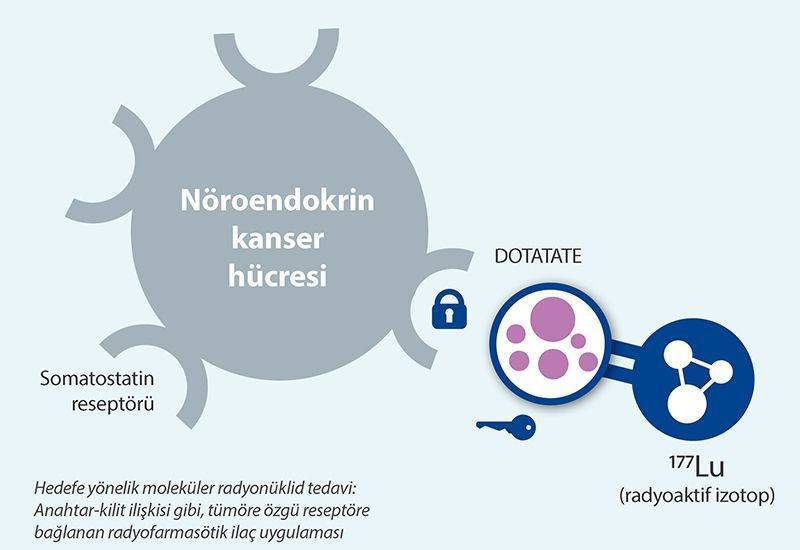
In recent years, planned with nuclear medicine specialists, molecular radioactive treatments have attracted attention through successful results. Lutetium 177 is the best-studied molecular treatment for these tumors. Before treatment, receptor distribution and tissue quantity are imaged using gallium 68-PET/CT . Gallium 68 PET/CT uses, unlike conventional PET (F18-FDG PET/CT), radioactive gallium 68 molecules rather than sugar molecules as tracers. Disease extent and metastases are identified to plan treatment dose. Intravenously administered radioactive peptides ( 177 Lu-DOTATATE ) attach to target cells and emit substantial radiation, potentially destroying cancer cells. Patients may need several days in hospital afterward. Usually 3-5 cycles are needed. It appears suitable for somatostatin receptor-positive tumors that have spread, cannot be operated on and do not respond to chemotherapy.
177 Lu-DOTATATE binds somatostatin receptors to deliver radiation directly to tumor cells.
Studies Leading to FDA Approval of Lu 177 for Gastric, Intestinal and Pancreatic Neuroendocrine Tumors
The FDA based approval on 2 clinical trials . In phase 3 NETTER-1, researchers randomly assigned 229 patients with somatostatin receptor-positive gastroenteropancreatic tumors to two groups. One received standard octreotide LAR; the other standard treatment plus 177 Lu-DOTATATE.
In the 177 Lu-DOTATATE arm, 20-month progression-free survival (disease control) was 65%, versus 11% with octreotide LAR alone. For 177 Lu-DOTATATE and controls, response rates were 18% and 3%. Compared with octreotide LAR alone, 177 Lu-DOTATATE reduced tumor growth and mortality risk.
In the second study, 1214 somatostatin-positive neuroendocrine tumor patients received 177 Lu-dotatate. Among the 360 gastroenteropancreatic cases, 16% showed complete radiological tumor disappearance or shrinkage.
With 177 Lu-dotatata, the most commonly reported serious side effects were low blood cell counts (myelosuppression), secondary cancers, kidney/liver damage, neuroendocrine hormonal crises and infertility.
Sources
fda.gov
Was this article helpful?
Your feedback helps us improve our content.




Reader comments
Share your comment
Your name and comment are published only after administrator approval. Your email address is never shown to visitors.
Be the first to comment.