
Olaparib maintenance treatment in BRCA-mutant ovarian cancer – the SOLO1 study

In this article
For newly diagnosed ovarian (female ovary) cancer, the standard treatment approach is surgery (cytoreductive surgery) followed by chemotherapy. However, cancer recurs within 2 years in 70-80% of patients. Although patients may benefit from subsequent treatments, the time until the next regrowth of the disease becomes progressively shorter with each recurrence. For years, many drugs have been tested to prolong the period before the disease grows again (disease-free survival) in patients who benefit from treatment. These studies have borne fruit in recent years. Today, drugs with proven benefit are available to prolong the disease-free period in ovarian cancers at high risk of recurrence. These drugs, containing the active ingredients olaparib, niraparib, rucaparib, and veliparib, are PARP inhibitors. PARP inhibitors have been approved for both treatment and maintenance treatment (treatment given to extend the recovery period) by the FDA.
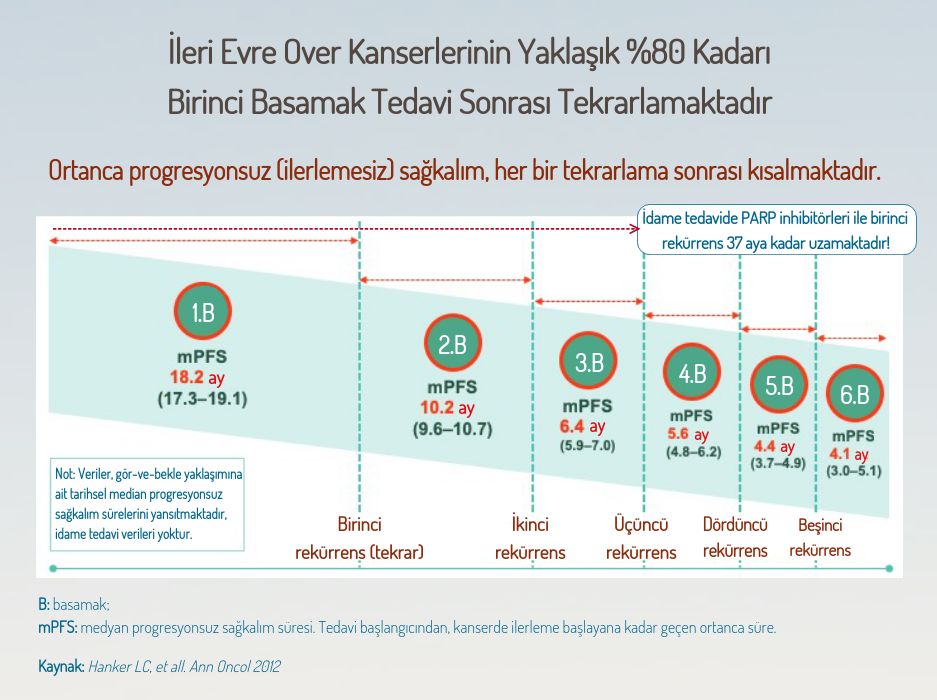
In our previous articles we discussed this topic. A summary of the studies and their results is presented in the tables and graphs below. In this article, we wanted to discuss the article updated in August 2020 on the PARP inhibitor olaparib.
The first PARP inhibitor approved by the FDA for ovarian cancer: Olaparib
Olaparib received its first approval in 2014 for treating ovarian cancer after multiple prior treatments. It was then approved for maintenance treatment after second-line chemotherapy in August 2017 and after first-line chemotherapy in December 2018. Olaparib is the first PARP inhibitor approved after first-line chemotherapy. It received FDA approval through the SOLO1 study.
The SOLO1 study found that giving olaparib as continued treatment after standard chemotherapy in newly diagnosed, locally advanced or advanced BRCA-mutant ovarian cancers at high risk of recurrence reduced the risk of disease progression by 69%.
The study included 391 women with newly diagnosed ovarian cancer and BRCA1 or BRCA2 mutations. Platinum-based chemotherapy was followed by placebo in one group and olaparib in the other among patients who achieved a complete or partial response. The study found a 69% reduction in the risk of disease recurrence in the olaparib group.
Disease recurrence occurred after 15.3 months in the placebo group, while median disease-free survival was not yet reached in the olaparib group because there were still very few recurrences.
The updated article published subgroup analyses of SOLO1, showing that the time until disease recurrence was much better in all subgroups receiving olaparib maintenance treatment:
Median progression-free survival (PFS), by response to chemotherapy
- After chemotherapy, if there was a complete response, median progression-free survival (PFS) was not yet reached because very few patients in the olaparib maintenance-treatment arm had recurrence.
- If a partial response was seen, it was found to be 30.9 months in the olaparib group and 8.4 months in the placebo group.
When the time until disease recurrence was examined according to whether surgery was performed initially (upfront surgery) or after chemotherapy (interval surgery):
- If the patient had the opportunity for surgery at the outset (was not debilitated and did not have very widespread abdominal disease or ascites), median progression-free survival was not yet reached in the olaparib arm. For interval surgery, it was 33.6 months in the olaparib arm and 9.8 months in the placebo arm.
- The group benefiting most was the group with no residual disease among patients who had the opportunity for initial surgery. Even the placebo arm in this group had disease-free survival of 21.9 months.
Studies of PARP inhibitors for first-line maintenance treatment (continued treatment), other than SOLO1 (POLA1, VELIA, PRIMA), included patients with BRCA mutations, non-BRCA homologous recombination deficiency, or no mutations. Their results showed very significant risk reductions not only in patients with BRCA mutations or homologous recombination deficiency but also in those with no mutations. The greatest benefit was in the BRCA-positive or homologous recombination-deficient group. BRCA and other genetic testing are therefore now recommended for patients with ovarian cancer, particularly those with high-risk features. Although we cannot yet use these drugs in Turkey because they are not reimbursed by SGK, we hope they will be reimbursed as soon as possible because their results are effective enough to change clinical practice.
Sources
Was this article helpful?
Your feedback helps us improve our content.




Reader comments
Share your comment
Your name and comment are published only after administrator approval. Your email address is never shown to visitors.
Be the first to comment.