
Small Cell and Non-Small Cell Lung Cancer – What Are the Differences?

In this article
There are two main types of lung cancer: small cell and non-small cell. Both affect the lungs but differ in several important ways, including treatment and prognosis (disease course).
Under a microscope, small cell lung cancer cells are indeed small and round. Non-small cell lung cancer cells are larger.
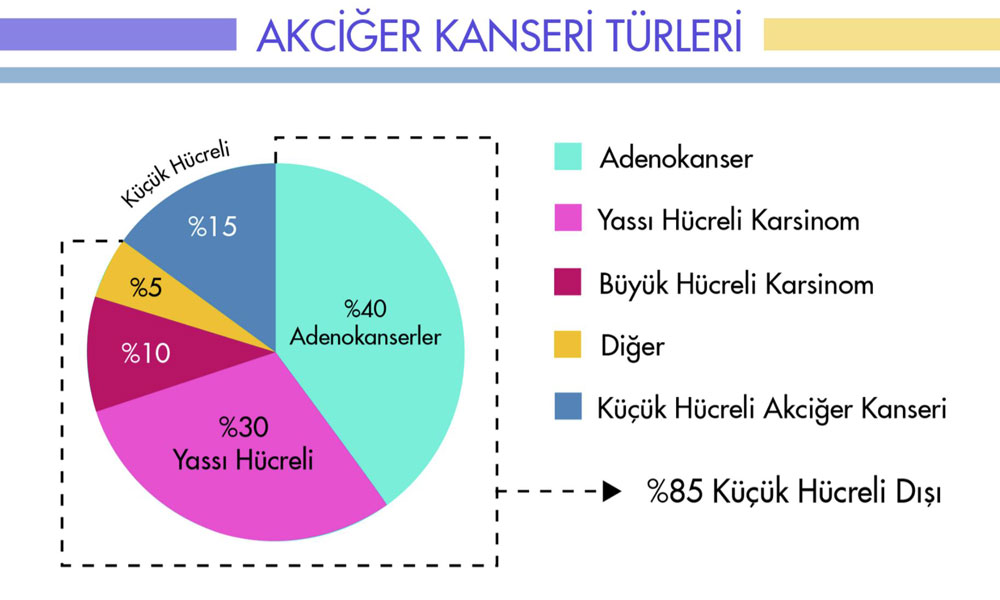
Approximately %15 of all lung cancers are small cell.
Non-small cell lung cancer has 4 main subtypes: adenocarcinoma, squamous cell carcinoma, large cell carcinoma and not otherwise specified (NOS= not otherwise specified).
This article discusses differences between small cell and non-small cell lung cancer in:
- symptoms,
- causes,
- diagnosis and
- treatment.
Are There Differences in Symptoms?
Small cell and non-small cell lung cancers cause similar symptoms. More than half of patients have no symptoms until cancer reaches an advanced stage. Awareness of possible symptoms and lung cancer screening for people at high risk because of heavy smoking are therefore important.
The following symptoms may indicate lung cancer:
- loss of appetite,
- bloody sputum,
- chest pain,
- a persistent, long-lasting cough,
- difficulty swallowing,
- persistent weakness without a clear reason,
- shortness of breath,
- swelling, particularly of the face and neck,
- wheezing
Symptoms of small cell and non-small cell lung cancer are largely similar. However, small cell lung cancer may cause greater fatigue and weight loss because it generally spreads faster. In advanced stages, lung cancer may cause bone metastases and resulting bone pain.
Are There Differences in Causes?
Risk factors and causes tend to be similar for small cell and non-small cell cancers.
Smoking is indisputably the most important lung cancer risk factor. Smoke and its chemicals, carcinogens, damage the lungs and cause cellular changes that may lead to cancer. Indeed, before smoking became widespread worldwide, lung cancer was rare.
However, smoking causes %99 of small cell lung cancers, while its role in non-small cell lung cancers is around %90.
Other causes of lung cancer include:
- Secondhand and even thirdhand tobacco smoke exposure,
- Exposure to chemicals such as asbestos, nickel, chromium, arsenic, soot or tar,
- A family history of lung cancer,
- Having HIV
- Living in an area with substantial air pollution
- Environmental radon exposure
- Related topic: Non-smoking causes of lung cancer (detailed)
Are There Differences in Diagnosis?
Tumor location gives clues about cancer type, but the precise type cannot be established until a pathologist finds and identifies cancer cells under a microscope.
By examining cell size and appearance, the pathologist can determine whether the cancer is small cell or non-small cell.
Examples of tests used to diagnose both lung cancer types include:
Lung cancer is usually diagnosed through biopsy following computed tomography or PET-CT scanning in people suspected to have the disease.
Biopsy: Biopsy involves testing a small sample of potentially cancerous lung cells. Today, CT-guided lung biopsy is the method we most often prefer for sampling tumors detected in the lungs. CT-guided biopsy causes fewer side effects and allows more effective sampling.
Bronchoscopy: A special instrument called a bronchoscope, with a camera at its tip, is inserted through the mouth or nose. A respiratory specialist or thoracic surgeon uses it to inspect the lungs and collect tissue samples.
Are There Differences in Staging?
Cancer stage describes tumor size and how far cancer has spread, and is among the most important determinants of treatment.
What Are the Stages of Non-Small Cell Lung Cancer?
- Stage 1means the tumor is confined to one lung and is not in lymph nodes.
- Stage 2means cancer has spread to lymph nodes around the affected lung.
- Stage 3ameans cancer has spread to lymph nodes around the windpipe, chest wall and diaphragm on the same side as the affected lung.
- Stage 3bmeans cancer has spread to lymph nodes in the other lung or neck.
- Stage 4means cancer has spread to the rest of the body and other parts of the lungs (metastatic disease).
What Are the Stages of Small Cell Lung Cancer?
We assess small cell lung cancer in two stages: limited to the thorax (chest) and extensive.
- When cancer remains confined to the chest cavity, the early-stage tumor is present in one lung and adjacent lymph nodes.
- In extensive-stage disease, the tumor has spread to the other lung and other organs.
Small cell lung cancer particularly tends to cause brain metastasis . Brain MRI should therefore always be performed during staging and follow-up to investigate disease in the brain.
Can Someone Have Both Small Cell and Non-Small Cell Lung Cancer?
Studies show that approximately 10 percent of people with lung cancer have both small cell and non-small cell cancers.
Are There Differences in Treatment?
Radiotherapy, chemotherapy, lung cancer surgery and immunotherapyall have roles in treating both lung cancer types. However, molecular treatments targeting genetic changes (smart medicines) are effective only in non-small cell lung cancer.
In first-line treatment of advanced small cell lung cancer, after 40 years, immunotherapies achieved a substantial survival benefit for the first time. The video below describes this development:
Small cell lung cancer tends to be more sensitive to chemotherapy than non-small cell lung cancer. Doctors may combine treatments depending on the stage and size of the tumor area.
Small cell lung cancer has a high likelihood of spreading to the brain. The brain may therefore be irradiated preventively even without evidence of disease. This is called prophylactic radiotherapy.
Small cell lung cancer is considered more aggressive than non-small cell lung cancer. Small cell cancers generally grow faster. In an estimated 90 percent of patients, cancer has already spread to nearby lymph nodes or organs at diagnosis.
Sources
Small cell vs. non-small cell lung cancer: What are the differences?.
Medical News Today. (2017, March 21).
Was this article helpful?
Your feedback helps us improve our content.




Reader comments
Share your comment
Your name and comment are published only after administrator approval. Your email address is never shown to visitors.
Be the first to comment.