
Sorafenib: a new drug in the treatment of aggressive thyroid cancer

Sorafenib (Nexavar®), used in targeted therapy, has offered new hope for aggressive thyroid cancer that is resistant to treatment.
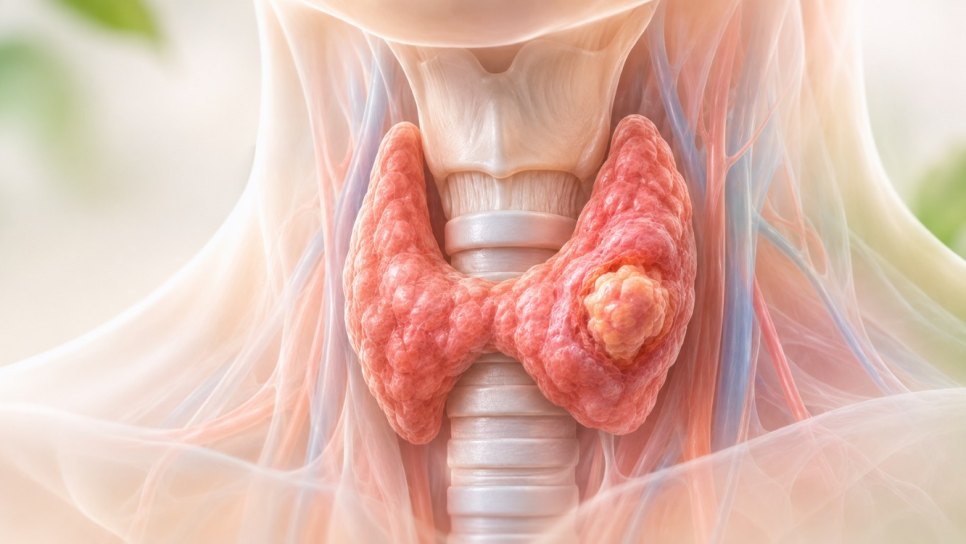
In recent years, thyroid cancer, which has increased particularly among women, accounts for approximately % 1 of all cancers. Considering the rate of increase in thyroid cancer over the past thirty years, it rose from 1973, when it was 3.6 per hundred thousand, to 2000, when it reached 8.7 per hundred thousand, and it continues to increase.
Thyroid cancers can, although rarely, metastasize (spread) to different organs, like other types of cancer. Before deciding on treatment for thyroid cancer, it is important to know the extent of the disease within the thyroid tissue, the patient’s age, whether there is metastasis to regional lymph nodes, and whether it has metastasized to distant organs. Therefore, after a diagnosis of thyroid cancer, the body must be assessed using comprehensive imaging tests. The primary treatment method used for thyroid cancers is surgery. The aim is to remove all thyroid tissue and ensure that no tumor remains. Therefore, total thyroidectomy (complete removal of the thyroid tissue) is the preferred surgical treatment method for thyroid cancers. Whether the cancer has metastasized to the lymph nodes is another factor that must be considered in treatment planning.
- Related topic: Thyroid Cancer Symptoms, Stages, and Treatment
After thyroid cancer surgery, patients receive radioactive iodine therapy to prevent the disease from recurring. The aim of this treatment is to destroy microscopic cancer cells remaining in the body that cannot be seen with the naked eye or detected by screening tests and to prevent the disease from recurring. However, despite all these surgical and radioactive treatments, recurrence may be observed in some patients with thyroid cancer. These recurrences may occur in the neck region or in other organs of the body, such as the lungs, liver, and bones. In these patients, repeated radioactive iodine treatments may not produce a response, and disease progression may be observed.
Until recently, there was no effective treatment for these recurrent types of thyroid cancer that are resistant to conventional treatment. Chemotherapy was also known to be ineffective against this type of cancer. New drugs were our most important unmet need for patients with thyroid cancer left so desperate.
One of the dozens of research findings in the field of cancer was shared with the public recently, and the promising results obtained against recurrent aggressive thyroid cancer have opened another door.
The American Society of Clinical Oncology’s clinical research results shared with the public at its 2013 annual meeting indicate that Sorafenib, used as a targeted drug in cancer treatment, has the potential to delay tumor growth in aggressive thyroid cancer.
The researchers conducted a study to evaluate Sorafenib, which targets certain proteins that contribute to cancer development, in the treatment of thyroid cancer. They investigated the effect of Sorafenib, which is used to treat inoperable liver cancer and advanced kidney cancer, on aggressive thyroid cancer. 417 patients with metastatic thyroid cancer resistant to radioactive iodine (RAI) treatment participated in the study; some patients were treated with Sorafenib, while the others received a placebo (an inactive substance given as if it were a drug).
As a result;
- It was found that the disease in thyroid cancer patients receiving Nexavar as their primary cancer treatment did not progress for an average of 10.8 months. In the placebo group, this period was determined to be 5.8 months.
- While tumor growth was stopped in most patients treated with Sorafenib and significant shrinkage was achieved in %12 of them, tumor shrinkage was observed in fewer than %1 of patients receiving placebo.
- The disease control rate (tumor shrinkage or keeping the disease stable for at least 6 months) was %54 in the Sorafenib group and %34 in the placebo group.
In my opinion, these results show that Sorafenib nearly doubled survival time in metastatic, treatment-resistant thyroid cancer.
Based on the data obtained in this study, I believe that if this new drug, Sorafenib, receives approval from the relevant authorities for the treatment of thyroid cancer, it will make a significant contribution to the treatment of our patients in the coming period.
Sources
Was this article helpful?
Your feedback helps us improve our content.


Reader comments
Share your comment
Your name and comment are published only after administrator approval. Your email address is never shown to visitors.
Be the first to comment.