The Cell That Removes Itself: Kerr, Wyllie, Currie and Apoptosis, 1972

In this article
The Cell That Removes Itself: Kerr, Wyllie, Currie and Apoptosis, 1972
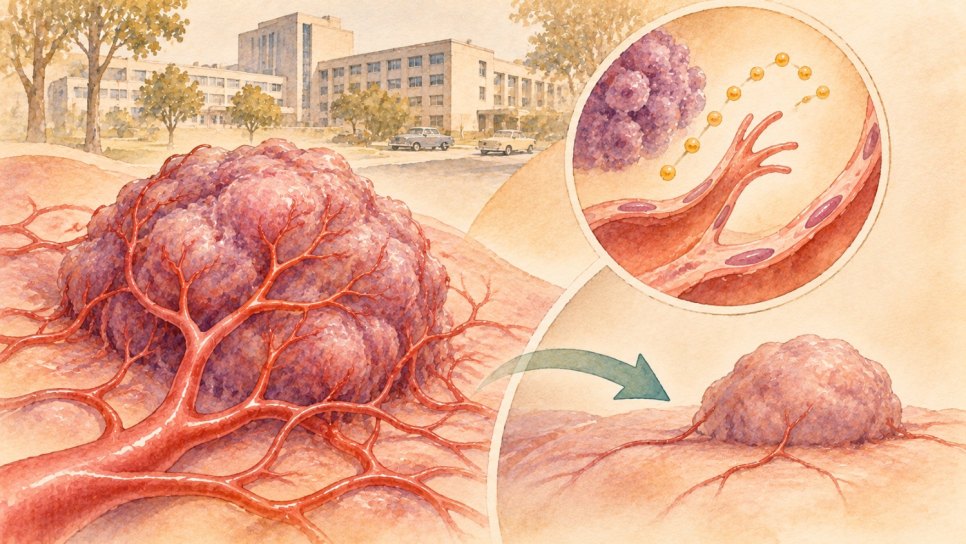
On Day 152 we looked at what a tumour calls in from outside: blood vessels. Today we look at what happens inside. A tumour is not only the sum of dividing cells; some cells also disappear. In 1972 three pathologists gave a name to one kind of this loss. In the tomorrow box of Day 152 I said I would verify the 1972 paper and how the name was coined; today I keep that promise.
Shrinking cells in the liver
John Foxton Ross Kerr was born in Sydney on 24 January 1934. According to the text that tells his life story, he studied medicine at the University of Queensland and, between 1962 and 1964, did doctoral work in London at University College Hospital Medical School under Sir Roy Cameron. The core of the story is a rat liver: when the portal vein supply of the liver was cut off, Kerr saw that some cells shrank instead of bursting, and that their nuclei looked very dense and dark. Kerr called this "shrinkage necrosis".
There is a conflict about dates. Kerr's biography says he published this finding in 1965; the verified 1965 citation I have is J Pathol Bacteriol 90(2):419-435, October 1965, and its title refers to hypertrophy and ischaemic injury of the liver, especially changes in lysosomes. The paper titled "Shrinkage necrosis: a distinct mode of cellular death", on the other hand, appears in the reference list of the 1972 paper as J Pathol, 1971. I do not know whether the term first appears in the 1965 paper or in the 1971 one; I have marked this row in amber in the diagram.
Precursors of planned cell loss
The idea did not appear from nothing. According to Richard Lockshin's 2023 review and a secondary page that gives the reference citations, Lockshin and Williams used the concept of "programmed cell death" in 1964 while studying the breakdown of the intersegmental muscles of the silkmoth, and in 1966 Saunders wrote in Science that cell loss in embryonic systems is a normal part of development. Lockshin writes that a similar collapse was seen in insect tissue too. Lockshin's introduction cites both 1964 and 1972 as the "emergence" of the term, while the main text credits the name "apoptosis" to 1972; he does not reconcile these two accounts. I tie the idea of "programmed cell loss" to 1964 and the name "apoptosis" to 1972.
A name in Aberdeen
According to Kerr's biography, he came to Aberdeen on study leave in September 1971. In Lockshin's account, Kerr was in Alastair Currie's laboratory, working with Currie's doctoral student Andrew Wyllie. The electron microscope showed that in several animal models the loss of single cells carried the same features. The result was "Apoptosis: a basic biological phenomenon with wide-ranging implications in tissue kinetics", published in the August 1972 issue of the British Journal of Cancer (volume 26, issue 4, pages 239-257).
According to the abstract, the paper proposes this term for "a hitherto little-recognized mechanism of cell elimination" and regards it as complementary to mitosis, though its opposite. Two stages are described: the condensation and fragmentation of the nucleus and cytoplasm into membrane-bound bodies; then the shedding of these, or their phagocytosis and breakdown by lysosomes. As the abstract puts it, the morphological features suggest that the process is active and inherently programmed.
For the name, Kerr's biography mentions James Cormack, Aberdeen's professor of Greek; Lockshin writes only that "a Greek scholar" was consulted and does not give the name. The meaning is consistent in both sources: the falling of leaves or petals. Lockshin adds that the name was conceived as a complement to mitosis, like a "bookend", and as something separate from lysis and coagulative necrosis. No source says which of the three proposed the name.
Tissue size is a sum
The size of a tissue is the difference between the cells that are born and the cells that are lost. Mitosis works in the positive direction, apoptosis in the negative. According to the abstract, apoptosis takes part in cell turnover in healthy adult tissues, in the focal elimination of cells in the embryo, and in physiological regression and atrophy.
In Kerr's observation the cells collapsed instead of bursting; the name was chosen to set this form apart from lysis and coagulative necrosis. The distinction was morphological; the mechanism was not yet known.
A paper in a cancer journal
According to the abstract, apoptosis occurs spontaneously in untreated malignant tumours and takes part, at least in some types, in tumour regression induced by treatment. Kerr's biography says that with Jeffrey Searle he studied cell loss by shrinkage in basal cell carcinomas and proposed that this shapes tumour growth kinetics. My inference: a tumour can grow not only through excess division but also through little cell loss; the sources do not put it in a sentence like this.
The paper's reference list also includes work such as the regression of the prostate after castration and nuclear shrinkage in the thymus under glucocorticoid; I saw the list of references and did not read how the paper discusses them. The line is familiar: when a hormone is withdrawn, tissue regresses; the hormone axis that runs from Beatson on Day 91 to Huggins on Day 112. I mention this as a link, not as a claim of the paper.
Where the genes came in
Linking the morphology to genes took decades. In 2002 the Nobel Committee awarded the prize to Sydney Brenner, H. Robert Horvitz and John E. Sulston "for their discoveries concerning genetic regulation of organ development and programmed cell death". According to the Committee's page, of the 1,090 cells in C. elegans, 131 disappear reproducibly during development; in 1986 Horvitz identified ced-3 and ced-4 and showed that both are required for the cell loss, and later found that ced-9 interacts with them and protects. The page never uses the word "apoptosis". The prize went to the work at the gene level; Kerr shared the Paul Ehrlich and Ludwig Darmstaedter Prize with Horvitz in 2000 (according to the biography), and his name is not among the Nobel laureates. I read this as the scope of the prize, not as a claim of injustice.
The link to cancer reappeared at the gene level. In 1988 Vaux, Cory and Adams reported in Nature, volume 335 (440-442): the t(14;18) translocation, frequent in follicular lymphoma, brings the bcl-2 gene next to the immunoglobulin heavy chain locus; in interleukin-3-dependent cells bcl-2 promoted cell survival, but not division (the cells stayed in G0), and together with c-myc it made pre-B cells permanently able to proliferate. The authors' proposal: by prolonging survival, bcl-2 may allow a clone to live until other oncogenes such as c-myc are activated. So a cancer gene could work not by speeding up division but by preventing cell loss. The tumour-kinetics intuition of 1972 became concrete in a gene.
Limits and costs
The first limit is that the 1972 paper is a morphological study. The description "programmed" was, in the abstract's wording, an inference from morphological features; genes and mechanism came later. Nor was apoptosis claimed to be the whole of normal cell removal.
The second limit is the way knowledge turned into a drug. A class of drugs that targets this cell-removal machinery is in use today: venetoclax, which blocks BCL-2. According to the abstract of a multicentre, retrospective study that I present in the Turkey section below, among 147 adults with relapsed or refractory chronic lymphocytic leukaemia the response rate was 83.0 percent and the complete response rate 65.3 percent; median follow-up was 61 months, and median overall survival and progression-free survival were both 60 months. This is an observational series without a control arm; a relative effect cannot be calculated, and the patients were selected.
The cost: the same abstract reports tumour lysis syndrome in 28.6 percent, mostly during the dose-escalation phase; grade 3 or higher neutropenia in 18.4 percent, thrombocytopenia in 14.3 percent, anaemia in 7.5 percent. I have not verified the approval date or the pivotal trials of venetoclax for this article; I do not write them.
What remained
- The idea that cell loss has an orderly, separate form, and the name "apoptosis"
- The calculation that tissue size is births minus losses
- That a cancer gene can work by preventing cell loss (bcl-2)
What fell or weakened
- Understanding cell loss only through injury and necrosis
- The assumption that cancer grows only through increased division
- Treating a morphological observation as a mechanism by itself
From the shrinking cell to a drug: 1964-2026. The axis runs from 1960 to 2030. Green marks are dates on which several sources, or a primary citation, agree; blue marks show dates resting on a single source. The amber bar is a period in which sources conflict: the first appearance of the term "shrinkage necrosis" between 1965 (biography, 1965 citation) and 1971 (reference list of the 1972 paper). Dates known only by year are drawn at mid-year.
Venetoclax and chronic lymphocytic leukaemia
I draw no direct Turkish link to Kerr or to Aberdeen. I report a study that shows how the idea of apoptosis reaches a clinical question today: "Real-World Outcomes of Venetoclax in Relapsed/Refractory Chronic Lymphocytic Leukemia" by Odabasi Giden, Özatlı, Erkurt, Karakus and colleagues, published in Hemato in 2026 (volume 7, issue 2, doi:10.3390/hemato7020016). According to the abstract, this multicentre, retrospective study evaluated 147 adults who started venetoclax between April 2019 and August 2025; the drug was given alone or with rituximab, obinutuzumab or ibrutinib, and 78.9 percent of the patients received a combination.
Median age was 64, and the median number of prior treatments was two. The authors write that the drug was generally well tolerated, that the main concern was tumour lysis syndrome during dose escalation, and that survival was worse in bulky disease. The abstract does not give the country or the centres of the study; the first author's address is Ondokuz Mayıs University (Samsun). That it is a Turkish study is my inference from this address. I did not read the full text.
From 1964 to today
What was verified, what stayed uncertain
- Citation: Br J Cancer 1972;26(4):239-257, doi:10.1038/bjc.1972.33, PMC2008650 (abstract and reference page read). The full text and author addresses were not read; the Aberdeen information comes from Kerr's biography and Lockshin's review.
- Origin of the name: James Cormack appears only in Kerr's biography; Lockshin says "a Greek scholar" and gives no name. The meaning (falling of leaves or petals) is consistent in both sources. No source says which of the three proposed the name.
- "Programmed cell loss" and "apoptosis": Lockshin's introduction cites both 1964 and 1972 as the "emergence" of the term, while his main text credits the name to 1972. I could not resolve the contradiction; I tied the concept to 1964 and the name to 1972.
- "Shrinkage necrosis": the biography says 1965; the title of the 1965 citation is about ischaemic injury of the liver and lysosomes. The paper "Shrinkage necrosis: a distinct mode of cellular death" appears in the reference list as J Pathol, 1971; I did not verify its volume and pages. I could not see whether the term appears in the 1965 paper.
- Precursors: Lockshin and Williams 1964 (J Insect Physiol, "Programmed cell death—II") and Saunders 1966 (Science) come only from a secondary page that gives reference citations; I did not verify volumes and pages. I did not write older names such as Glücksmann 1951, Vogt and Flemming because I could not verify them.
- Kerr's life: birth, education, arrival in Aberdeen, prizes and 4 June 2024 come only from the biography.
- Prostate and thymus work in the reference list: I saw that they are listed; I did not read how the paper discusses them. The link to the hormone axis is my interpretation.
- Nobel: the quotation and the ced genes come from the Nobel Committee's press release; the page does not use the word "apoptosis".
- Vaux 1988: abstract level; the t(14;18) link is from the abstract.
- Venetoclax: abstract level; country and centres are not in the abstract; retrospective, uncontrolled. Approval date and pivotal trials were not verified and are not written.
- Yesterday's box: the 1972 paper and how the name was coined were verified; Cormack as the person who coined the name rests on a single source.
Looking Inside the Body: Hounsfield and Computed Tomography, 1972
Today we saw the plan inside the cell. Tomorrow we turn to a new way of looking inside the body: Godfrey Hounsfield's computed tomography. I will verify the date of the first clinical image and with whom the prize was shared.
Author's note: What I paid most attention to in this article was keeping clear what the 1972 paper actually did: it named an observation and did not explain a mechanism. My second concern was, where sources conflict (the origin of the name, the term "shrinkage necrosis"), not to pick one, and to set venetoclax's response rate beside the cost of tumour lysis syndrome.
Sources and Further Reading
- Kerr JFR, Wyllie AH, Currie AR. Apoptosis: a basic biological phenomenon with wide-ranging implications in tissue kinetics. Br J Cancer 1972;26(4):239-257. doi:10.1038/bjc.1972.33 (read at abstract level).
- Kerr JF. A histochemical study of hypertrophy and ischaemic injury of rat liver with special reference to changes in lysosomes. J Pathol Bacteriol 1965;90(2):419-435. doi:10.1002/path.1700900210 (citation taken only from another paper's reference list; the text was not read).
- Lockshin RA. Review article on the history of programmed cell loss. Front Cell Death 2023. doi:10.3389/fceld.2023.1197400 (read with a summarising tool).
- John Foxton Ross Kerr 1934-2024. Biography. connectsci.au/hr/article/37/1/HR25018 (read with a summarising tool).
- Nobel Committee. Press release, Nobel Prize in Physiology or Medicine 2002. nobelprize.org (read with a summarising tool).
- Vaux DL, Cory S, Adams JM. Bcl-2 gene promotes haemopoietic cell survival and cooperates with c-myc to immortalize pre-B cells. Nature 1988;335:440-442. doi:10.1038/335440a0 (read at abstract level).
- History of apoptosis research. doc.surf (secondary, Wikipedia-derived page; used only for the Lockshin-Williams 1964 and Saunders 1966 citations, read with a summarising tool).
- Odabasi Giden A, Özatlı D, Erkurt MA, et al. Real-world outcomes of venetoclax in relapsed/refractory chronic lymphocytic leukemia. Hemato 2026;7(2). doi:10.3390/hemato7020016 (read at abstract level).
- Mukherjee S. The Emperor of All Maladies: A Biography of Cancer. New York: Scribner; 2010 (general context; the relevant part was not reread for this article).
This article is Day 153 of the "365 Days of Cancer History" series and presents the naming of apoptosis as a historical reading. It is historical-popular content; it is not a diagnosis or a treatment recommendation. Consult your physician for treatment decisions. The sources have been verified; details resting on a single secondary source, on an abstract only, or on a text that could not be read are marked in the fact-check notes.
Was this article helpful?
Your feedback helps us improve our content.