The Break in the Chromosome: Janet Rowley and the Translocation, 1973
In this article
The Break in the Chromosome: Janet Rowley and the Translocation, 1973
On day 154 we looked inside the body, slice by slice; today we look inside the cell, at the chromosomes. On day 137 we described how the Philadelphia chromosome was misread in 1960 and how each link in the chain was added in a different year; Rowley's 1973 is the most quoted link of that chain. In the "tomorrow" box of day 154 I said I would verify the date of the paper and the role of the banding method: the Nature paper is dated 1 June 1973, but some sources place the discovery in 1972; I leave that conflict open below.
The same size, the same look
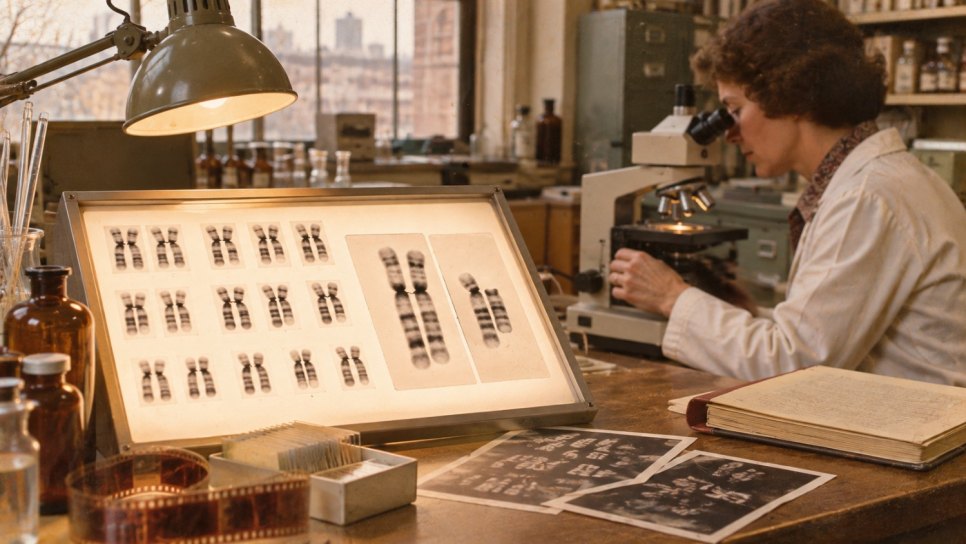
Counting chromosomes had been possible since 1956; recognising them one by one was another matter. According to a Nature review, banding in the early 1970s made it possible to identify individual chromosomes. The review's box describes Q-banding, in which staining with quinacrine gives each chromosome its own pattern of stripes. How wearing the earlier years were we know from Peter Nowell's words: according to Radich's 2022 summary, Nowell found the decade after 1960 frustrating (day 137; conceptual summary).
Q-banding has its roots in Stockholm. According to an obituary of Lore Zech published in Molecular Cytogenetics in 2013, Zech developed the Q-banding technique while working in the group of Torbjörn Caspersson at the Karolinska Institute; the text says that her department head did not support the idea that human chromosomes have distinct bands, and that she presented her findings in 1971 at the Fourth International Congress of Human Genetics in Paris. The only source for these lines is that obituary; it does not give the year of the technique.
Janet Rowley's path
According to the biography of the National Library of Medicine (NLM), Janet Davison Rowley (1925-2013) was born in New York, took her medical degree at the University of Chicago in 1948, worked in children's clinics and at a foundation for developmental disabilities, worked part time for about twenty years while raising four sons, and returned to the University of Chicago in 1962 as a research associate in hematology; she became an associate professor in 1969 and a professor in 1977. The biography also says that she spent about a year in England (Oxford); the year varies between 1961 and 1962 in the sources.
Nine patients, the same mark
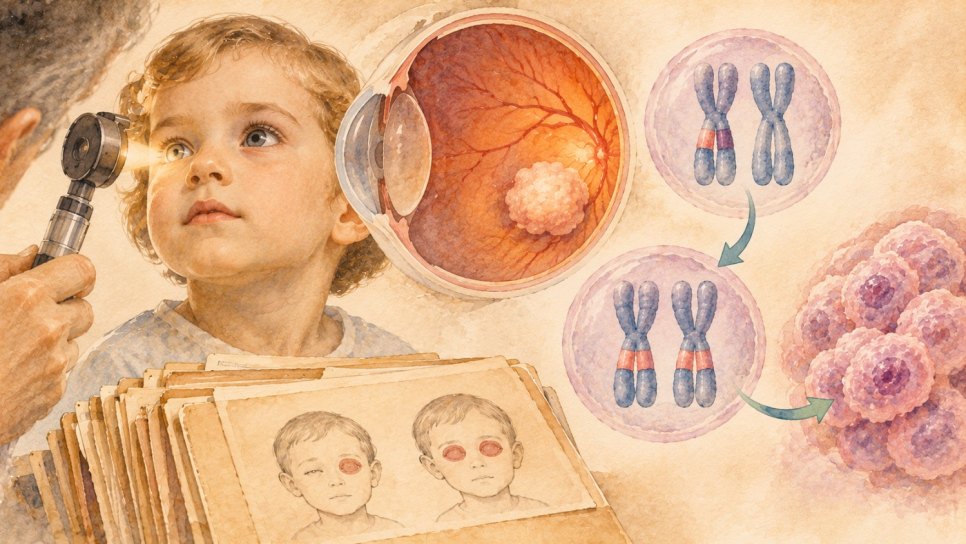
Rowley's paper in Nature appeared in volume 243, pages 290-293, in the issue of 1 June 1973; according to Nature's page it was received on 8 January 1973, and a revised version is listed for 8 February 1973. Its title names the two techniques she used: quinacrine fluorescence and Giemsa staining. According to the abstract, cells from nine consecutive patients with chronic myeloid leukemia (CML) were examined. All nine had the Philadelphia chromosome, which at the time was understood as a deletion (loss of a piece) in the long arm of chromosome 22. The new techniques also showed something unexpected in every cell of every patient: extra, dully fluorescing material at the end of the long arm of one of the chromosomes 9. The amount of this extra material roughly matched what was missing from the Philadelphia chromosome. The author wrote that this suggested a previously unrecognised translocation between 22 and 9.
I read this at abstract level; I could not reach the full text of the paper.
Translocation
A piece that breaks off one chromosome and attaches to another. The notation "9;22" says that chromosomes 9 and 22 are involved. Rowley's 1973 abstract describes a piece going from 22 to 9; later gene studies showed that this was a reciprocal exchange and that the ABL gene on 9 was moved to 22 (below). A rearrangement seen at the chromosome level can become the joining of two genes at the gene level; in CML the result is the BCR-ABL fusion gene.
This is a simplified definition.
The second report: 8;21
Another report appeared the same month: in Annales de génétique (volume 16, issue 2, pages 109-112), Rowley reported a translocation, found with quinacrine fluorescence, in a patient with acute leukemia. The PubMed record gives June 1973 and has no abstract. According to a 1998 news item of the University of Chicago, this was the exchange between chromosomes 8 and 21 in acute myeloblastic leukemia, and the item places it in early 1972, before the Philadelphia chromosome finding. A Nature review calls 8;21 "the first translocation identified". Which came first has to be sought in the order of observation, not of publication; I could not resolve it and therefore make the "first" claim with a caveat.
Cause or consequence?
The 1973 reports showed a recurring, disease-specific change; causation is a separate matter. According to the Nature review, for a long time the prevailing view was that chromosome changes were secondary accidents, not primary events. The NLM biography says that Rowley's argument that particular translocations lead to particular diseases challenged this view. Causation was settled by later links; I give their citations from the reference list of the Nature review:
De Klein and colleagues showed in 1982 (Nature 300:765-767) that the ABL oncogene had been moved to the Philadelphia chromosome; Heisterkamp and colleagues in 1983 (Nature 306:239-242) that ABL sits next to the breakpoint; Groffen and colleagues in 1984 (Cell 36:93-99) located the breakpoint region of BCR; Shtivelman and colleagues in 1985 (Nature 315:550-554) described the BCR-ABL fusion transcript. Daley, Van Etten and Baltimore showed in 1990 (Science 247:824-830) that the p210 BCR-ABL gene starts a CML-like disease in mice (this last citation from a record page). These steps were taken not by Rowley herself but by other laboratories; 1973 was the first link of the chain.
A trail that reaches other cancers
According to the NLM biography, by 1990 more than seventy translocations had been described in various cancers. Two of them are familiar from earlier days. On day 136 we looked at the map of Burkitt lymphoma: according to the Nature review, the changes in chromosomes 8 and 14 were reported by Zech and colleagues in 1976 (Int J Cancer 17:47-56); the involvement of c-MYC was shown in 1982, but the review credits that work in one place to Croce and Gallo and in another to Croce and Leder. On day 153 t(14;18) came up too: Vaux, Cory and Adams wrote in 1988 that this translocation brings bcl-2 next to the immunoglobulin heavy chain locus.
Limits and cost
The first limit is what the finding is: the same change in all nine patients is an association; it does not show a cause. The road to causation took a decade after Rowley's 1973 and many laboratories. The second limit is the source: the 8;21 report has no abstract and I did not read its text; I know the Nature paper only from its abstract.
The third limit is the cost that came with the drug. Imatinib (day 137), which targets BCR-ABL at the end of this chain, is a drug used for a long time; in a Türkiye study of stopping treatment (below), 27 of 41 patients lost the major molecular response and restarted the drug. The path from the chromosome finding to the drug continues, for the patient, with the question of how long the drug will be taken and whether it can be stopped. Pausing the drug is a matter of research under close molecular monitoring; this article is not treatment advice.
What remains
- Looking for a recurring, disease-specific chromosome change in a cancer
- A chromosome finding as a door to a gene finding (like BCR-ABL)
- Use of the translocation in diagnosis and follow-up
What fell or was limited
- The reading of the Philadelphia chromosome as a plain loss of a piece of chromosome 22
- The view that chromosome changes in cancer are secondary accidents
- The belief that one person and one year tell the discovery
From the Philadelphia chromosome to the translocation and today: 1960-2023. The axis runs from 1945 to 2030. Green marks are publications whose citation is confirmed in several sources or in a primary record; blue marks rest on a single source. The amber bar is the period in which the sources conflict about the date of Rowley's 9;22 finding: 1972 (University of Chicago news item) to 1 June 1973 (Nature publication). Dates known only by year are drawn mid-year.
An imatinib discontinuation study in Türkiye
I could not verify the date of the first karyotype analysis or of the first diagnosis of a Philadelphia chromosome in Türkiye; I draw no Türkiye link to Rowley or Zech. The study I report comes from the far end of this chain: Savaş EM, Yılmaz S, Başer Dikyar AA et al., "Long-term Results of Imatinib Discontinuation in Patients with Chronic-phase Chronic Myeloid Leukemia: A National Multicenter Prospective Study", Turkish Journal of Haematology 2023;40(4):236-241. According to the abstract, 41 adult patients with chronic-phase CML from four centers were followed in a single-arm, non-randomized study; the median follow-up after stopping imatinib was 48 months (6-81 months).
Results: molecular relapse-free survival at month 48 was 33.2 percent; 27 of the 41 patients lost the major molecular response and restarted imatinib; all of them regained a deep molecular response. My arithmetic: 27/41 is about 65.9 percent, that is, about two thirds relapsed. The authors write that pausing the drug with close molecular monitoring is safe and economical, with savings of about 4.39 million liras (about 245,150 dollars), and describe it as the first tyrosine kinase inhibitor discontinuation study from Türkiye. The abstract in the DOAJ record is truncated and the confidence interval printed there did not seem to fit the estimate; I therefore do not give the interval, and the figures need to be checked against the original paper. I did not read the full text.
From 1960 to today
What was confirmed, what stayed uncertain
- Date conflict: Nature's page says 1 June 1973 (volume 243, issue 5405), received 8 January 1973. The 1998 news item of the University of Chicago places the 9;22 finding "later in 1972"; the Nature review says "in 1972 she discovered" but its own reference list gives the 1973 citation; the NLM biography gives 1972 in one place and 1973 in another. The observation may go back to 1972, the publication is 1973; I could not resolve it.
- Order of 8;21 and 9;22: the Chicago news item puts 8;21 in "early 1972" and before 9;22; the Nature review calls 8;21 the "first". The two publications are in the same month (June 1973); the day of the Ann Genet issue is unknown. I therefore made the "first" claim with a caveat.
- Reciprocity: the Nature abstract describes a piece going from 22 to 9; Radich (2022) summarises the finding as a "reciprocal translocation"; the movement of ABL to 22 was shown by later studies. The Chicago news item's wording "a cancer gene moving from 9 to 22" is a later reading.
- Zech and Rowley: the obituary says Rowley published the finding after visiting Zech and that Zech saw the chromosome 22 link but did not publish it; the same text cites a 1970 paper by Caspersson, Gahrton, Lindsten and Zech as identifying the Philadelphia chromosome as chromosome 22. These two conflict; because it is a single obituary I did not write the detail as a claim. The year of Q-banding and Giemsa banding (Seabright 1971) were not verified and not written.
- Oxford year: the NLM biography says 1962, a video transcript 1961; the Chicago news item says "sabbatical" in 1962, the NLM does not use that word. I wrote no year in the text.
- Lasker: the category of the prize and the co-recipients (Nowell, Knudson) are from the Chicago news item; the year is 1998.
- Burkitt and MYC: citations are from the reference list of the Nature review; the 1982 work gets two different attributions there, Croce-Gallo and Croce-Leder, so I gave no names.
- Daley 1990: Radich's reference list writes the page range as "834-830" (impossible); a record page gives 824-830, which I used.
- Savaş 2023: abstract and citation from two record pages (DOAJ; a university repository); the DOI (10.4274/tjh.galenos.2023.2023.0194) from a university record. The confidence interval of the abstract seemed not to fit the estimate; not written. I did not read the text.
- Citation of the Nature review: author and year could not be verified from the page; only the DOI.
- Yesterday's box: the date of the paper (1 June 1973; received 8 January 1973) and the role of banding (quinacrine fluorescence and Giemsa; Q-banding in Stockholm) were examined; the 1972 claim was left as a conflict.
Are Carcinogens Mutagens? Bruce Ames and the Salmonella Test, 1973
Today we looked at how a break in a chromosome relates to cancer. Tomorrow we go down to a smaller scale: testing with bacteria whether a substance can cause cancer. I will verify the publication date and citation of the test by Bruce Ames and his team and the role of the liver extract.
Author's note: What I paid most attention to in this piece was to resist the assumption of "one date" and "one person who discovered": Rowley's observation and the Nature publication may not be in the same year, the technique has its roots in Stockholm, and causation was the ten-year work of other laboratories. My second point of attention was to keep a recurring finding apart from a causal one.
Sources and Further Reading
- Rowley JD. A new consistent chromosomal abnormality in chronic myelogenous leukaemia identified by quinacrine fluorescence and Giemsa staining. Nature 1973;243(5405):290-293. doi:10.1038/243290a0 (read at abstract level; page read with a summarising tool).
- Rowley JD. Identification of a translocation with quinacrine fluorescence in a patient with acute leukemia. Ann Genet 1973;16(2):109-112 (PubMed record only; no abstract, text not read).
- Radich JP. Another Philadelphia story. Haematologica 2022;107(3):566-567. doi:10.3324/haematol.2021.280581 (read with a summarising tool; secondary source).
- National Library of Medicine (NLM). Biography: Dr. Janet Davison Rowley. Changing the Face of Medicine, nlm.nih.gov (read with a summarising tool; secondary source).
- University of Chicago Medicine. Janet Rowley, MD, wins 1998 Lasker Award. uchicagomedicine.org (read with a summarising tool; secondary source).
- Schlegelberger B. Lore Zech. Mol Cytogenet 2013;6:20. doi:10.1186/1755-8166-6-20 (read with a summarising tool; secondary source).
- Chromosome translocations: dangerous liaisons revisited. Nature Reviews Cancer, doi:10.1038/35106108 (Nature Education archive PDF; read with a summarising tool; author and year could not be verified from the page).
- Daley GQ, Van Etten RA, Baltimore D. Induction of chronic myelogenous leukemia in mice by the P210bcr/abl gene of the Philadelphia chromosome. Science 1990;247:824-830 (via a record page; read with a summarising tool).
- Savaş EM, Yılmaz S, Başer Dikyar AA et al. Long-term results of imatinib discontinuation in patients with chronic-phase chronic myeloid leukemia: a national multicenter prospective study. Turk J Haematol 2023;40(4):236-241 (read at abstract level; read with a summarising tool).
- Mukherjee S. The Emperor of All Maladies: A Biography of Cancer. New York: Scribner; 2010 (general context; the relevant part was not re-read for this piece).
This piece is day 155 of the "365 Days of Cancer History" series and presents the discovery of the translocation as a historical reading. It is historical-popular content; it is not diagnostic or treatment advice. Consult your physician for treatment decisions. The sources have been verified; details that rest on a single secondary source, only on an abstract or on a text that could not be read are marked in the fact-check notes.
Was this article helpful?
Your feedback helps us improve our content.