Two Hits: Knudson, Retinoblastoma and the Arithmetic of Inherited Cancer, 1971
In this article
Two Hits: Knudson, Retinoblastoma and the Arithmetic of Inherited Cancer, 1971
Yesterday a nation built money and an organisation for cancer (Day 150). In the same year, in April, a physician did something else: he did a calculation. Why does a childhood eye tumour appear in one eye in some children and in both eyes in others? His answer ran to four pages. On Day 148, after the Li-Fraumeni families, I said we would return to the two-hit idea in the coming days. Today I keep that promise.
A physician, a pile of records
Retinoblastoma is a childhood tumour of the retina, the lining at the back of the eye. According to the NCI summary for clinicians it accounts for about 3 percent of cancers in children under 15, and two thirds of cases are diagnosed before the age of 2. In some children the tumour appears in both eyes, often in several foci and very early. In others it appears in one eye, in one focus, later. In some families the disease runs through generations.
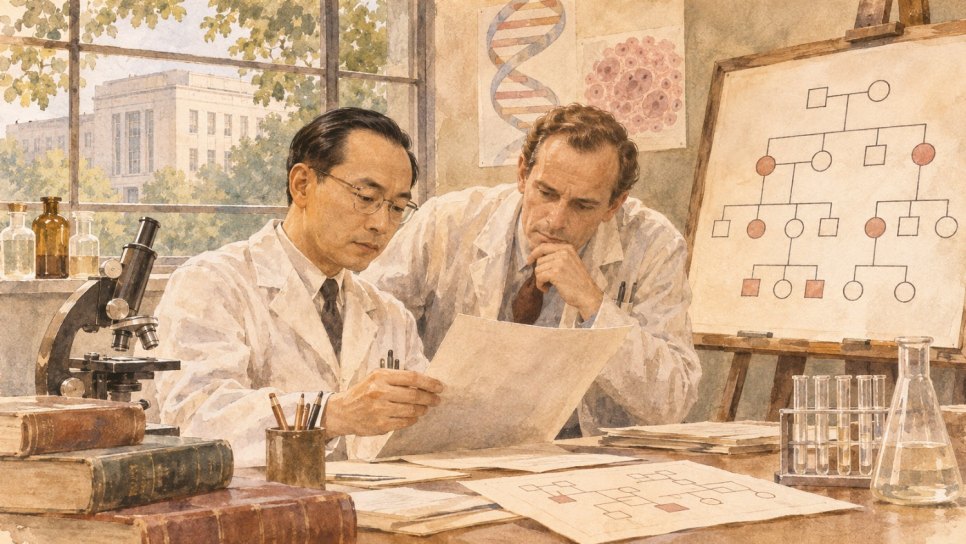
Alfred Knudson was born in Los Angeles in 1922; according to the Kyoto Prize page he took his medical degree at Columbia (1947) and a doctorate in biochemistry and genetics at Caltech (1956). In 1969 he became a professor at the University of Texas in Houston. According to Chernoff's 2021 retrospective he was 49 in 1971 and was studying inherited metabolic diseases; he went through patient charts that stretched back years. Croce's biographical note says the records were those of children with retinoblastoma at M.D. Anderson. According to Chernoff the analysis was done without a computer: curve fitting and Poisson statistics, in a four-page paper with one author and one figure.
The idea did not arise in a vacuum. Chernoff cites Nordling (1953) and Ashley (1969) for the theory of multiple mutations in cancer; the 1954 multistage theory of Armitage and Doll belongs to the same lineage. Ashley's review of June 1969 already has "two hit" in its title: using age curves of stomach cancer, it argues that a multistage model fits better than a two-stage one. So the phrase "two hit" is not Knudson's alone. What Knudson brought was to tie an abstract age curve to the countable observations of one human disease, and to bring inheritance into it.
Four pages: two mutations
The paper appeared in the Proceedings of the National Academy of Sciences, volume 68, issue 4, pages 820-823 (PubMed and SciSpace records). According to the abstract, Knudson studied 48 retinoblastoma cases and published reports. Conceptual summary: retinoblastoma is a cancer that arises from two mutational events; in the hereditary form the first mutation comes through a germ cell and the second occurs in a body cell; in the non-hereditary form both occur in body cells.
The numerical part is this: if the second event is taken to produce on average about three tumours per carrier of the first mutation, the Poisson distribution accounts within one framework for carriers who never develop a tumour, those with a tumour in one or both eyes, and several tumours in one eye. The same average also allows mutation rates to be estimated; the abstract reports that the rates of the first mutation in germ-line and body cells and of the second in body cells came out roughly equal. According to Chernoff, Knudson inferred from the familial cases that the affected gene behaves recessively.
How to read two hits
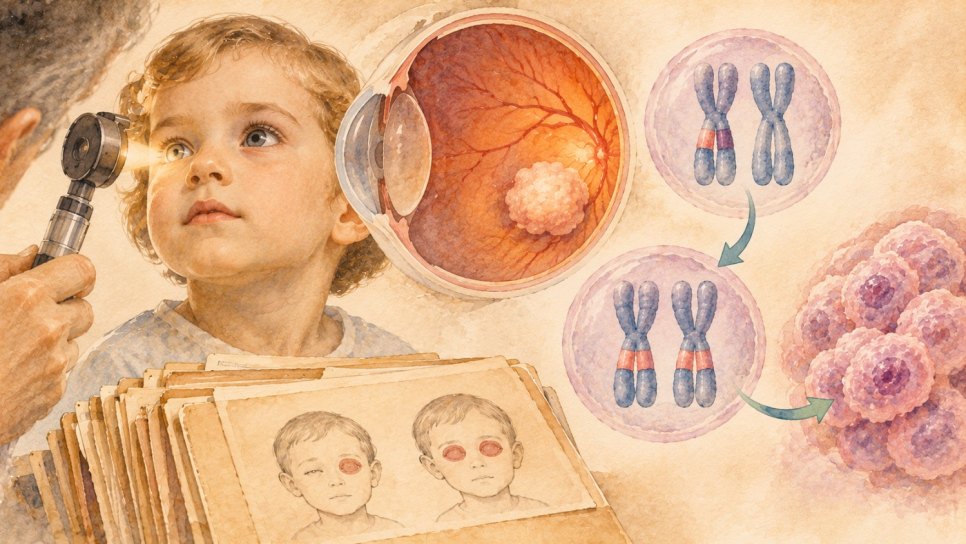
Every gene has two copies. A child with hereditary retinoblastoma carries the first "hit" from birth, in every cell of the body. The retina holds millions of cells, and it takes only one of them to damage the other copy too. Many cells means many chances: the tumour appears early, in several foci, often in both eyes. The child without the hereditary form must receive two separate hits in the same single cell. That is a rare coincidence; the tumour is single, late and in one eye. Two faces of the same disease, the same number of events.
A small calculation makes this concrete. In a Poisson distribution with an expected three tumours, the probability of seeing none is e-3, about 5 percent. That is my own arithmetic, a prediction of the model rather than a measurement taken from the paper. According to the Kyoto Prize page Knudson proposed in 1973 that the two hits fall on the two copies of the same recessive gene, and in 1982 he suggested the name "anti-oncogene". Today such genes are called tumour suppressor genes.
From hypothesis to gene
A few years later another name was looking in a similar direction. In his PNAS paper of 1 December 1973, Comings proposed that tumours arise when both members of a pair of regulatory genes are damaged, and that in autosomal dominant hereditary tumours such as retinoblastoma one faulty regulatory gene comes from the germ line and the other arrives later. Whether the two were independent, and who came first with the idea of two copies of one gene, my sources do not say; I do not claim it.
Some of the evidence came from chromosomes. According to the reference titles of a Nature review, two separate reports in 1976 linked a deletion in the long arm of chromosome 13 to retinoblastoma (Knudson and colleagues; Francke and Kung). In 1983 Webster Cavenee and colleagues showed in Nature that recessive alleles are expressed through chromosomal mechanisms; according to Chernoff, the loss of polymorphic cutting sites in retinoblastomas supported the idea of one damaged RB allele and a lost partner. In 1986 Friend, Bernards, Rogelj, Weinberg, Rapaport, Albert and Dryja reported in Nature, volume 323 (643-646), a DNA segment from the RB locus at 13q14; this region is often deleted in retinoblastomas and osteosarcomas, and no transcript was found. In 1987 Lee and colleagues cloned and sequenced the gene (Chernoff). Fifteen years had passed since Knudson described it. The germ-line p53 mutation that Malkin and colleagues found in Li-Fraumeni families in 1990 (Day 148) was the second great example of the same logic. The Kyoto Prize page adds that the hypothesis led to the discovery of other suppressor genes such as WT1 and BRCA1.
Limits and costs
The first limit is that for twelve years the hypothesis remained a statistical inference: 48 cases, two events and a model. Being proved right does not erase that. The second limit is that "two" is not a ceiling. According to Chernoff, two hits start a tumour but do not complete it; third hits are needed as well. Some genes can act even with one copy lost (haploinsufficiency; shown in mice for p27, and this should not be counted as a human finding). RB1 is sometimes silenced by promoter methylation without any change in the DNA sequence. So two hits is a principle and a starting point, not the blueprint of every cancer.
The cost falls on children with the hereditary form. According to the NCI summary the hereditary form accounts for 25-30 percent of retinoblastoma and the non-hereditary form for 70-75 percent; all patients with bilateral disease and about 15 percent of those with unilateral disease are regarded as hereditary. About 25 percent of hereditary RB1 variants come from an affected parent and about 75 percent arise anew. So the absence of a family history does not exclude the risk. The abstract of Friend and colleagues also notes that carriers are at high risk of second tumours, especially osteosarcoma. Genetic testing, family screening and follow-up bring a burden of their own.
What remained
- The idea that hereditary and non-hereditary cancer are two ends of the same path
- Risk that is recessive at the cell level but looks dominant in the family
- The concept of the tumour suppressor gene and the programme to search for it
What fell or weakened
- The scheme of "exactly two hits, no more, no fewer"
- The name "anti-oncogene" (replaced by tumour suppressor gene)
From multistage theory to RB1: 1953-1990. The axis runs from 1950 to 1991. Green markers are dates on which several sources agree; blue markers show dates resting on a single source or only on a reference-list entry. In this article no dates conflict between sources, so no amber marker is used. Dates known only by year are drawn mid-year.
An Istanbul series
I draw no direct Turkish link to Knudson's model; I only report a clinical picture. The study by Cebeci, Tuncer and Kebudi, published in 2020 in the Journal of Ophthalmology (Istanbul University, Istanbul Faculty of Medicine, Ophthalmology, and the Oncology Institute, Paediatric Haematology-Oncology), examined, out of 298 consecutive retinoblastoma patients between 1992 and 2017, the 18 who were 5 years or older (6 percent). The median age at diagnosis was 9 (5-18); in 8 patients (44.4 percent) the first diagnosis was wrong; 16 underwent enucleation; at a median follow-up of 97 months survival was 100 percent and the eye-salvage rate was 11.2 percent. The authors also recall that in low-resource countries most patients present with advanced disease.
The study's abstract does not mention RB1 testing. My inference is this: the clinical counterpart of two hits is the rule "tumour in both eyes or at an early age, may be hereditary, follow the family". That rule works only with early diagnosis and access to genetic counselling. How this works in Turkey I cannot say from these sources.
From 1953 to today
What was verified and what remains uncertain
- Citation: PNAS 68(4):820-823, April 1971; consistent across the PubMed and SciSpace pages. The full text of the paper could not be opened; content is taken from abstracts and from Chernoff's retrospective.
- 48 cases: according to the PubMed and SciSpace abstracts, "48 cases and published reports". Only Croce's biographical note says the records belonged to M.D. Anderson; Chernoff and the Kyoto page do not mention it. I did not use the percentages on a lecture slide (hereditary share 35-45 percent) because they do not fit 48 cases; the hereditary share is taken from NCI.
- "Three tumours" and mutation rates: from the abstracts; not verified against the text of the paper.
- e-3 ≈ 5 percent: my own calculation and a prediction of the model; I did not verify the real penetrance.
- The term "two hit": the 1971 abstract says "two mutational events". Ashley's 1969 title has "two hit". I could not find who first applied the term to Knudson's model.
- Two copies of the same gene: according to the Kyoto page Knudson proposed it in 1973; Comings's paper is dated 1 December 1973. I could not establish which came first; I did not read the citation of Knudson's 1973 review.
- Armitage-Doll (1954), Nordling (1953): only from Chernoff and from the reference list of a review; I did not read the papers. I did not state how many stages Armitage and Doll proposed.
- The 1976 deletion reports: only the reference-list titles of a Nature review; content not read.
- Cavenee 1983: citation from the DOI (10.1038/305779a0); content from Chernoff. Lee 1987: from Chernoff only; no citation.
- Friend 1986: author list, volume and pages from the University of Wisconsin bibliography page; publication date 16-22 October 1986.
- Knudson's life: birth in 1922 and the prizes from the Kyoto page. That he passed away in 2016 comes from the citation of Nature's obituary of August 2016; the exact day was not verified.
- Limits: third hits, haploinsufficiency and epigenetic silencing from Chernoff. The mouse finding (p27) was not generalised to humans.
- Turkey: authors and centre from the PMC page, numbers from the abstract. The study does not address Knudson or RB1 testing.
- Yesterday's box: the 1971 paper, the "two hit" idea and its relation to Day 148 were verified.
The Vessel a Tumour Calls: Judah Folkman and Angiogenesis, 1971
Today we looked at the origin of a tumour, at its gene. Tomorrow, the same year, a surgeon's question about what a tumour feeds on: could a growing tumour be calling new vessels to itself? I will verify Judah Folkman's idea of 1971, the first reactions to it and how it reached the drug.
Author's note: What I paid most attention to in writing this was separating Knudson's work from the phrase "two hit" without handing him the phrase. Others had used it before him; Knudson's share is that he tied it to a countable disease, to inheritance and finally to a gene. A hypothesis that stayed without proof for twelve years and then turned into a gene is one of the threads of "science correcting itself" in this series.
Sources and Further Reading
- Knudson AG Jr. Mutation and cancer: statistical study of retinoblastoma. Proc Natl Acad Sci U S A 1971;68(4):820-823. doi:10.1073/pnas.68.4.820 (read through the PubMed and SciSpace abstracts; the full text could not be opened).
- Chernoff J. The two-hit theory hits 50. Mol Biol Cell 2021;32(22):rt1. doi:10.1091/mbc.E21-08-0407 (read with a summarising tool).
- Ashley DJB. The two "hit" and multiple "hit" theories of carcinogenesis. Br J Cancer 1969, pp. 313-328. doi:10.1038/bjc.1969.41 (read with a summarising tool).
- Armitage P, Doll R. The age distribution of cancer and a multi-stage theory of carcinogenesis. Br J Cancer 1954 (only the citation was seen; content not read).
- Comings DE. A general theory of carcinogenesis. Proc Natl Acad Sci U S A 1973;70(12):3324-3328. doi:10.1073/pnas.70.12.3324 (read with a summarising tool).
- Cavenee WK, et al. Expression of recessive alleles by chromosomal mechanisms in retinoblastoma. Nature 1983;305:779. doi:10.1038/305779a0 (citation only).
- Friend SH, Bernards R, Rogelj S, Weinberg RA, Rapaport JM, Albert DM, Dryja TP. A human DNA segment with properties of the gene that predisposes to retinoblastoma and osteosarcoma. Nature 1986;323(6089):643-646 (read at abstract level).
- Kyoto Prize Foundation. 2004 Kyoto Prize Laureates: Alfred George Knudson Jr. kyotoprize.org (read with a summarising tool).
- Croce CM. Biographical note on Alfred G. Knudson, 2018. amphilsoc.org (read with a summarising tool).
- National Cancer Institute. Retinoblastoma Treatment (PDQ), health professional version. cancer.gov (first 100,000 characters read).
- Cebeci Z, Tuncer S, Kebudi R. Clinical features and long-term follow-up of patients with retinoblastoma in Turkish children older than 5 years of age. J Ophthalmol 2020;2020:8148013. doi:10.1155/2020/8148013.
- Mukherjee S. The Emperor of All Maladies: A Biography of Cancer. New York: Scribner; 2010 (general context; the relevant part was not reread for this article).
This article is Day 151 of the "365 Days of Cancer History" series and presents Knudson's two-hit hypothesis as a historical reading. It is historical-popular content, not a diagnosis or treatment recommendation. For treatment and genetic counselling decisions, consult your physician. The sources have been verified; details resting on a single secondary source, on an abstract only or on a text that could not be read are marked in the fact-check notes.
Was this article helpful?
Your feedback helps us improve our content.