The Vessel the Tumour Calls: Judah Folkman and Angiogenesis, 1971
In this article
The Vessel the Tumour Calls: Judah Folkman and Angiogenesis, 1971
On Day 150 I described the National Cancer Act signed at the end of 1971, and on Day 151 how a hypothesis became a gene in April of the same year. Today we return to two other dates of that year: 1 February and 18 November 1971. A surgeon argued that a tumour is not made only of dividing cells, that it also calls vessels to itself, and that this call could be cut. In the tomorrow box of Day 151 I said I would verify the first reactions to this idea and how it extended to a drug. Today I keep that promise.
A surgeon and a one-millimetre tumour
Judah Folkman was born in Cleveland on 24 February 1933. According to the National Academy of Sciences biographical memoir he worked in Robert E. Gross's laboratories at Harvard Medical School and, in 1967, became surgeon-in-chief of the children's hospital in Boston, the youngest to hold the post. The scene that concerns us comes from his years in military service.
According to the same memoir, Folkman was called up by the Navy in 1960 and worked with Frederick Becker at the National Naval Medical Center. The experiment is described like this: melanoma cells grew to about 1 mm in isolated thyroid glands fed from outside with fluid; when the same cells were implanted back into a living animal, they produced huge tumours. Conceptual summary: what the perfusion lacked was the tumour's own vessels.
Here the sources conflict. Domenico Ribatti's history places the earliest relevant work in 1963: Folkman and Becker perfused canine thyroid glands with haemoglobin solutions, and tumours stopped growing at 1-2 mm; the 1960 naval experiment does not appear there. The ASCO Post describes an experiment in Bethesda with rabbits and mice. I cannot tell from the sources at hand whether these are the same experiment or parts of one line of work. I leave "1960 or 1963" open and mark this row in amber in the figure.
The idea was not born in a vacuum
The tumour's relation to vessels had been observed long before 1971. According to Ribatti, Ide and colleagues were among those who suggested in 1939 that tumours release factors that stimulate vessel growth; Algire and Chalkley showed in 1945 that growing malignant tumours continuously call new capillaries. In 1968 Greenblatt and Shubik reported a filter experiment in the hamster cheek pouch using the transparent chamber technique: the filter held back cells, yet vessels still proliferated in the tissue beside a melanoma. The authors attributed this to a soluble "humoral" factor and noted that direct contact could not be fully excluded.
So the observation that "a tumour calls vessels" was not new. Moreover, according to Ribatti, until the early 1970s the prevailing view was that tumour vessels were an inflammatory response to tumour cells undergoing destruction: the vessel was a consequence of the tumour, not a condition of it. Folkman brought two things together: showing that these vessels are called by a factor, and saying that this factor could be a therapeutic target.
A factor, a hypothesis
The first is the paper by Folkman, Merler, Abernathy and Williams in the Journal of Experimental Medicine, volume 133, issue 2 (pages 275-288), dated 1 February 1971. According to the abstract, human and animal solid tumours produce a factor that is mitogenic for capillary endothelial cells; the authors named it tumour angiogenesis factor (TAF), reported that its important components are RNA and protein, and suggested that blocking TAF might arrest solid tumours at a diameter of a few millimetres. Ribatti describes the same work as an angiogenic fraction from Walker 256 carcinoma, with a molecular weight of about 10,000 daltons.
The second is "Tumor angiogenesis: therapeutic implications" in the New England Journal of Medicine of 18 November of that year (volume 285, issue 21, pages 1182-1186). PubMed lists it as a review and gives no abstract; I did not open the full text. The 2008 editorial in Nature Reviews Cancer reports the following idea from the paper (conceptual summary): how tumour implants stimulate new vessel formation must be well understood before a therapy based on interfering with angiogenesis can be devised. The same editorial says that the therapeutic value of angiogenesis research for patients had not been voiced before Folkman; that is a "first" claim, it rests on a single editorial, and I read it as "the first on record".
How to read angiogenesis dependence
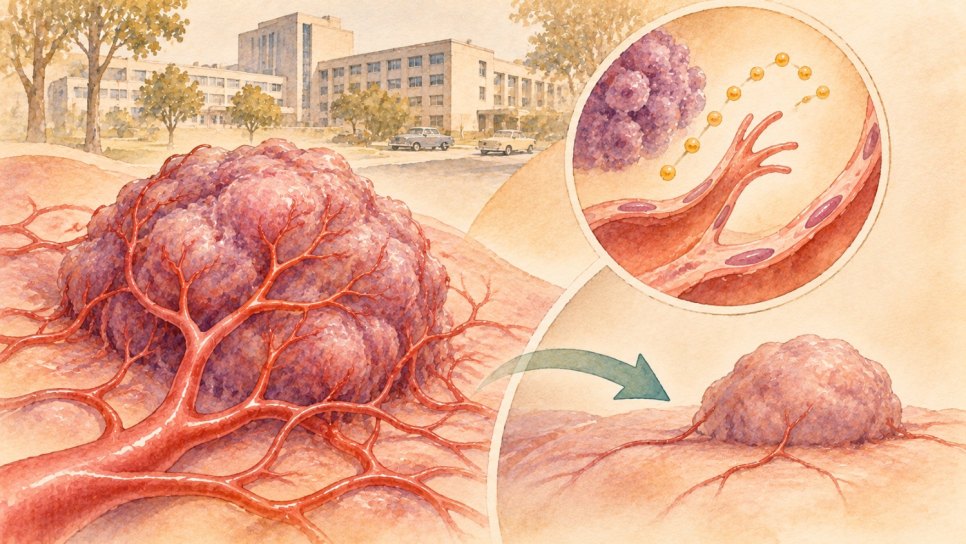
Angiogenesis is the sprouting of new vessels from existing ones. If a tumour cannot call vessels, it may stay at a few millimetres, as the 1971 abstract says; if it can, it is fed and grows. The logic Folkman proposed was to cut this call rather than to target the cell directly.
One consequence of this logic is that the target is less the tumour cell itself than the vessel process that feeds it. This was a hypothesis; testing it awaited the discovery of a factor, and then a drug trial in humans.
Applications judged too visionary
According to the ASCO Post, Folkman met the scepticism and ridicule of researchers focused on destroying tumour cells directly; this made grants, publications and recruitment harder. The same article reports Steven Brem saying that his first grant applications were turned down as "too visionary"; that is a recollection, not a document. The Nature Reviews Cancer editorial also writes that Folkman's contributions were "numerous and occasionally not well-received".
One should not exaggerate. According to the memoir, a ten-year agreement with Monsanto began in 1972, the largest industry-academic collaboration of its time. The idea was both turned down and funded: an example that does not quite fit the series' "rejected pioneer" pattern.
From molecules to a drug
Giving the idea a molecular form took decades. The memoir recalls Michael O'Reilly's work leading to angiostatin (Cell, 1994; a fragment of plasminogen) and the development of endostatin. On the stimulator side, according to the Gairdner Foundation page, Napoleone Ferrara isolated and sequenced vascular endothelial growth factor (VEGF) in 1989; the molecule turned out to be identical to the vascular permeability factor that Dvorak had described in 1983.
According to the ASCO Post, a front-page New York Times story in 1998 quoted James Watson as saying that Folkman would cure cancer within two years. Folkman corrected this in Scientific American the same year: inhibitors would not be a cure but could make cancer "more survivable and controllable". The drug itself came later. On 3 June 2004, Hurwitz and colleagues reported in the New England Journal of Medicine, volume 350 (2335-2342), 813 patients with previously untreated metastatic colorectal cancer: 402 received IFL chemotherapy plus bevacizumab (an antibody against VEGF), 411 IFL plus placebo. According to LabMedica, FDA clearance was announced in early 2004; Folkman reportedly said it proved the long-pursued angiogenic hypothesis and turned a theory into a treatment (conceptual summary; secondary report).
Limits and costs
The first limit is the kind of finding. TAF and the animal experiments are laboratory findings; a tumour calling vessels in an animal does not mean the same result will follow in humans. The two-year cure expectation of 1998 is an example, and Folkman's own correction deserves to be recalled.
The second limit is the size of the gain in humans. In the Hurwitz trial, median overall survival was 20.3 versus 15.6 months (hazard ratio 0.66); in relative terms, an event rate lower by about a third, in absolute terms a median difference of 4.7 months. Progression-free survival was 10.6 versus 6.2 months (hazard ratio 0.54); response rate 44.8% versus 34.8%; duration of response 10.4 versus 7.1 months. A meaningful gain, but not a cure; shown when added to chemotherapy, in previously untreated patients.
Cost: grade 3 hypertension occurred in 11.0% of the bevacizumab arm and 2.3% of the placebo arm; the paper's abstract calls it "easily managed". I did not verify the other side effects or the drug's cost for this article, so I do not list them.
What remained
- The idea that tumour growth depends on calling vessels
- A class of drugs aimed at the vessel signal (an antibody against VEGF)
- A hypothesis that demanded evidence: first a factor, then a molecule, then a clinical trial
What fell or weakened
- The expectation that "inhibitors alone will cure" (the 1998 reports)
- The picture of a single "tumour factor": in later years several molecules, VEGF among them, were recognised
- The view that tumour vessels are merely an inflammatory consequence
From the tumour's call for vessels to a drug: 1939-2004. The axis runs from 1935 to 2006. Green markers are dates on which several sources agree; blue markers show dates resting on a single source or only on a reference-list entry. The amber bar is the one period in which sources conflict: the naval thyroid experiment dated 1960 (National Academy of Sciences memoir) and 1963 (Ribatti). Dates known only by year are drawn mid-year.
A Turkish Oncology Group study
I do not draw a direct Turkish link to Folkman; I report a study that shows how the hypothesis extends to a present-day clinical question. The study by Hacan, Sonugür, Öçal and colleagues, published for the Turkish Oncology Group (TOG) in the International Journal of Cancer in 2026 (volume 159, issue 8, 2075-2083), examined predictive markers in patients with metastatic colorectal cancer treated with bevacizumab. According to the abstract, the prospective study enrolled 88 patients with unresectable disease; at baseline, serum VEGF, bFGF, PDGF-B, endothelin-1, nitric oxide and T-cell subsets were measured, as well as bevacizumab trough levels and anti-drug antibodies.
According to the abstract, higher baseline VEGF, PDGF-B and endothelin-1 were associated with better survival; an "Angiogenesis Index" predicted progression-free and overall survival; a trough level above 25 µg/mL on day 14 was linked to better overall survival. The authors regard the findings as promising but needing validation. My inference: the drug's benefit is not the same for everyone, and who will benefit remains an open question.
From 1939 to today
What was verified and what remains uncertain
- Citations: J Exp Med 1971;133(2):275-288 (abstract read) and N Engl J Med 1971;285(21):1182-1186 (PubMed; review, no abstract). The full text of the NEJM paper was not opened; I took its content from the account in the Nature Reviews Cancer editorial.
- The first experiment: the National Academy of Sciences memoir says 1960, Navy, melanoma, about 1 mm; Ribatti says 1963, canine thyroid, 1-2 mm; the ASCO Post says rabbits and mice. I could not resolve the conflict.
- Terms: who coined "angiogenesis" and "anti-angiogenesis", and when, differs between sources (memoir: Boston City Hospital; Ribatti: "anti-angiogenesis" in 1971). I did not write it.
- Precursors: Ide (1939) and Algire-Chalkley (1945) come only from Ribatti. The Greenblatt-Shubik 1968 citation was verified; one source page wrongly parses the second author as "Philippe", where Philippe Shubik is meant. I could not verify Ehrmann-Knoth (1968), so I did not write it.
- Reactions and 1998: the scepticism, ridicule, "too visionary" and the Watson-Folkman correction come from the ASCO Post (secondary, anecdotal). I did not verify the date of the report or the Scientific American citation; the figure shows only the year. The Monsanto agreement is from the memoir.
- VEGF 1989, Dvorak 1983: from the Gairdner page only. Angiostatin 1994 is from the memoir; I did not verify the citation of the endostatin paper, so I did not write it.
- Bevacizumab: the Hurwitz figures come from the abstract on the Ovid page. I could not verify the exact FDA approval day; the LabMedica report is dated 10 March 2004, and Folkman's words come from it as a conceptual summary. I did not write toxicities other than hypertension. I did not use the ASCO Post's macular degeneration claim.
- Folkman's life: birth, Harvard, Gross, the 1967 post and 14 January 2008 come from the memoir; not cross-checked with a second source.
- Turkey: from the abstract; the number of centres is not in the abstract; no causal link to Folkman is claimed.
- Yesterday's box: the 1971 idea, the first reactions and the extension to a drug were verified.
The Cell That Removes Itself: Kerr, Wyllie, Currie and Apoptosis, 1972
Today we looked at what the tumour calls from outside. Tomorrow, what happens inside: an orderly process by which cells remove themselves. I will verify the 1972 paper by Kerr, Wyllie and Currie and how the name "apoptosis" came to be.
Author's note: What I paid most attention to here was separating Folkman's real contribution from the observation that "a tumour calls vessels", which I did not hand to him: he tied an old observation to a factor, and a factor to a therapeutic hypothesis. Second, where sources conflict (1960 or 1963) I did not pick one, and I kept the laboratory finding, the inflated expectation and the median gain of 4.7 months in humans apart.
Sources and Further Reading
- Folkman J. Tumor angiogenesis: therapeutic implications. N Engl J Med 1971;285(21):1182-1186. doi:10.1056/NEJM197111182852108 (PubMed citation; full text not opened).
- Folkman J, Merler E, Abernathy C, Williams G. Isolation of a tumor factor responsible for angiogenesis. J Exp Med 1971;133(2):275-288. doi:10.1084/jem.133.2.275 (read at abstract level).
- Greenblatt M, Shubik P. Tumor angiogenesis: transfilter diffusion studies in the hamster by the transparent chamber technique. J Natl Cancer Inst 1968;41(1):111-124. doi:10.1093/jnci/41.1.111 (read at abstract level).
- Ribatti D. Judah Folkman, a pioneer in the study of angiogenesis. Angiogenesis 2008;11:3-10 (read with a summarising tool).
- National Academy of Sciences. Judah Folkman: biographical memoir. nasonline.org (read with a summarising tool).
- Nature Reviews Cancer. Editorial, August 2008;8:565 (read with a summarising tool).
- ASCO Post. Tribute to Judah Folkman (read with a summarising tool; secondary source).
- Hurwitz H, Fehrenbacher L, Novotny W, et al. Bevacizumab plus irinotecan, fluorouracil, and leucovorin for metastatic colorectal cancer. N Engl J Med 2004;350(23):2335-2342. doi:10.1056/NEJMoa032691 (read at abstract level).
- Gairdner Foundation. Napoleone Ferrara page. gairdner.org (read with a summarising tool).
- LabMedica. Report on FDA clearance of bevacizumab, 10 March 2004 (read with a summarising tool; secondary source).
- Hacan BA, Sonugür FG, Öçal M, et al. Predictive biomarkers in metastatic colorectal cancer patients treated with bevacizumab: a Turkish Oncology Group (TOG) study. Int J Cancer 2026;159(8):2075-2083 (read at abstract level).
- Mukherjee S. The Emperor of All Maladies: A Biography of Cancer. New York: Scribner; 2010 (general context; the relevant part was not reread for this article).
This article is Day 152 of the "365 Days of Cancer History" series and presents Folkman's angiogenesis hypothesis as a historical reading. It is historical-popular content, not a diagnosis or treatment recommendation. For treatment decisions, consult your physician. The sources have been verified; details resting on a single secondary source, on an abstract only or on a text that could not be read are marked in the fact-check notes.
Was this article helpful?
Your feedback helps us improve our content.