
The Changing Face of Clinical Trials - One Comprehensive Protocol for Multiple Questions

In this article
We use scientific evidence to guide medical practice, and methods of obtaining it have changed over time. The traditional standard conducts a series of studies comparing one or two drugs or different treatments in one disease. Over time, however, this has become insufficient for important clinical questions and problems. For example, targeted-drug studies cannot include people with rare genetic types of the disease. Interest is also growing in mechanism-based studiesthat assess eligibility beyond traditional disease definitions, and standard clinical trials are insufficient for these too. There is also increasing need to answer more questions more efficiently in less time.
A new method meeting these needs; evaluates multiple diseases or multiple treatment types for the same disease within the same research. Such studies are defined as comprehensive protocols designed to answer multiple questions , or briefly “master protocols”.
Master protocols fall into 3 main categories;
- basket,
- umbrella,
- and platform trials.
Basket trials examine one drug/treatment type's effect on multiple diseases. Umbrella trials investigate multiple drugs/treatments in one disease. The platform form basically resembles umbrella trials, but additionally allows treatments to enter or leave the platform according to an algorithm.
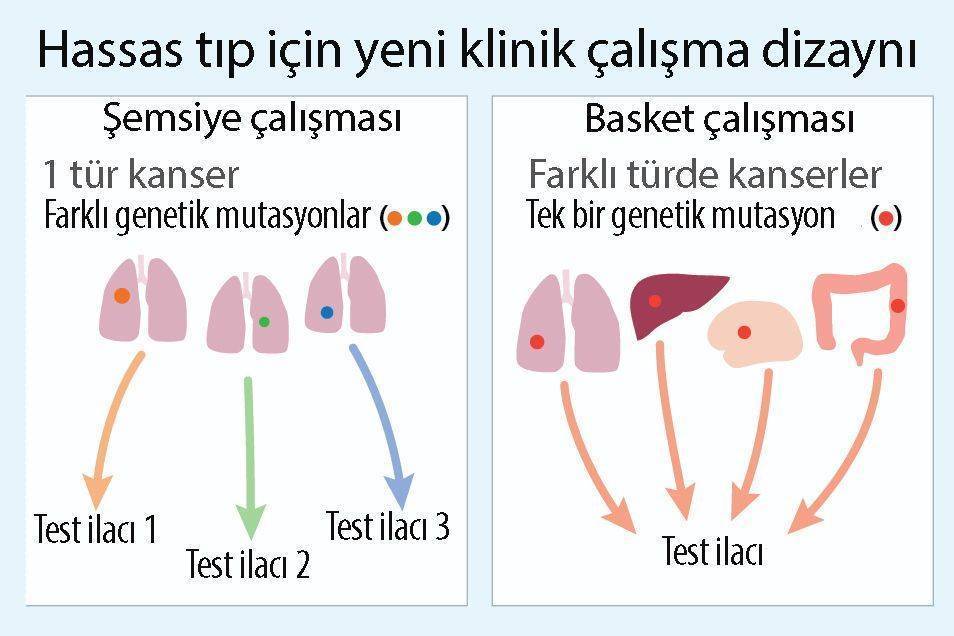
In general, master protocolsmay include one or multiple treatments effective against one or multiple diseases. Each is defined by a particular disease subgroup's biomarkers . A master protocol may directly compare competing drugs or evaluate different treatments against their own control groups.
Cancer is not one disease; as knowledge grows, we see numerous subtypes within the same organ with very different characteristics.
Advances in finding tumor subtypes and identifying mutations necessary for targeted treatments mean the master protocols below are far more widely used in cancer treatment investigations than in other health fields. Precision-targeted treatment advances increase the need for efficient, rapid results from basket and umbrella trials, for which standard trials are insufficient. The B2225 master protocol is a basket example, investigating across many cancers the effects of imatinib. NCI-MATCH is an umbrella example investigating multiple genetic markers and related targeted treatments in cancers containing targeted mutations. Two major examples explain cancer protocols in detail;
I-SPY 2 An exploratory platform trial investigating new treatments for early breast cancer subtypes in the neoadjuvant (preoperative tumor-shrinking) setting. Various drugs are tested, primarily to determine whether a complete surgical result can be obtained without waiting years. It is also expected to help predict event-free survival.
Innovations in the I-SYP 2 design include identifying treatments or combinations most appropriate for patients' subgroups, detecting therapies with low side-effect likelihood, using Bayesian decision rules to determine whether side effects must be stopped or when they may be triggered, identifying drugs/treatments likely to succeed, and guiding future trials. A trial network and information infrastructure have been established for this dynamic design.
By March 2017, 12 drugs had been evaluated and 5 advanced for further investigation. Discussions continue about I-SPY 2's successful drugs entering I-SPY 3, designed to prove their effectiveness.
2. Lung-MAP A phase 2. - 3. master protocol in advanced squamous non-small cell lung cancer. A shared biomarker-screening platform assigns patients to genetic subgroups, evaluating each targeted treatment independently. Patients outside any biomarker-defined subgroup enter an “unmatched” group, allowing more screening and preventing the shortage of cases encountered in standard methods.
Lung-MAP aims to establish safety and effectiveness for biomarker-matched therapies within one protocol, whereas I-SYP 2 takes an adaptive approach consistent with discovering effective new drugs.
Outside cancer, examples include DIAN-T4 for Alzheimer's and PREVAİL II for Ebola virus.
Innovations
Master protocols have two types of innovation;
- first, an information network to accelerate studies, improve data quality and facilitate collection and sharing,
- second, a common protocol incorporating innovative statistical approaches to design and data analysis.
Trial network and infrastructure
These comprise three headings: a common imaging platform, centralization and shared governance, and trial sites and systems.
Common Imaging Platform
Independent trials for each therapy allow patients outside subgroups meeting inclusion criteria to join studies without missing opportunities. Every suitable trial is identified for each master-protocol patient through a common screening platform. This coordinated screening is central, and efficient use of patients and resources is a major advantage.
Centralization and Shared Governance
Central sharing across all trials under a master protocol is another major advantage. Governance bodies such as a steering committee, institutional review board and data monitoring committee may be established. Besides using fewer resources, central governance allows consistent decisions on different aspects of all trials. In both examples, treatment discontinuation or administration decisions depend on centralization. These systems and bodies improve data quality.
New drug marketing approvals can change standard clinical practice and affect ongoing master protocols. For example, in Lung-MAP, Nivolumab shows superiority to Docetaxel, selected as standard care in biomarker-matched substudies. Approval of Pertuzumab, included in I-SPY 2's test treatment, causes it to replace Transtzumab, standard care for HER2-positive breast cancer.
In both cases, compared with individual trials, master protocols offer advantages in coordinating changes in a dynamic market.
Summary and Conclusion
Master protocols vary in size and shape but share much in common, all requiring extensive planning and coordination. Innovative design maximizes information from research and improves data quality for implementation and trial efficiency. Properly designed protocols can last years and quickly adapt to innovations alongside clinical events and laboratory results. As new drug targets become increasingly precise, coordinated research is necessary to meet our era's scientific needs.
Sources
Master Protocols to Study Multiple Therapies, Multiple Diseases, or Both.
N Engl J Med. July 6, 2017
Was this article helpful?
Your feedback helps us improve our content.




Reader comments
Share your comment
Your name and comment are published only after administrator approval. Your email address is never shown to visitors.
Be the first to comment.