The Fifth Position of Uracil: Heidelberger, Fluorinated Pyrimidines and 5-Fluorouracil (1954-1962)
In this article
The Fifth Position of Uracil: Heidelberger, Fluorinated Pyrimidines and 5-Fluorouracil (1954-1962)
Yesterday we described the program in which thousands of compounds were tried in mouse tumors with public money (Day 130), and we left it with a question: instead of searching for a drug at random, was there anyone who looked at what a tumor needs and built a compound to fit? This article tells one of the best-known answers to that question, 5-fluorouracil. We saw a drug that imitates a building block of the cell on Day 127 as well (Elion and Hitchings); here the molecule being imitated is uracil. Let me say at the outset that the sources part ways in two places: who made the observation, and who made the synthesis.
A rat liver and a hypothesis
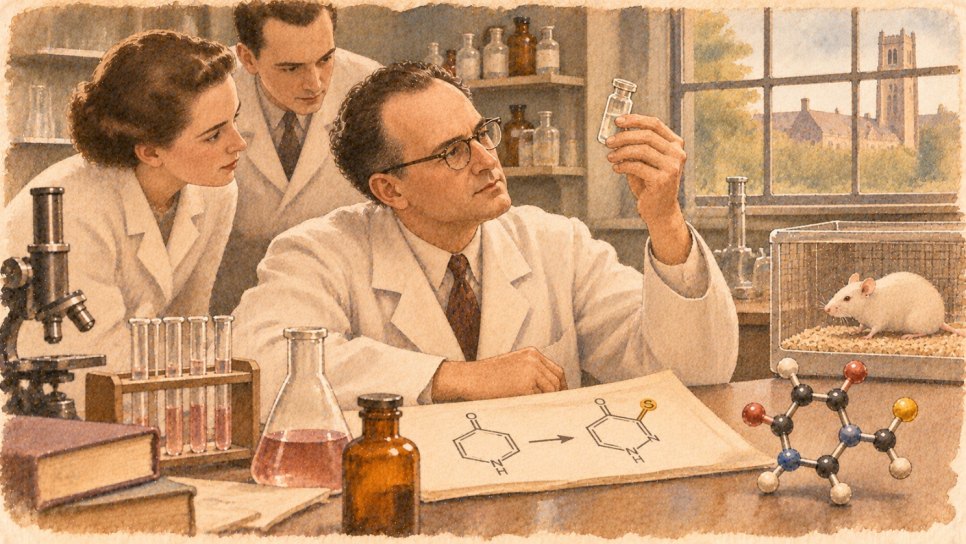
First, a distinction. Pyrimidines (uracil, thymine, cytosine) and purines (adenine, guanine) are the bases of nucleic acids; on Day 129 we saw adenine pair with thymine and guanine with cytosine. Thymine is found in DNA and uracil in RNA, and the difference between the two is exactly this: thymine has a methyl group at its 5th position and uracil does not (consistent with Kohn's account). That is the "fifth position" of this article's title. Heidelberger's idea was to add a fluorine atom at the 5th position of uracil.
In the early 1950s the textbook view was this: mammalian tissues do not use preformed pyrimidines, unlike preformed purines (abstract of a 1961 review; secondary). A study published in 1954 showed that this was not true, at least in rat liver tumors: the tumors took up radioactively labeled uracil more readily than normal liver. The sources part ways on the authors. One secondary account names Abraham Cantarow and Karl Paschkis; the reference list of another review carries "Rutman, Cantarow and Paschkis (1954)," and the page does not explain what that study described. I have not read the original paper.
Charles Heidelberger (1920-1983) was at this time a professor of oncology at the University of Wisconsin (from 1948; secondary source) and worked at the McArdle Laboratory in Madison (Kohn). The attraction of the observation was this (my inference): if a tumor cell needs more uracil than normal, a molecule that resembles uracil but spoils its job could enter the tumor more than normal tissue. Heidelberger's own reasoning, according to Kohn, was chemical: thymine has a methyl group at the 5th position; if fluorine is put at the same position on uracil, the fluorine could interfere with the production or function of thymine. Kohn writes that this proved correct, but that the mechanism was more complicated than expected. In other words the hypothesis pointed a direction; the detail would be worked out by other studies over years (my reading; Kohn does not say this in this sentence).
A paper with nine authors
"Fluorinated pyrimidines, a new class of tumour-inhibitory compounds" was published in volume 179 of Nature, pages 663-666, in the issue of 30 March 1957. The authors are Heidelberger, Chaudhuri, Danneberg, Mooren, Griesbach, Duschinsky, Schnitzer, Pleven and Scheiner. The text of the paper is behind a paywall; I have not read it. According to Kohn's summary, the compound showed anticancer activity in mice and rats. According to a secondary account, Heidelberger had found that a fluorine-bearing compound (fluoroacetic acid) blocks a vital enzyme, and he asked Robert Duschinsky and Robert Schnitzer at Hoffmann-La Roche to synthesize the compound; to whom the synthesis should be credited differs between sources. The same account says the patent was taken out in 1956. The title speaks not of one drug but of a "class": the abstract of a 1961 review notes that after this observation many pyrimidine antagonists such as 5-fluorouracil, 5-fluorodeoxyuridine and 6-azauridine were synthesized and evaluated.
The first human data came a year later: Curreri and colleagues (1958) ran the first clinical study at McArdle; at that time FDA approval was not yet required. Some tumors regressed, but only at doses that caused severe toxicity (Kohn). In a 1962 review by Ansfield and colleagues, about 21 percent of patients were reported to have tumor shrinkage, and remissions lasted 9 months on average (Kohn's account; I have not read the original paper). According to secondary sources the compound entered medical use in 1962. That date rests not on an approval document but on the account of a secondary review; I did not research the approval process separately.
The antimetabolite: an imitating molecule
An antimetabolite is a substance that resembles a building block the cell uses closely enough but spoils its job: if the cell cannot tell the false molecule from the real one, it disrupts its own process in trying to use it (general knowledge; simplified account). 5-Fluorouracil belongs to this class, as do aminopterin (Day 122) and 6-mercaptopurine (Day 127). What is distinctive in this story is that the starting point was both an observation (the tumor takes up more uracil) and a piece of chemical reasoning (a methyl in thymine, fluorine in uracil). In 2014 a review in Nature Reviews Clinical Oncology (Wilson et al.) treats the fluorinated pyrimidines as a class that targets thymidylate biosynthesis and has "stood the test of time"; I read only the review's abstract and reference list. The same page says the fluorinated pyrimidines (5-FU, capecitabine, S-1) remain the foundation of many combination regimens. Its reference list also shows a 1992 meta-analysis of using the drug together with leucovorin (the Advanced Colorectal Cancer Meta-Analysis Project); I have not read its content.
The difference between this story and the screening program of Day 130 is subtle. In a screening program the compound is found first and the mechanism asked about afterwards; here the order was reversed: first a difference in the cell, then a molecule fitted to that difference. The distinction is not sharp, because 5-FU too was in the end supported by testing in mouse and rat tumors; the design hypothesis was tested by animal experiment, and the human data came only afterwards.
Cost and limit: effect and toxicity
The first cost is dose. In the first clinical study, tumor regressions were seen at doses that gave severe toxicity. Let us read relative and absolute effect together: the shrinkage rate of about 21 percent in the 1962 review means that in about 79 percent of patients no tumor shrinkage was reported (a simple inference), and among those who responded the remission lasted 9 months on average. This calls for care about the number by which a drug is said to have "worked." In chemotherapy the dose determines both benefit and harm; when the dose that gives benefit and the dose that gives severe side effects lie close together, this is called a narrow therapeutic range, and it is one of the reasons drugs are still dosed carefully today (general knowledge, not from a source).
The second limit is the "clever design" narrative. The 1954 observation concerned rat liver tumors; the first effect in the 1957 paper was shown in mice and rats, and this cannot be generalized to humans. Kohn says the mechanism turned out more complicated than expected: the hypothesis showed the right direction, not the detail. The title of a 1981 paper by Heidelberger ("On the rational development of a new drug: the example of the fluorinated pyrimidines") shows how he framed this story; I have not read the paper.
This story is sometimes called "the first rationally designed cancer drug." The sources I have do not make that "first" claim: Kohn says "discovery," and the title of Heidelberger's 1981 paper says "rational development." I do not say "first"; Elion and Hitchings's 6-mercaptopurine (Day 127) had developed a few years earlier with a similar imitation logic, and which counts as "first" depends on what is understood by design.
Third, I made no link between the screening program of Day 130 and this work: I have read nothing about which source funded Heidelberger's work.
What remains
- The idea of a drug built from a metabolic difference as an imitating molecule based on structure
- The fact that fluorinated pyrimidines are still the foundation of many combination regimens
- The three-step path from observation to hypothesis and from hypothesis to clinic
What fell or was limited
- The "one observation, one clever drug" narrative; the mechanism was more complicated than expected
- The expectation of a broad and safe effect at the first doses
- The assumption that a mouse and rat result can be carried straight to humans
The path of 5-fluorouracil, 1954-1962. The axis runs from 1953 to 1963. The date of 30 March 1957 rests on the Nature citation; the 1954 observation, the 1958 first clinical study and the 1962 review rest on secondary sources; the 1956 patent has only a secondary account as its source and is therefore drawn in amber. Because only the year is known for the events other than 30 March 1957, they are drawn at mid-year.
I did not look for a local link in this article
I found no verified source on a Turkish name in this story or on any first use specific to Türkiye, and I invented no link. In the places I looked (sources on drug history, the citation of the Nature paper) no Turkish name appeared. A general inference (not from a source): because fluorinated pyrimidines today appear in many treatment protocols for cancers such as colorectal and stomach cancer, the 1957 paper described here has a counterpart, generations later, in the treatment of patients in Türkiye too.
From 1948 to today
What was verified, what conflicts
- Nature citation: Nature 179:663-666, 30 March 1957; nine authors (from the paper's page; text not read).
- The 1954 observation, authors: one secondary account names Cantarow and Paschkis, a review's reference list names "Rutman, Cantarow and Paschkis (1954)"; the abstract of a 1961 review says only "studies of 1954 and 1957." I did not verify the original paper, its journal or its volume.
- Credit for the synthesis: one secondary source writes that Duschinsky and Schnitzer were asked for the synthesis; another credits Heidelberger and Duschinsky with showing tumor inhibition; Kohn names Duschinsky only as an author of the 1957 paper. I took the Roche connection from a secondary source, not from the paper's page.
- The 1956 patent and "medical use in 1962": from a secondary source (relayed through a reference book). I found no FDA approval date and did not write "FDA approval."
- First clinical study: Curreri et al. (1958), McArdle; the statements "FDA approval was not required then" and "regression at doses of severe toxicity" are from Kohn. I did not verify the journal of the original paper.
- 21 percent and 9 months: Kohn's account of Ansfield et al. (1962); I have not read the original paper. "No shrinkage reported in 79 percent" is my own arithmetic inference and does not cover possible differences in measurement.
- Heidelberger's life: born 1920, professor of oncology in Wisconsin from 1948; from a secondary source. I did not use details about the end of his life.
- Mechanism: Kohn says "more complicated than expected"; only the abstract and reference list of the Wilson et al. review were read. No molecular detail of the mechanism is given in this article.
- The "test of time" wording: belongs to the review's title; the statement that it is the foundation of many combinations is from the same page.
- Kohn's book: the page gives no publication year; so I wrote no year in the source.
- Link to the screening program: I saw no link in any source between the CCNSC program of Day 130 and this work; I made none.
- Wikipedia: used as a secondary lead only for a few dates and attributions; it was not put in the source list. Jordan (2016) and Heidelberger (1981) are at citation level only.
Being able to measure that a drug works
Until now we have mostly judged that a drug worked by watching a tumor shrink. But what if there were a measure showing that a drug really removed a tumor? Min Chiu Li and choriocarcinoma (1956): I will tell it after verifying the date of the first paper, with which drug he worked and what he measured.
Author's note: The easy way to write this article was "a drug born of one clever observation." My sources part ways on the authors of the observation, on who owns the synthesis and on the first patient results; and the mechanism was more complicated than first thought. I did not reduce these to one clean story. I noted the papers I could not read in the fact-check box.
Sources and Further Reading
- Heidelberger C, Chaudhuri NK, Danneberg P, Mooren D, Griesbach L, Duschinsky R, Schnitzer RJ, Pleven E, Scheiner J. Fluorinated pyrimidines, a new class of tumour-inhibitory compounds. Nature 1957;179:663-666 (doi:10.1038/179663a0; only the citation and publication date were read; the text is behind a paywall).
- Kohn KW. Drugs Against Cancer: Stories of Discovery and the Quest for a Cure, chapter "The 5-Fluorouracil Story" (discover.nci.nih.gov; read; secondary; no publication year on the page).
- Wilson PM, Danenberg PV, Johnston PG et al. Standing the test of time: targeting thymidylate biosynthesis in cancer therapy. Nat Rev Clin Oncol 2014;11:282-298 (only the abstract, key points and reference list were read).
- An Evaluation of 5-Fluorouracil in Malignant Disease. Ann Intern Med 1961;55(5):731-741 (doi:10.7326/0003-4819-55-5-731; only the citation and the start of the abstract were read; the author list was not on the page).
- Jordan VC. A retrospective: on clinical studies with 5-fluorouracil. Cancer Res 2016;76(4):767-768 (doi:10.1158/0008-5472.CAN-16-0150; only the citation was read; the text was not read).
- Heidelberger C. On the rational development of a new drug: the example of the fluorinated pyrimidines. Cancer Treat Rep 1981;65(Suppl 3):3-9 (citation only; from the reference list of Wilson et al.; not read).
- Michael Heidelberger Papers. "Letter from Charles Heidelberger to Michael and Charlotte Rosen Heidelberger," about 1958 (profiles.nlm.nih.gov; only the catalog note was read; the letter's text was not read).
- Mukherjee S. The Emperor of All Maladies: A Biography of Cancer. New York: Scribner, 2010. (Not separately verified for this article.)
This article is Day 131 of the "365 Days of Cancer History" series and tells the development of the fluorinated pyrimidines and 5-fluorouracil in the 1950s as a historical event. It is historical-popular content; it is not a diagnosis or treatment recommendation. Consult your physician for decisions about your health. Sources have been verified; details that rest only on a secondary source are noted in the fact-check notes.
Was this article helpful?
Your feedback helps us improve our content.