Does the Body Notice the Cancer Inside It? Burnet, Lewis Thomas and Immune Surveillance (1957-1959)
In this article
Does the Body Notice the Cancer Inside It? Burnet, Lewis Thomas and Immune Surveillance (1957-1959)
Yesterday we told the story of tying the duration of a drug to a measurable marker (Day 132). Today's article has no drug; it has an idea. On Day 96 we described Paul Ehrlich's thought that the immune system might be holding cancer cells in check: there was no proof, and the idea waited. This article tells how it returned between 1957 and 1959 from two different directions. Two warnings: today's Thomas is Lewis Thomas, not to be confused with E. Donnall Thomas, who appears tomorrow. And this is the story of a hypothesis; it was seriously questioned in later years, and its present form differs from its first one.
The ground prepared in the laboratory
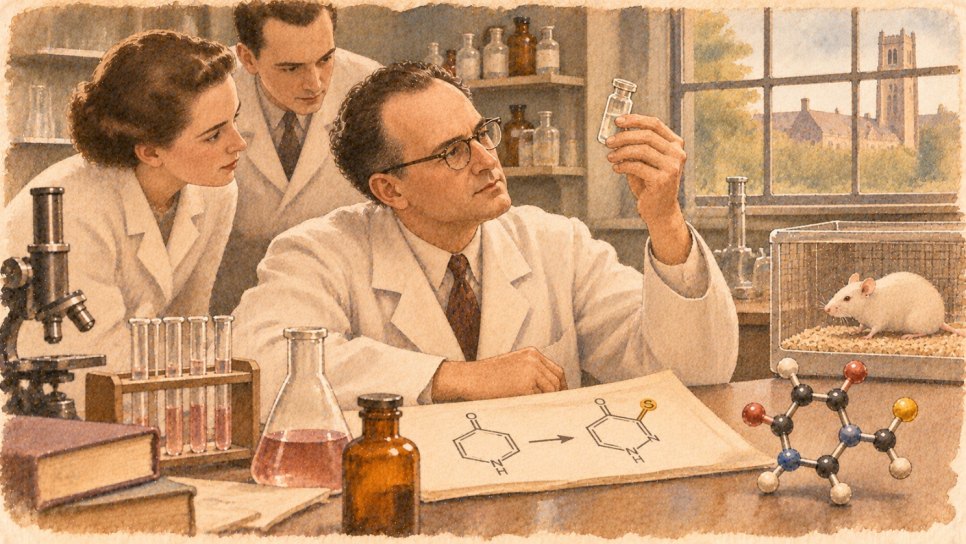
Mouse tumors transplanted into another mouse could be rejected; but did that show that the tumor itself was recognized, or only the genetic difference between the two mice? Experiments with genetically identical (inbred) mice made the distinction possible. According to Ribatti's historical review, Gross (1943) and Foley (1953) showed that immunity could be raised against mouse tumors produced by a carcinogen. In 1957 Prehn and Main published a paper on sarcomas produced by methylcholanthrene (titled "Immunity to methylcholanthrene-induced sarcomas"). By general knowledge this work showed that each tumor carries its own antigen; I did not read the abstract of the original paper and did not verify this detail in this session.
Frank Macfarlane Burnet came to the question from another place. From 1944 to 1965 he was director of the Walter and Eliza Hall Institute in Melbourne; he shared the 1960 Nobel Prize in Physiology or Medicine with Peter Medawar for the discovery of acquired immunological tolerance, and he proposed the clonal selection theory in an article in 1957 (AAI page). Acquired tolerance meant that the immune system learns to tell self from foreign (general knowledge, simplified). My inference: for someone who held that the body separates "self" from "foreign", a system that also watches later-altered versions of its own cells was a natural next step; the sources do not make the link this way.
Two doors, one question
In 1957 Burnet published a two-part article titled "Cancer: a biological approach" in volume 1 of the British Medical Journal; the first part is in issue 5022, pages 779-786. I did not read the original text; the conceptual summary below rests on secondary sources and is not a verbatim quotation. Somatic mutations can give cells new antigenic features; the immune system may recognize and remove them; small clusters of cells may be eliminated without any clinical sign. According to Greenberg and Greene's 1976 summary, Burnet regarded this surveillance as the work of thymus-dependent immunity.
Lewis Thomas (1913-1993) worked at New York University from 1954 to 1966 (encyclopedia.com; I did not verify his title in those years). In 1959, in the discussion section of a volume edited by H. S. Lawrence, on page 529, he put forward a view. According to Greenberg and Greene's account (conceptual summary): he said that preserving uniformity of cell type is a universal requirement of multicellular organisms, and concluded from this that the rejection of tissue transplanted from another individual (allograft rejection) might be the main natural defense against cancer. The title and publisher of the volume differ between sources; details are in the fact-check box.
My interpretation: Burnet started from clonal selection, Thomas from transplant biology; the two paths reached the same place. In the sources I searched they have no joint publication; the name "Burnet and Thomas hypothesis" was built later. Thomas later led a cancer hospital in New York from 1973 to 1980 (encyclopedia.com).
Immune surveillance: a hypothesis, not a treatment
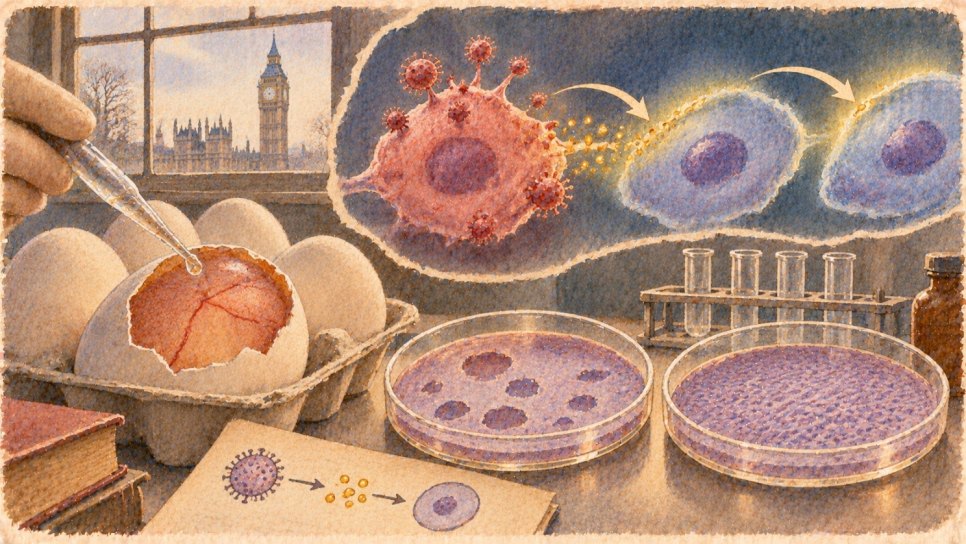
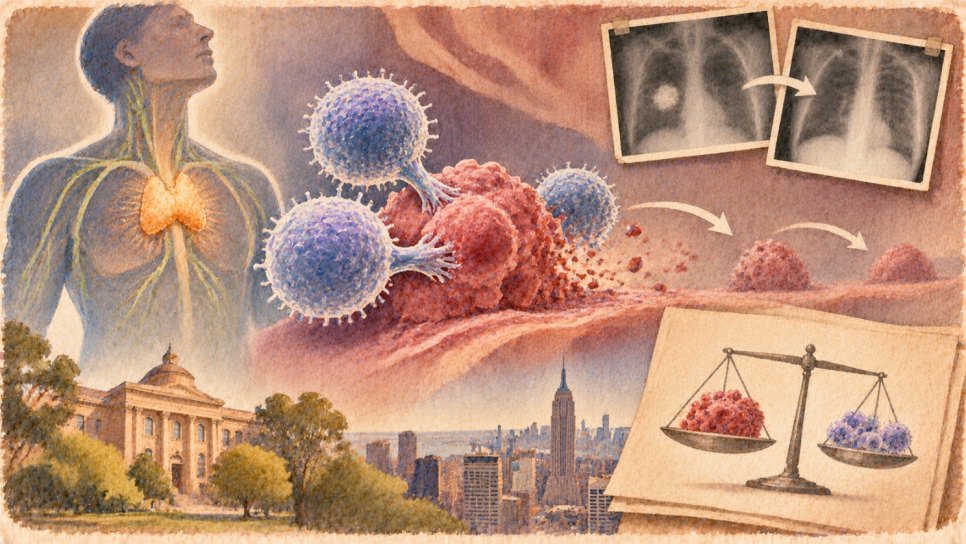
Immune surveillance (immunosurveillance) is the idea that the immune system continuously watches transformed cells and removes some of them without any clinical sign (simplified definition). In everyday speech people say "immunity prevents cancer"; the hypothesis instead asks for which type of immunity, which tumor and under which conditions that is true. Its value lies in giving a testable prediction: an animal lacking immunity should develop cancer more often or earlier. The term appears in the title of a 1970 book chapter by Burnet; I did not look into its first use. Some sources name Burnet and Thomas as the founders of the hypothesis, but Ehrlich's 1909 foresight (Day 96) and the groundwork of Prehn and Main should not be dropped; for that reason I do not say "first".
In current use the idea has been extended by the concept of "immunoediting"; the title of the 2002 review by Dunn and colleagues is "from immunosurveillance to tumor escape". The difference: the immune system does not only remove; it also shapes the properties of the tumor cells that survive.
Cost and limit: evidence, generalization and false hope
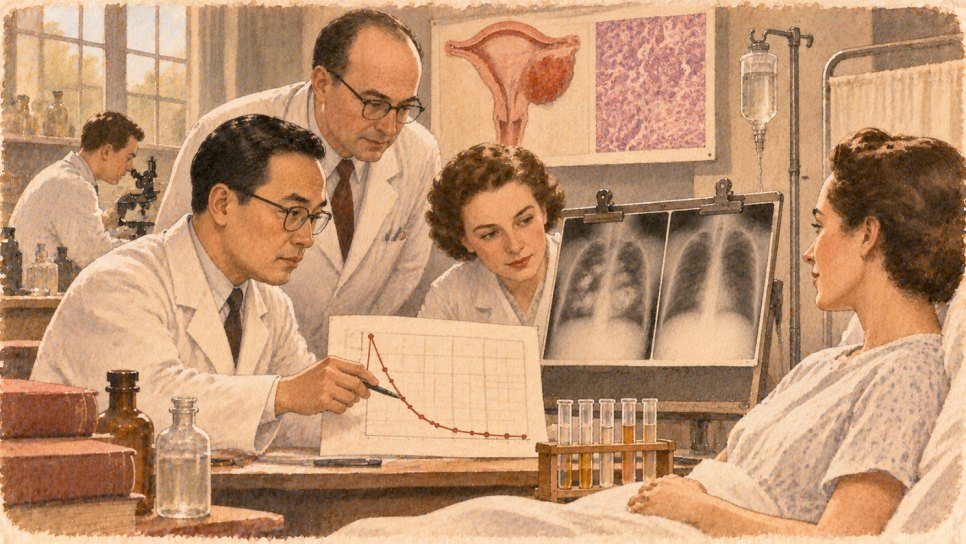
The first limit is evidence. According to Greenberg and Greene, Prehn and others criticized Burnet's model, arguing that adaptive immunity rarely eliminates incipient tumors and that few spontaneous tumors appear in mice without a thymus. In Stutman's study published in Science on 8 February 1974 (abstract read), athymic nude mice and normal mice were exposed to 3-methylcholanthrene at birth; within 120 days there was no difference in either latent period or incidence of local sarcomas and lung adenomas. The author concluded that thymus-dependent immunity did not appear to prevent tumor development through surveillance. This mouse finding was a serious blow to the first form of the hypothesis; it cannot be carried directly to humans.
The second point is that the story does not end here. In 1976, in a paper titled "Non-adaptive rejection of small tumour inocula as a model of immune surveillance", Greenberg and Greene tested whether surveillance could also exist through a route independent of the thymus; my inference is that the title points to a non-adaptive mechanism. In 2001 Shankaran and colleagues reported in Nature (abstract read) that lymphocytes and IFNγ protect against carcinogen-induced sarcomas and spontaneously arising epithelial carcinomas and shape the recognizability of the tumor by the immune system; the authors described immunity as an "extrinsic tumour-suppressor system". According to a review (Dunn et al., 2002; I could not reach the page again in this session) the hypothesis had been largely abandoned soon after it was proposed. These two decades between negative and positive results show how science corrects itself.
The third limit is false hope. The inference "if immunity removes cancer, strengthening it means no cancer" does not follow from these data (my inference). It is known that some cancers are more frequent in patients with suppressed immunity (general knowledge; no source read for this article); but which cancers, and by what mechanism, is a separate debate. This article has no dose, risk ratio or patient outcome, so there is no data for which to give relative and absolute effects.
Fourth, the distance between an idea and a treatment. Immunity-based therapies are products of this idea half a century later and will be taken up in later days of the series, with their own evidence.
What remains
- The idea that tumor cells can be recognized by the immune system
- Applying the "self and foreign" framework to cancer
- The thought that immunity not only removes but shapes tumors (2002)
What falls or is limited
- The assumption that only thymus-dependent immunity performs surveillance
- The inference that strengthening immunity would prevent cancer
- The validity of the hypothesis in its first form; seriously shaken after Stutman 1974
The path of an idea: 1909 to 2002. The axis runs from 1900 to 2010. Green markers are publications whose citation was verified; the amber marker is the 1959 discussion note, whose citation conflicts between sources; blue markers are dates and citations taken from secondary sources. Years are drawn mid-year; two events of the same year are shown on two rows.
I did not look for a local link in this article
I found no verified source for a Turkish name or a Turkey-specific first use in this story, and I invented no link. A general inference (not from a source): since immunity-based therapies are now part of oncology practice in Turkey too, the idea in this article carries an indirect historical root for patients in the country as well. Still, for which tumor and which patient it holds is a question for the coming days, not for this article.
From 1909 to today
What was verified, what conflicts
- Thomas 1959 citation: Greenberg and Greene (Nature 1976;264:356-359) cite Thomas as "Cellular and Humoral Aspects of the Hypersensitivity States, ed. H. S. Lawrence, p. 529, Cassell, London, 1959". What I remember is the title "Hypersensitive States" and the publisher Hoeber-Harper, New York; I did not verify this. I do not say which is correct; the page number comes only from Greenberg and Greene.
- Thomas's statement: the "uniformity of cell type" and allograft rejection content comes from Greenberg and Greene's unquoted account; I did not see the original discussion text. There is no verbatim quotation claim here.
- Burnet 1957: the citation Br Med J 1957;1(5022):779-786 was taken from secondary sources; the pages of the second part (841-847) come from the attribution of Darnell and Posner (Nat Immunol 2003;4:201), and I did not verify its title or dates. I did not read the text. I did not give the issue date; only the year.
- Prehn and Main 1957: the citation JNCI 1957;18(6):769-778, doi:10.1093/jnci/18.6.769 is from a database record; the abstract was not read. "Each tumor carries its own antigen" is general knowledge.
- Gross and Foley: from Ribatti's review; the text cites Gross's work once as 1943 and elsewhere as 1953. I wrote 1943; I could not resolve the second date. I did not confirm Ribatti's volume and page details from the page.
- Stutman 1974: Science 1974;183(4124):534-536, 8 February 1974; only the abstract was read (the author's name was not listed on the page; that Stutman wrote the 1974 study is from other records). The 120 days and "no difference" come from the abstract.
- Dunn et al. 2002: the statement that the hypothesis was "largely abandoned soon after" is from my earlier reading; I could not reach the page today. The history of the hypothesis should not rest on a single source.
- Shankaran 2001: only the abstract was read; it gives no mouse-strain detail such as RAG-2, so I did not write it.
- First use of the term "immune surveillance": not researched; only the title of Burnet's 1970 chapter was verified (Karger record; the text is paywalled and was not read).
- Burnet and Thomas biographies: Burnet's dates and Nobel from the AAI page; Thomas's career from encyclopedia.com. Thomas's title in 1959 was not verified.
- Two Thomases: today's is Lewis Thomas; tomorrow's E. Donnall Thomas is a different person.
- Wikipedia: used only as a hint; not placed in the source list. Access to some sites (PubMed, PMC) was restricted; the affected points are noted above.
Will the body accept someone else's bone marrow?
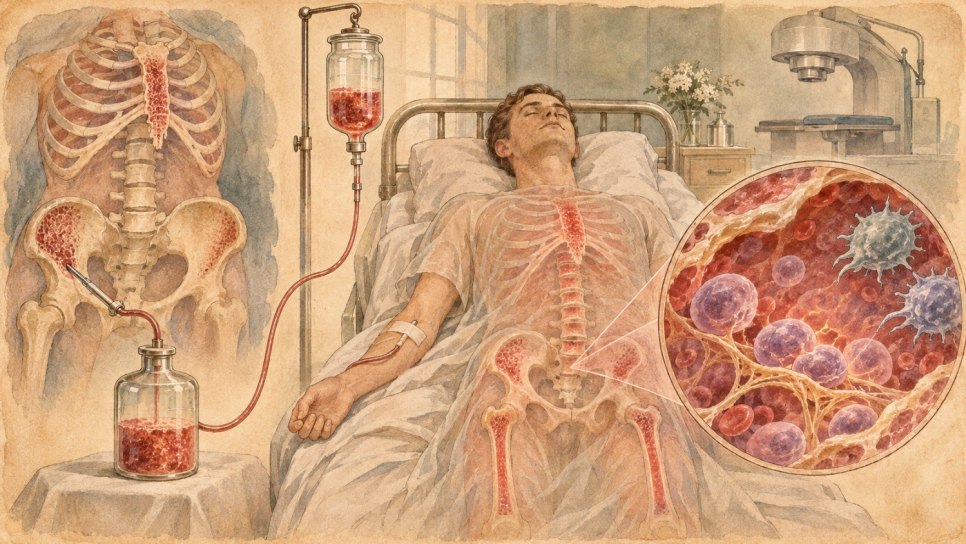
Today the logic of transplant rejection was carried into an idea about cancer. So what did the same logic say to a physician who tried to give a patient with destroyed bone marrow the marrow of another person? E. Donnall Thomas and around 1957: I will tell it by verifying the first transplant attempts, who did what and when, and the "first" claims.
Author's note: The easy way through this article was to say "Burnet and Thomas discovered that immunity watches over cancer." The sources I have say it was a hypothesis, that its first form was seriously tested, and that it was rebuilt later. The citation for Thomas's 1959 note conflicts; I could not read the original texts. I did not reduce these to one clean story.
Sources and Further Reading
- Burnet FM. Cancer: a biological approach. Br Med J 1957;1(5022):779-786 (citation from secondary sources; text not read; see the fact-check note for the continuation).
- Prehn RT, Main JM. Immunity to methylcholanthrene-induced sarcomas. J Natl Cancer Inst 1957;18(6):769-778 (doi:10.1093/jnci/18.6.769; citation only; abstract not read).
- Thomas L. Discussion remark, in: Lawrence HS (ed.), 1959, p. 529 (as attributed by Greenberg and Greene; the volume's title and publisher conflict between sources; original text not read).
- Burnet FM. The concept of immunological surveillance. Prog Tumor Res 1970;13:1-27 (doi:10.1159/000386035; Karger record; citation only; text paywalled, not read).
- Stutman O. Tumor development after 3-methylcholanthrene in immunologically deficient athymic-nude mice. Science 1974;183(4124):534-536 (doi:10.1126/science.183.4124.534; abstract only).
- Greenberg AH, Greene M. Non-adaptive rejection of small tumour inocula as a model of immune surveillance. Nature 1976;264:356-359 (doi:10.1038/264356a0; read only at first-page level).
- Shankaran V et al. IFNγ and lymphocytes prevent primary tumour development and shape tumour immunogenicity. Nature 2001;410(6832):1107-1111 (doi:10.1038/35074122; abstract only).
- Dunn GP, Bruce AT, Ikeda H, Old LJ, Schreiber RD. Cancer immunoediting: from immunosurveillance to tumor escape. Nat Immunol 2002;3(11):991-998 (doi:10.1038/ni1102-991; page not reachable in this session; from an earlier reading).
- Ribatti D. The concept of immune surveillance against tumors: the first theories. Oncotarget (2016/2017; volume and page details not confirmed from the page).
- Mukherjee S. The Emperor of All Maladies: A Biography of Cancer. New York: Scribner, 2010. (For general context; the relevant section was not read for this article in this session.)
This article is Day 133 of the "365 Days of Cancer History" series and tells, as a historical event, the emergence of the immune surveillance hypothesis between 1957 and 1959 and its testing in the following years. It is historical-popular content; it is not a diagnosis or treatment recommendation; no drug doses are given. Consult your physician for decisions about your health. Sources have been verified; details that rest on a secondary source or could not be read are marked in the fact-check notes.
Was this article helpful?
Your feedback helps us improve our content.