Until the Marker Reaches Zero: Min Chiu Li, Choriocarcinoma and Methotrexate (1956)

In this article
Until the Marker Reaches Zero: Min Chiu Li, Choriocarcinoma and Methotrexate (1956)
Yesterday we told the story of a drug built by looking at what a cell needs (Day 131), and we left a question: what if there were a measure that showed a drug had truly removed a tumor? Today's story is one of the most striking answers to that question. We saw on Day 122 that antifolate drugs produced temporary regressions in childhood leukemia (Farber, aminopterin). Here the same family of drugs is applied to a rare cancer that grows in the uterus, and the story is decided less by the drug than by a measurement: a hormone that can be measured in blood and urine. I say at the outset: the sources part ways on the order of authors of the paper, on the year Min Chiu Li was dismissed, and on the date of the first patient.
What was gestational choriocarcinoma?
Gestational choriocarcinoma is a cancer that arises in the uterus when cells that would normally form the placenta multiply abnormally (in line with the NCI page's definition, simplified). Before methotrexate, in the NCI's account, this disease almost always ended in loss of life; the Lasker Foundation's page writes that about 90 percent of untreated patients lost their lives. I have not read an original record for either.
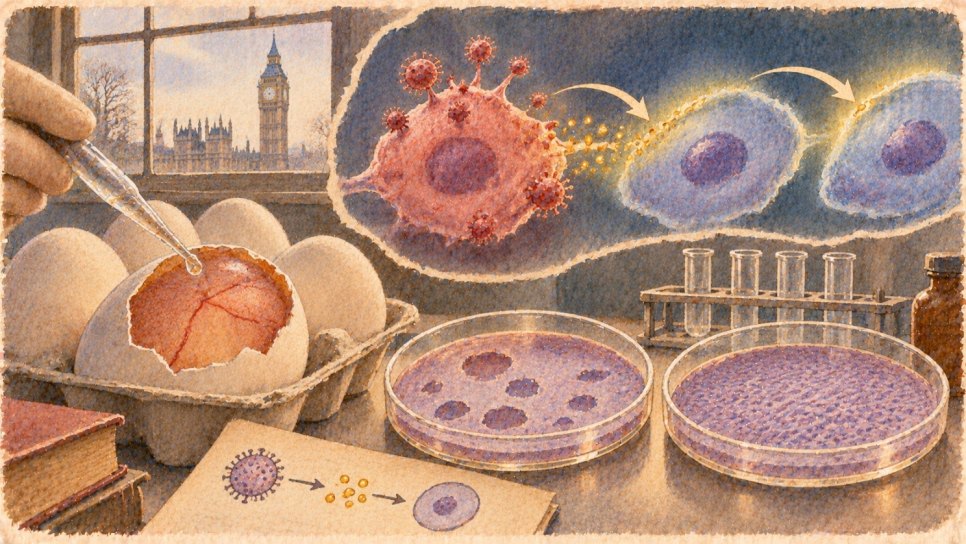
This tumor had a distinguishing feature: it produces human chorionic gonadotropin (hCG). hCG is the pregnancy marker in healthy women; the NCI page says it is also associated with trophoblastic and testicular tumors and with some melanomas and carcinomas. The Lasker page says these tumors secrete "a hormone that can be measured" and that Li's team tracked treatment response with it.
Roy Hertz was the other half of this work. According to the NCI page he had become head of the NCI Endocrinology Section in 1946. His earlier publications were also in the hormone field: the reference list of Buckle's 1959 paper shows two Science notes by Hertz, from 1944 and 1948; the title of the second is "folic acid antagonist interference with estrogen-induced tissue growth in the chick genital tract." I have not read their contents. My inference is this: the hormone axis of the series (Day 91 Beatson, Day 105 Lacassagne) passes here, by a side road, through Hertz's laboratory, with the question of folic acid and tissue growth; no source says this.
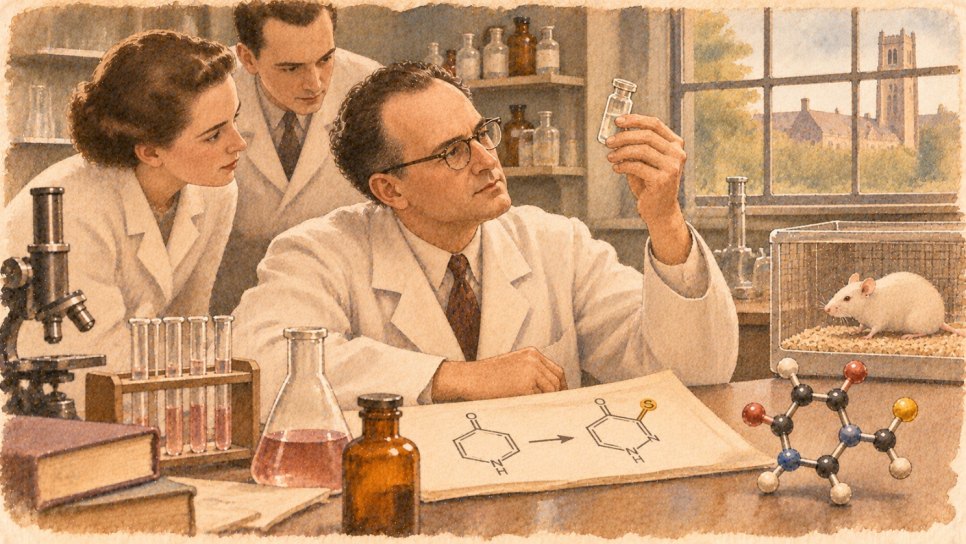
Min Chiu Li (1919-1980; born in Mukden, secondary source) joined Hertz's team at the NCI. According to the NCI page, Li had first tried an antifolate in patients with metastatic melanoma; the tumor did not regress, but urinary β-hCG fell markedly. A secondary account places these trials at Sloan Kettering (1953-1955); the two accounts do not match in detail, but both say that the hCG fall was seen before choriocarcinoma.
"Effect of methotrexate therapy upon choriocarcinoma and chorioadenoma"
The paper was published in 1956, in volume 93, issue 2 of the journal, on pages 361-366. Its title was "Effect of methotrexate therapy upon choriocarcinoma and chorioadenoma." The authors are Hertz, Li and Spencer; but the order varies by source. A database record and the reference list of a 1959 paper put Hertz first; the NCI page writes "Li MC, Hertz R, Spencer DB." I have not read the text, so I did not settle the order myself. The NCI page calls this work the first documented radiographic regression of tumor metastases with chemotherapy and says a solid tumor responded to chemotherapy for the first time.
Mukherjee's account (from an online copy; my summary): a patient with bleeding lung tumors is stabilized and given methotrexate; after four rounds her tumors appear to vanish, and Li and Hertz publish the result. Mukherjee places the event in August 1956; another secondary account puts the first patient in 1955. Because neither fully matches the paper's 1956 date or each other, I give neither a patient nor a day.
The real novelty was what happened after the tumor became invisible. According to Mukherjee, Li used the hCG the tumor shed as the cancer's fingerprint: even when the tumors shrank and vanished, if hCG stayed slightly above normal, he kept giving methotrexate, despite added toxicity, until hCG fell to zero. Mukherjee also writes that patients whose drug was stopped early relapsed, while those who were kept on it longer stayed free of disease even after the drug was stopped. A secondary account says the same. This is not presented as a controlled comparison (my note).
In 1958 Hertz and colleagues reported a series of 27 patients in JAMA; according to the NCI page five were completely cured (I have not read the original paper). The same year Li, Hertz and Bergenstal described treatment with folic acid and purine antagonists in the New England Journal of Medicine; I saw only its title and citation. According to the Lasker Foundation's page, Li's team added actinomycin D in 1961 for cases resistant to methotrexate and, using the two drugs in sequence, reported a 75-85 percent cure of 5 to 10 years in 500 patients. The NCI page says the cure rate reached 80 percent in 1962.
Tumor marker: a measurable trace
A tumor marker is a substance, made by the tumor or by the body in response to it, that can be measured in blood or urine (general knowledge; simplified account). The difference here was this: whether a tumor is visible is not the same question as whether tumor cells remain. Examination and imaging show the residue of a tumor that the eye can pick out; hCG can carry a trace of cells that cannot be seen. Li's approach was to make this second question the measure that decides when treatment stops. The response was defined by the hormone falling to zero.
The link between this story and yesterday's (Day 131) is this: in 5-fluorouracil the drug was designed by looking at what the cell needs; here the drug was largely ready and the innovation was measuring how long to give it. We will meet other markers in later articles of the series. A caution: that hCG suits this job depends on these tumors producing it; not every cancer has such a measurable trace (general knowledge, not from a source).
Cost and limit: the price of extra doses, a rare disease and inequality
The first cost is toxicity. Mukherjee writes that Li gave the extra rounds "despite added toxicity." According to the account, the NCI's institutional board saw this as giving unnecessary doses to patients it considered cured, that is, as poisoning them, and dismissed Li. I could not confirm that reasoning in another source. The date of Li's dismissal also differs among sources: one secondary page says 1957, Mukherjee's text says mid-1960; a popular article gives no year. I do not say which is right. The disagreement itself points to an ethical question: does the point at which treatment stops get decided by the visible tumor disappearing, or by a measurable hormone falling to zero? According to the account the board chose the first measure; later comparisons, as far as Mukherjee reports, supported Li's direction.
The second limit is the numbers. Let us read relative and absolute effect together: five complete cures among 27 patients in the 1958 series is about 19 percent (simple inference); that is, in the first report about 81 percent of patients were not reported as completely cured. The figures of 80 percent (1962) and 75-85 percent (500 patients, combination after 1961) rest on different denominators, and the NCI page does not state the denominator of 80 percent; so it would not be right to put the 19 percent of the first series and the later 80 percent on the same scale.
The third limit is generalization and access. Gestational choriocarcinoma is a rare disease: according to the NCI page it occurs in about 1 in 20,000 pregnancies in the US and up to 1 in 2,000 pregnancies in some developing countries. The same page reports close to 100 percent cure today in specialized centers when the disease has not spread; the result depends on access to care (my inference). An example of a solid tumor cured with chemotherapy does not mean that common solid tumors will be cured the same way.
The fourth is the word "first." The NCI page says "the first time a solid tumor responded to chemotherapy"; the Lasker page says "the first chemical cure of gestational choriocarcinoma"; Mukherjee's text calls it the first chemotherapeutic cure of cancer in adults. The three are not the same claim. Farber's childhood leukemia regressions of 1948 (Day 122) were not in a solid tumor and were temporary.
What remains
- The idea of setting the length of treatment by a measurable indicator
- The demonstration that a solid tumor can be cured with chemotherapy
- Marker-based follow-up in hormone-producing tumors
What falls or is limited
- The assumption "no visible tumor, so treatment is done"
- The belief that chemotherapy in a solid tumor always gives only a temporary response
- The one-drug, one-center narrative; a second drug was added in 1961
The path of choriocarcinoma and methotrexate, 1953-1962. The axis runs from 1953 to 1963. Green markers are publications whose citation is verified (1956, 1958); amber markers are dates that rest on a single secondary source or conflict between sources; the blue marker is the figure on the NCI page. For the year of Li's dismissal, two different years from two different sources are shown on two rows. Events whose year alone is known are drawn mid-year.
I did not look for a local link in this article
In this story I could not find a verified source on a Turkish name or on a first use specific to Turkey, and I invented no link. A general inference (not from a source): since hCG measurement is used today in monitoring pregnancy and gestational trophoblastic disease, the idea in this article, tying treatment and follow-up to a measurable indicator, has a counterpart in obstetrics-gynecology and oncology practice in Turkey as well.
From 1946 to today
What was verified, what conflicts
- Paper citation: Proc Soc Exp Biol Med 1956;93(2):361-366; PMID 13379512; doi:10.3181/00379727-93-22757 (from a database record; text not read). The record shows a publication date of "1 November 1956"; I did not treat the day as reliable and wrote only the year.
- Author order: the record and Buckle's (1959) reference list give Hertz-Li-Spencer; the NCI page and Wikipedia put Li first. I did not see the original page.
- Date of the first patient: one secondary account says 1955, Mukherjee's online text copy says August 1956; the paper was published in 1956. No patient name or day is written.
- First observation of the hCG fall: the NCI page describes the β-hCG fall in melanoma patients on an antifolate; a secondary account places it at Sloan Kettering (1953-55). I did not merge the detail.
- Date of dismissal: one secondary account says 1957, Mukherjee's text mid-1960; a popular page gives no year. I could not access the articles by Freireich (2002) and Hajdu (2013). The reasoning ("poisoning") is only from Mukherjee's text.
- 27 patients, 5 complete cures: from the NCI page; I did not read the JAMA 1958;168(7):845-854 paper (citation from Buckle's reference list). The 19 percent is my arithmetic.
- 80 percent (1962), 75-85 percent (500 patients): from the NCI and Lasker pages; the denominators differ and the NCI's is not stated. So they were not compared.
- "90 percent" and "almost always loss of life": from the Lasker and NCI pages respectively; no original record was read for either.
- "First" claims: the NCI, Lasker and Mukherjee say different things (solid tumor response; chemical treatment of gestational choriocarcinoma; chemotherapeutic cure in adults). I gave the three separately, attributed to their sources; I did not say "first."
- Mukherjee: the relevant section was read from an online text copy; no page number is given and the last 27,000 characters of the text were not read.
- Wikipedia: used only as a lead (birth 1919, Mukden, lost his life in 1980, Sloan Kettering 1953-55, the 1957 date); not included in the source list. No dosage information was deliberately given.
Does the body notice the cancer inside it?
Ehrlich floated the idea in the early 1900s that the immune system could weed out cancer cells, but could not prove it (Day 96). So on what basis did two scientists return to that idea about fifty years later under the name "immune surveillance"? Burnet and Thomas, around 1957-1959: I will tell it after verifying which Thomas said what, and in which year.
Author's note: The easy way through this article was to say "a drug saved a patient, and science moved forward." The sources I have part ways on the order of authors, the date of the first patient and the year of Li's dismissal; the "first" claims also differ from one another. I did not reduce these to one clean story. I marked the papers I could not read in the fact-check box.
Sources and Further Reading
- Hertz R, Li MC, Spencer DB. Effect of methotrexate therapy upon choriocarcinoma and chorioadenoma. Proc Soc Exp Biol Med 1956;93(2):361-366 (doi:10.3181/00379727-93-22757; PMID 13379512; citation only; text not read; author order differs among sources).
- National Cancer Institute. Methotrexate (cancer.gov/research/progress/discovery/methotrexate; read; secondary).
- Lasker Foundation. 1972 Albert Lasker Clinical Medical Research Award (laskerfoundation.org; award page; read; secondary).
- Hertz R, Bergenstal DM, Lipsett MB, Price EB, Hilbish TF. Chemotherapy of choriocarcinoma and related trophoblastic tumors in women. JAMA 1958;168(7):845-854 (citation only; from Buckle's reference list; not read).
- Li MC, Hertz R, Bergenstal DM. Therapy of choriocarcinoma and related trophoblastic tumors with folic acid and purine antagonists. N Engl J Med 1958;259(2):66-74 (citation only; from a hemonc.org record; not read).
- Buckle AER. Methotrexate in treatment of metastasizing chorioncarcinoma. Br Med J 1959;2(5161):1210-1213 (PMC1991423; only the citation and reference list were read).
- Freireich EJ. Min Chiu Li: a perspective in cancer therapy. Clin Cancer Res 2002;8(9):2764-2765 (PMID 12231514; citation only; I could not access the text).
- Mukherjee S. The Emperor of All Maladies: A Biography of Cancer. New York: Scribner, 2010. (The relevant section was read from an online text copy; page number not verified.)
This article is Day 132 of the "365 Days of Cancer History" series and tells the treatment of gestational choriocarcinoma with methotrexate in the 1950s, and the use of hCG as a measure of treatment, as a historical event. It is historical-popular content; it is not a diagnostic or treatment recommendation; no drug dose is given. For decisions about your health, consult your physician. The sources have been verified; details that rest only on a secondary source are marked in the fact-check notes.
Was this article helpful?
Your feedback helps us improve our content.