Will the Body Accept Someone Else's Bone Marrow? E. Donnall Thomas and the First Transplant Attempts (1957-1959)
In this article
Will the Body Accept Someone Else's Bone Marrow? E. Donnall Thomas and the First Transplant Attempts (1957-1959)
Yesterday we told how the logic of transplant rejection was carried into an idea about cancer, immune surveillance (Day 133). Today the same logic stands as an obstacle in front of a physician: giving a patient someone else's bone marrow. The person in this article is E. Donnall Thomas, a different person from yesterday's Lewis Thomas. A word first: Thomas's 1957 paper is not a success report but a measurement of a limit. The sources also part ways on the number of patients and on the date of the first identical-twin transplant.
Radiation, lead and a leaking hope
The laboratory part of the story is summarized in Thomas's 1990 Nobel lecture. In 1949 Jacobson showed that mice survived life-threatening irradiation when the spleen was shielded with lead; at first this protection was attributed to fluid stimulants from the spleen. Soon afterward Lorenz and colleagues showed that the same protection came from intravenously infusing marrow from a mouse of the same strain (reference dated 1951). In 1955 Main and Prehn reported that mice protected with marrow accepted skin grafts from the donor strain, which suggested that living donor cells had settled. The same two names appeared yesterday with the sarcoma paper; I did not verify from a source that they are the same people, and my inference leans that way.
E. Donnall Thomas was born on 15 March 1920 in Mart, Texas, and graduated from Harvard Medical School in 1946 (Britannica). According to the National Academy of Sciences memoir, as an intern at the Peter Bent Brigham Hospital he cared for leukemia patients; in a year at MIT in 1950 he first considered marrow transplantation. In early 1955 his former Boston colleague Joseph Ferrebee drew him to the Mary Imogene Bassett Hospital in Cooperstown, New York.
"Intravenous infusion of bone marrow in patients receiving radiation and chemotherapy"
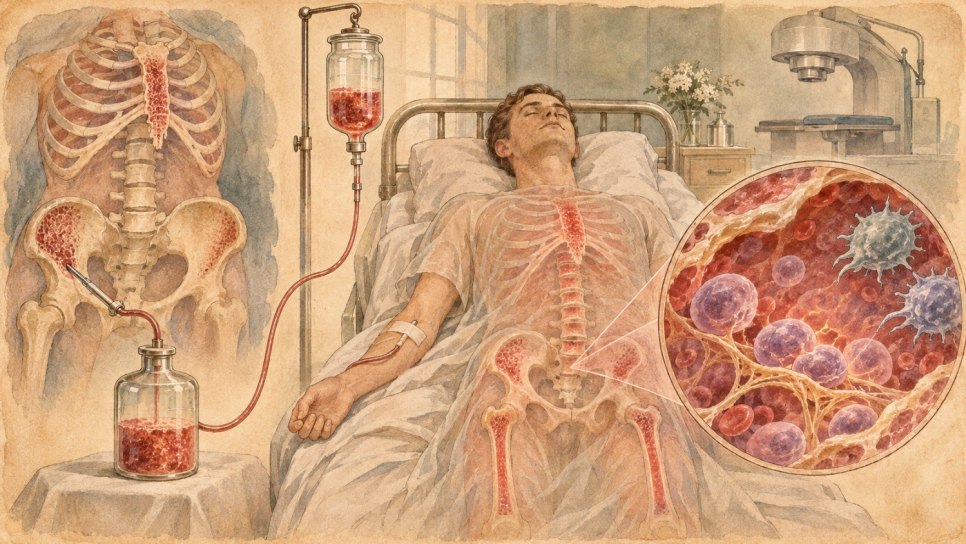
The paper was published on 12 September 1957, in volume 257, pages 491-496, titled "Intravenous infusion of bone marrow in patients receiving radiation and chemotherapy". Among the authors I could confirm Thomas, Lochte and Lu; the work was supported by the Atomic Energy Commission and the U.S. Public Health Service (Fred Hutch page). I did not read the original text. According to the accounts, from the autumn of 1955 the team gave patients donor marrow; they collected it from fetal and adult cadavers, from ribs removed at surgery, and by needle aspiration from the hip bone.
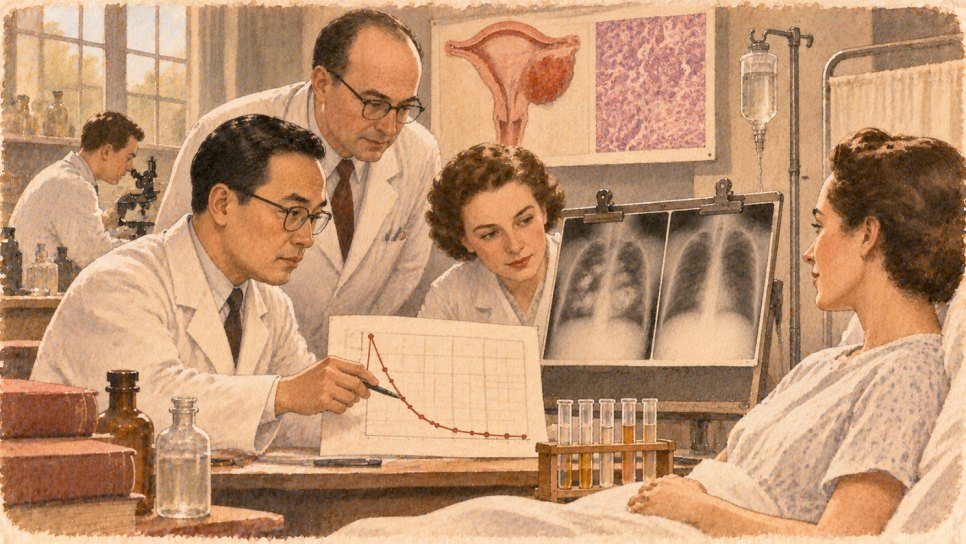
The National Academy of Sciences memoir writes that the first paper reported marrow grafts in six patients without donor matching and found only one transient graft. In his Nobel lecture Thomas says that this single transient graft "hardly constituted true marrow transplantation" (conceptual summary). The team showed that large amounts of human marrow could be given safely through a vein; no blood clotting was seen. At the same time, in the conceptual summary of his own words, it saw that allogeneic grafting in humans would be very difficult. According to the Fred Hutch page, not enough radiation had been given to destroy the diseased marrow, and the paper discussed the possibility that the graft could cause disease against the host. This is not presented as a success story; it should be read as a report that measured a limit.
What came after was a separate road. The team turned to the dog model, in which they could work with outbred dogs and littermates; the same page says it took about eight more years for this model to show the importance of tissue compatibility. According to the Nobel lecture, tissue-typed dog littermates, as reported in 1971, were almost always successful, and methotrexate was used to reduce graft-versus-host disease.
Three kinds of transplant, one obstacle
Bone marrow transplantation means taking blood-forming cells from another person (allogeneic), from an identical twin (syngeneic; "isologous" in the title of the 1959 paper) or from the person himself (autologous) and giving them back (simplified definition). Allogeneic transplantation has a two-way problem: the host may see the donor cells as foreign and reject them; the donor cells may see the host as foreign and attack it, which is called graft-versus-host disease. The second problem is the reverse of yesterday's story: there immunity was a guard that removed the foreign; here the immune cells are the very thing being transplanted.
In an identical twin these two problems do not exist, because the tissue makeup is the same. For that reason twin transplants were both proof and limit: they showed that marrow could settle again, but they offered no solution that could be applied to a general patient.
Cost and limit: zero survivors, a returning disease and the chance of a match
The first cost is the results themselves. In the first paper only one of six patients had a transient graft. According to the memoir, allogeneic transplants were tried in 154 patients between 1958 and 1962 and no long-term survivor emerged; most investigators left the field. The number 154 comes from a single source (the memoir); I could not verify it. These patients were mostly people facing a life-threatening disease; the sources do not describe the consent obtained at the time, so I say nothing about consent.
Second, even in twin transplants the disease returned. According to the Nobel lecture and the memoir, the first two patients reported in 1959 were two children with advanced acute lymphoblastic leukemia whose twins were the donors; after irradiation twin marrow was given and marrow function recovered, but the leukemia relapsed within a few months. With the irradiation regimen of that time, the transplant did not cure the disease on its own. The memoir also mentions a twin transplant in 1960 for a seven-year-old with aplastic anemia as probably the first cure by marrow transplantation; single source.
Third, in the same years, in France, Georges Mathé is reported to have given marrow to Yugoslav researchers accidentally irradiated (Rev Fr Etud Clin Biol 1959;4:226-238; citation only). According to the Nobel lecture a later review suggested this brought little benefit; the same lecture also notes that Mathé obtained a durable allogeneic graft in a leukemia patient, who developed chronic graft-versus-host disease and lost his life to infectious complications (dated only by a 1964 source).
Fourth, matching and inequality. According to the Nobel lecture, Good and colleagues performed the first matched sibling transplant in November 1968 in an infant with an immune deficiency, and Thomas's team in March 1969 in a patient with advanced leukemia; Britannica gives 1968 as the first relative transplant, which conflicts. As general knowledge, the chance that a sibling is a full tissue match is roughly one in four (simplified); this means patients without a matched donor may be the majority (my inference). Donor systems, which we will meet in later articles, gain importance for this reason.
Finally the word "first": Britannica places the first successful transplant between twins in 1956, but the report of the twin transplants is dated 1959; a record introducing Mathé calls his the first transplant with an unrelated donor; the Nobel lecture puts the matched sibling transplants in other years. These are different claims, not interchangeable; I do not say "first".
What remains
- The demonstration that large amounts of human marrow could be given safely through a vein
- The dog model and the idea that tissue compatibility is a must
- Graft-versus-host disease recognized as a kind of limit
What falls or is limited
- The assumption that "giving the marrow is enough"
- Treating the first, insufficient irradiation scheme as adequate
- The thought that allogeneic transplants with unmatched donors held promise in the late 1950s
The path of a transplant idea: 1949 to 1990. The axis runs from 1945 to 1995. Green markers are publications whose citation was verified (1957, 1959); blue markers are dates taken from the Nobel lecture or a secondary source. Events whose year alone is known are drawn mid-year.
The first transplant in Turkey: two years, one name
One source, a 1998 article in the Marmara Medical Journal (Çetiner et al.), writes that the first bone marrow transplant in Turkey was performed in 1977 in Ankara by Prof. Dr. Korkut Özerkan of the Hacettepe School of Medicine; it does not state the type of transplant. A student project (Bilkent, 2021) says 1978 according to official records. The two dates conflict and I could not verify either with an original record; for that reason I give no year and do not say "first". I also did not use the other details of the student project.
From 1949 to today
What was verified, what conflicts
- The 1957 paper: NEJM 257:491-496; the date of 12 September 1957 is from the Fred Hutch page. Of the authors, Thomas, Lochte and Lu are listed in one record; one page mentions four authors, and I did not verify the other name. I could not reach the PubMed page; I did not read the text.
- Number of patients: the memoir and Fred Hutch say six; one record describes "six patients with cancer or leukemia and one with myeloma, three lost their lives, two responded". I did not reconcile them; I wrote six.
- One transient graft: from the memoir and the Nobel lecture.
- Twin transplants: the title and authors of the JCI paper (Thomas, Lochte, Cannon, Sahler, Ferrebee; 1959; doi:10.1172/JCI103949; pages 1709-1716 inferred from the scanned-page links; volume not verified; text not read). The detail "two children, advanced ALL, leukemia relapsed within months" is from the Nobel lecture and the memoir. Britannica places the first successful twin transplant in 1956; the memoir gives a 1957-1959 range. Not resolved.
- Mathé 1959: the citation is from a bibliographic record (Mathé, Jammet, Pendic et al.); I saw that the record does not name Vinca, so I did not write the name. Text not read.
- 154 patients: a single source (the memoir; I did not see its author on the page). "Most investigators left the field" is from the same source.
- 1960 twin with aplastic anemia: a single source (the memoir); no name was given.
- Matched sibling: the Nobel lecture separates Good's November 1968 infant transplant from Thomas's March 1969 leukemia transplant; Britannica says "in 1968, a leukemia patient with a related donor". They conflict; I followed the Nobel lecture.
- Cooperstown and Columbia: Britannica writes that Thomas was at Columbia University in 1955-1963; other sources name the Bassett Hospital. I did not examine the link.
- Ford et al.: in the Nobel lecture the text says 1955 and the reference list says 1956; for that reason I left it out.
- The "one in four" match probability: general knowledge; no source read for this article.
- Turkey: 1977 (Marmara Med J 1998; Çetiner et al., citing a 1997 report by Akoğlu and Budak-Alpdoğan) versus 1978 (student project); neither verified with an original record.
- Wikipedia: a hint only; not placed in the source list. Radiation doses were deliberately not given. Access to some sites (PubMed) was restricted.
How does a cell caught by a virus warn its neighbor?
Today we saw that the cells of immunity are the very thing being transplanted. So how, in that same 1957, was a small substance found that a cell meeting a virus releases to protect other cells, and why did it become a story that reached cancer? Interferon, Isaacs and Lindenmann: I will tell it by verifying the names, the year and the "first" claims.
Author's note: The easy way through this article was to say "Thomas started bone marrow transplantation and won the Nobel". The sources I have say the first paper was a limit and not a success, that the next five years went without success, that even in twin transplants the disease came back, and that the "first" claims differ from one another. The sources part ways on the number of patients and on the date of the twin transplant; I could not read the original texts. I did not reduce these to one clean story.
Sources and Further Reading
- Thomas ED, Lochte HL Jr, Lu WC et al. Intravenous infusion of bone marrow in patients receiving radiation and chemotherapy. N Engl J Med 1957;257:491-496 (citation only; historyofmedicine.com record; text not read).
- Thomas ED, Lochte HL Jr, Cannon JH, Sahler OD, Ferrebee JW. Supralethal whole body irradiation and isologous marrow transplantation in man. J Clin Invest 1959 (doi:10.1172/JCI103949; title and authors only; text not read).
- Thomas ED. Nobel lecture (1990), Nobel Foundation (nobelprize.org; read; summarizing).
- Fred Hutchinson Cancer Center. A pioneering paper turns 50 (2007; fredhutch.org; read; secondary).
- National Academy of Sciences. Biographical memoir of E. Donnall Thomas (nasonline.org; read; I did not see the author on the page; secondary).
- Mathé G, Jammet H, Pendic B et al. Transfusions et greffes de moelle osseuse homologue chez des humains irradiés à haute dose accidentellement. Rev Fr Etud Clin Biol 1959;4:226-238 (citation only; historyofmedicine.com record; not read).
- Britannica. E. Donnall Thomas (britannica.com; read; secondary).
- Çetiner M, Ratip S, Ovalı E, Kartı S, Bayık M, Akoğlu T. Bone marrow transplantation data for Marmara University School of Medicine: 1989-1998. Marmara Med J 1998;4 (only the introductory sentence was read).
- Mukherjee S. The Emperor of All Maladies: A Biography of Cancer. New York: Scribner, 2010. (For general context; the relevant section was not read for this article in this session.)
This article is Day 134 of the "365 Days of Cancer History" series and tells, as a historical event, the beginning of the bone marrow transplant attempts in the 1950s. It is historical-popular content; it is not a diagnosis or treatment recommendation; no irradiation or drug doses are given. Consult your physician for decisions about your health. Sources have been verified; details that rest on a secondary source or could not be read are marked in the fact-check notes.
Was this article helpful?
Your feedback helps us improve our content.