
The Future of Oncology Investment: A Biotechnology Revolution in Cancer Diagnosis and Treatment

In this article
One in two people will develop cancer during their lifetime. Yet oncology is on the brink of a revolution expected to stimulate investment. This article summarizes developments and investment in oncology through the lens of biotechnology.
The Importance of Cancer
- Cancer is the second leading cause of death.
- By 2050, cancer's annual global cost is projected to reach 25.2 trillion dollars.
- We are experiencing substantial progress in diagnosis and treatment, with expanding opportunities for publicly listed oncology companies. Nevertheless, oncology remains a highly complex sector requiring deep expertise and knowledge to navigate effectively.
- Biotechnology valuations have recently fallen substantially. Large pharmaceutical companies have historically paid high merger and acquisition premiums to renew expiring patents and maintain innovative product portfolios. This strategy has enabled them to keep their innovative products and services up to date.
- The financial resources currently available to large pharmaceutical companies, their so-called "dry powder," equal about 75% of biotechnology companies' combined market capitalization. This indicates considerable capacity for investment in the sector.
- Oncology is considered one of biotechnology's leading segments by measures including growth, innovation and prevalence.
What Is Oncology, and Why Is the Burden So Large?
Oncology is the medical study of cancer. Cancer is not a single disease but a broad group affecting different organs or tissues, characterized by changes that cause cells to divide uncontrollably. Because these are the body's own cells, they can often evade immune responses. Rapid mutation means existing treatments, particularly in advanced disease, may work only for a limited time before resistance develops and the disease progresses. Most cancer deaths (90%) are associated with metastasis, the spread of cancer cells to other parts of the body, increasing disease severity.
One in two people will develop cancer at some point in life. This group of diseases is the second leading cause of death after cardiovascular disease and is projected to cost society more than 25 trillion dollars globally from 2020 to 2050.
Oncology aims to treat cancer by understanding its underlying biology in detail, both in vitro (in test tubes) and in vivo (in living organisms). Its ultimate goal is to improve diagnosis, develop prevention strategies and enhance cancer care through therapeutic approaches. This involves finding cancers earlier and developing more effective treatments to achieve better outcomes.
What Breakthroughs Are Transforming Cancer Research?
A biological revolution is driving major progress in cancer diagnosis and treatment.
The DNA sequencing revolution is a key driver of innovation
Much of the biological revolution can be attributed to advances in genome sequencing. Beginning with the success in 2003 of the Human Genome Project, the cost of sequencing a human genome has steadily fallen. Moore's law predicts that doubling transistor counts every two years halves computing costs, but genome sequencing costs have improved much faster.
Today, a human genome can be sequenced for just 600 dollars, a relatively low cost for its invaluable contribution to scientific understanding. This dramatic cost reduction in recent years increases the broad applicability of genetic research and personalized medicine. Affordable sequencing contributes greatly to understanding disease and developing treatments.

RELATED TOPICS:
CAR T-cell therapy and gene editing
Improved scientific understanding has enabled us to use biological processes and mechanisms to our advantage. A patient's T cells, the immune system's hunter cells, can be removed, genetically engineered to identify cancer cells and returned to the patient. This important innovation offers new ways to strengthen the immune system's fight against cancer.
Developed by companies such as Novartis and Kite Pharmaceuticals, acquired by Gilead Sciences, these approaches are called chimeric antigen receptor (CAR) T-cell therapies. They use a patient's own T cells, genetically engineered to target and fight cancer. CAR T-cell therapies have achieved major successes in blood cancers such as lymphoma and leukemia and already have approvals in this area. Other cellular approaches (such as TIL therapy) are also advancing rapidly.

CRISPR gene editing enables highly precise changes to cellular DNA, opening the door to the next generation of cell therapy. It makes two important developments possible:
- Engineered Allogeneic T Cells: This approach removes the need to extract and modify each patient's own T cells. Allogeneic cells can be genetically engineered in advance and available "off the shelf," allowing faster, more practical treatment, a particular advantage when care is urgently needed.
- Cell Therapy for Solid Tumors: CRISPR and similar technologies support efforts to develop cell therapies for solid tumors arising in organs or tissues. These cancers are more common than blood cancers, so effective treatments would represent a major advance in the fight against cancer
RELATED TOPICS:
The Living Cancer Medicine, CAR T-Cell Therapy, Turns 10: The Lives It Has Changed Will Amaze You
The First CRISPR Treatment Approved in the UK for Sickle Cell Disease and Thalassemia
Liquid biopsies
Early cancer diagnosis can save lives. After years of work by companies such as GRAIL and Guardant Health, a noninvasive blood test can now diagnose cancer. This innovative approach, called "liquid biopsy", is a highly sensitive diagnostic method that detects cancer-derived genetic material in the bloodstream.
One striking feature is the ability to detect multiple cancers in seemingly healthy people and even identify their origin. Earlier detection allows more successful treatment. Early intervention, particularly for metastatic or rapidly progressing cancers, can substantially reduce mortality.
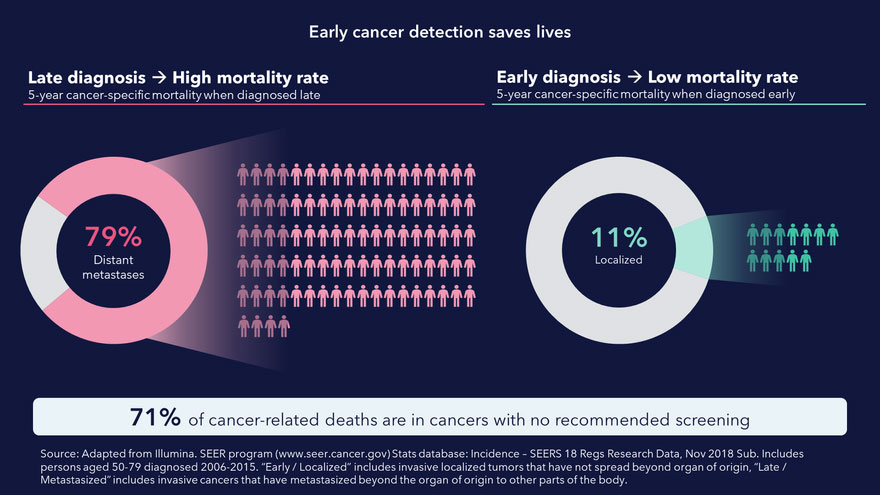
Advanced liquid biopsies may play an important role in selecting cancer treatment and monitoring patients after remission. By detecting cancer-cell genetic material in the blood, they offer valuable information on which treatments may work better. Their findings can also inform the design and development of clinical trials.
Immuno-oncology and immunotherapy
The past decade has seen the emergence of successfully commercialized antibody-based therapies representing an important advance in immunology, focused on immune checkpoints. Immune checkpoints are brakes that prevent our immune system from overreacting. Cancer cells, with high mutation rates, can influence these checkpoints and evade immune defenses.
Using checkpoint inhibitors such as PD-1 antibodies, oncologists can remove the "cloak" allowing cancer cells to hide from the immune system. This form of immunotherapy has substantially improved survival in certain cancers, particularly melanoma. For some patients and cancer types, survival curves do not reach zero, meaning the disease is fully controlled and potentially cured.
Immunotherapies, particularly medicines such as Keytruda (pembrolizumab), are now routinely used as first-line cancer treatments. Keytruda is the world's highest-revenue medicine and is expected to generate 24 billion dollars in worldwide sales in 2023. This represents an important advance in cancer treatment.

Despite this progress, only about 20% of patients respond to immunotherapy, creating an important opportunity for new immuno-oncology approaches. A method developed by Immunocore, for example, enables T cells to target particular proteins inside cancer cells. This opens a new frontier by enabling engineered T cells that may be effective against solid tumors.
Targeted oncology and precision medicine
Our understanding and treatment of cancer have evolved, enabling more detailed classification of patient groups and almost personalized, targeted therapies. These usually target mutations driving tumor development and thereby offer greater effectiveness and/or safety. Antibody technology has also enabled more precise, effective drug delivery to cancer tissue. For example, Enhertu has almost doubled progression-free survival in a particular breast cancer category.
Related topic: Precision Oncology and Personalized Treatment: A Comprehensive Look at the Medicine of the Future
These technologies are substantially improving survival and quality of life while also increasing healthcare industry revenues. They are changing the cancer treatment paradigm and offer hope through more effective, personalized options.

A Productivity Surge in Oncology Research and Development
These innovations form a major part of increased productivity in drug research and development (R&D). The number of new molecular entities approved by the US Food and Drug Administration (FDA) in 2022, for example, doubled compared with 2010. Oncology's share of these approvals continues to grow.

The graph above shows oncology accounting for the highest percentage of drug approvals compared with other therapeutic areas. In 2021, oncology also had a higher approval percentage than in the preceding decade (2010-2020), potentially reflecting increased research interest and investment. Other areas had lower or approximately unchanged approval percentages in 2021 compared with that decade.
The Present and Future of Oncology Investment
Several important long-term factors influence oncology's development, each helping shape the future of cancer research and treatment.
Why Oncology?
- Population Aging: United Nations (UN) data project that the population aged 60 and older will increase 2.5-fold to about 2.5 billion by 2050. An aging population means greater cancer risk, as older people are more likely than younger people to develop cancer. This may increase the number of cases.

- Obesity and Lifestyle Factors: Obesity and other lifestyle factors are important cancer risk factors. Their increasing prevalence may drive a long-term rise in cancer cases.
- Environmental Factors: Environmental factors such as industrial pollution also contribute to rising cancer incidence. According to the European Environment Agency (EEA), pollution is responsible for about 10% of European cancer cases.
Together, these factors are helping the oncology market grow. IQVIA projects that the global oncology market will reach 375 billion dollars by 2027 in value.

Exploring Oncology Investment Opportunities
An explosion of innovation and healthy capital markets over the past decade has greatly increased the number of oncology companies, particularly evident in initial public offerings (IPOs) by new firms. Analyses show that oncology IPO rates rose markedly over the past 10 years, illustrating the rapid growth of investment, innovation and the company population.

This probably means greater investment opportunities.
Is Oncology More Attractive Than Other Biotechnology Areas?
Nasdaq experts offer an interesting answer. Nasdaq is the world's second-largest stock exchange and its first electronic exchange, particularly known for technology companies. It is an important trading and investment center for technology, biotechnology, retail, industrial and many other businesses. It provides financial services including IPOs, stock trading and financial data sharing.
To understand why oncology is considered a leading segment of biotechnology, analysis of indices such as the Nasdaq Biotechnology Index (NBI) and S&P Biotechnology Select Industry Index (SPSIBI) may help:
- Innovative, Fast-Growing Companies: Oncology offers potential exposure to innovative, fast-growing companies at the forefront of new treatments and technologies. This innovation provides attractive growth potential for investors.
- NBI's Dominance by Established Leaders: NBI is dominated by slower-growing, established leading companies, potentially offering less growth than dynamic, innovative oncology businesses.
- SPSIBI's Risk of Exposure to Speculative Companies: SPSIBI may expose investors to speculative, cash-burning companies, potentially increasing risk.
- No Exposure to Nontherapeutic Areas: Oncology indices benefit from exposure to nontherapeutic fields such as diagnostics, while broad biotechnology indices may focus less on these areas.
- Overlooking Quality Factors: Biotechnology indices may overlook factors such as scientific success and management track records, potentially exposing investors to lower-quality companies.
- Policy Tailwinds: The Biden–Harris administration's goal of halving cancer mortality by 2050 creates a positive policy tailwind for oncology, potentially making investment in these companies more attractive.

These two pie charts show how the Tema CANC ETF (exchange-traded fund) portfolio is balanced across oncology technologies and company profiles. The left chart presents technology allocations in colored segments, demonstrating broad exposure across oncology. The right chart shows company profiles: "Establishment," "Growth" and "Emerging Biopharma." This distribution balances risk by company maturity, investing both in solid companies at the establishment stage and in emerging biotechnology firms with high potential.
Why Consider Oncology Investment in the Current Environment?
Nasdaq experts believe biotechnology currently offers exceptional value.
Over the past two years, biotechnology has experienced its worst downturn in decades.
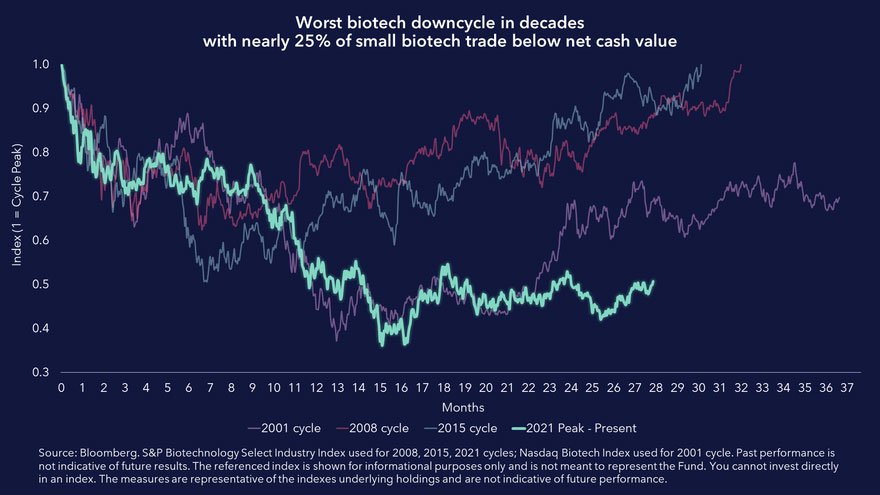
The graph compares biotechnology downturns across economic cycles. Its horizontal axis shows months (0-37) and its vertical axis index values (0.3 to 1.0). Cycles beginning in 2001, 2008, 2015 and 2021 appear in different colors, showing how index values changed over time. The 2001 (blue), 2008 (green) and 2015 (purple) cycles eventually reached an index value of 1 (the peak), whereas the 2021 cycle (red) declined continuously to around 0.5. This indicates that the biotechnology market in 2021 experienced its worst period in decades and that nearly 25% of small biotech companies' trading values were below cash value.
The analysis suggests nearly 25% of small biotech firms trade below the net cash on their balance sheets, meaning negative enterprise values. Although some need cash to complete R&D programs, this is a striking indication of how far valuations have fallen.
Large Pharmaceutical Companies Must Replace Revenue Streams and Have the Resources to Do So
The challenges large pharmaceutical companies face over the next five years, and their strategies for meeting them, are important. About 350 billion dollars in revenue exposed to patent expirations presents a major challenge. Their strategic options include:
- Acquiring Innovative Biotechnology Firms: Large pharmaceutical companies may acquire smaller innovative biotechs to fill revenue gaps left by expiring patents, expanding their portfolios with new products.
- Available "Dry Powder": Large pharmaceutical companies have substantial capital, or "dry powder," available for acquisitions. These resources total 838 billion dollars, representing 74% of the S&P biotechnology index's combined market value and indicating capacity for major purchases.
- A Focus on Oncology: Oncology stands out as a main focus for future pipelines, reflecting its strong potential and continual need for innovative treatments.
- Recent Deals: Deals such as Pfizer's acquisition of Seagen illustrate large pharmaceutical companies' interest in oncology. These transactions often carry high premiums, averaging 98% according to the analysis.
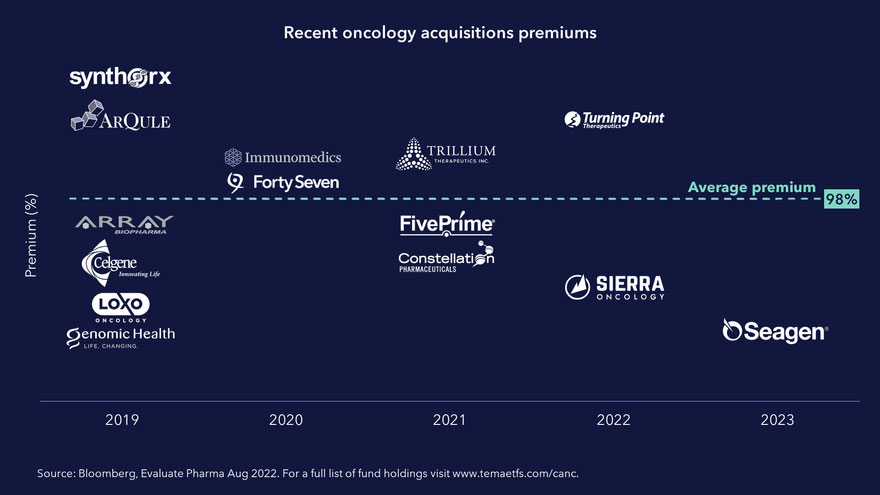
The graph shows premiums paid in oncology acquisitions from 2019 to 2023. Companies are positioned by acquisition year, with the premium above market value marked over each. Some were acquired at large premiums, others at relatively lower ones. A dashed line at the top shows an average premium of 98%, indicating that acquired companies were purchased with a premium averaging almost twice their market value.
What Are the Risks of Investing in Oncology?
Risks in oncology and biotechnology investment arise from the sectors' complex, dynamic nature. Managing them is critical to investment success. The risks and management strategies include:
- Product Risk:
-
- Scientific Risk: A biological hypothesis may fail. Careful analysis of scientific data and hypotheses can reduce this risk.
- Clinical Risk: A product may not work as expected in humans. Detailed expert analysis of clinical data can minimize this risk.
- Commercial Risk: A product may generate insufficient revenue. Accurate modeling of market size and potential using third-party commercial data can reduce this risk.
- Financing Risk:
-
- Biotechs may need additional funding to complete R&D programs. Rigorous balance-sheet analysis and limited position sizing can help manage this risk.
- Regulatory Risk:
-
- This ever-present healthcare risk is particularly relevant with new policies and regulations. Changes such as US Medicare pricing rules or reimbursement rules in Türkiye may be manageable industry risks. Cancer medicines' position among protected therapeutic categories because of substantial unmet medical need may mitigate the adverse effects of such regulation.
Conclusion
The oncology revolution is accelerating as companies' opportunities expand. Identifying those positioned to benefit and managing risk rigorously, however, requires expertise.
Sources
Was this article helpful?
Your feedback helps us improve our content.




Reader comments
Share your comment
Your name and comment are published only after administrator approval. Your email address is never shown to visitors.
Be the first to comment.