What Does a Tiny Chromosome Tell Us? Nowell, Hungerford and the Philadelphia Chromosome (1960)
In this article
What Does a Tiny Chromosome Tell Us? Nowell, Hungerford and the Philadelphia Chromosome (1960)
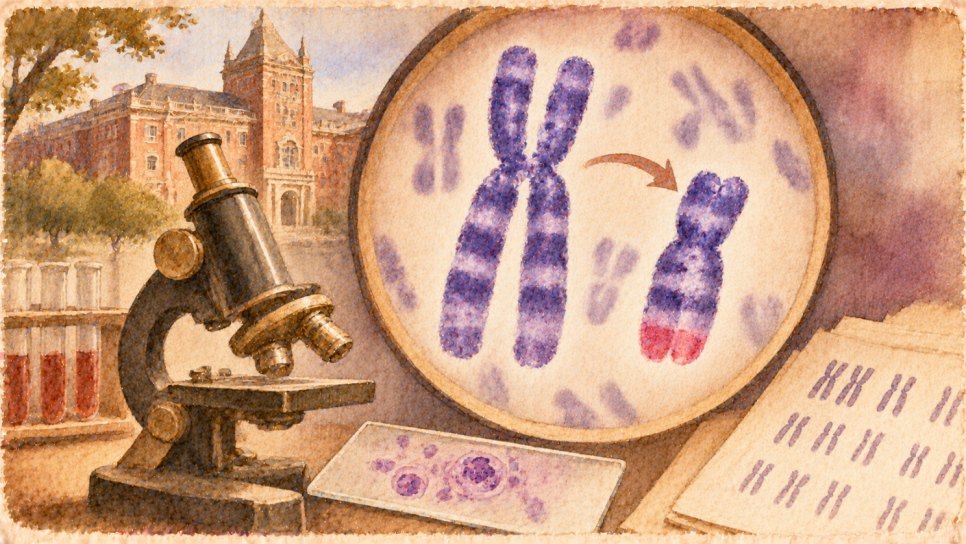
Yesterday we looked at the map of a disease (Day 136); today we look at a single chromosome under the microscope. On Day 98 we described Boveri's 1914 hypothesis: cancer might arise from one cell whose chromosomes had gone wrong, but there was no evidence. Boveri never worked with a tumour. Almost half a century later, two researchers in Philadelphia saw the same small chromosome again and again in the blood cells of leukaemia patients. Years afterwards, Peter Nowell would write in his own account that the finding supported Boveri's idea. But on that day it was not proof of a cause, and its first interpretation was wrong.
The number forty-six, and a microscope
Counting chromosomes was harder than it looks today. In their laboratory in Lund, Joe Hin Tjio and Albert Levan examined 261 chromosome spreads from 22 cultures of fetal lung and wrote that they were surprised to find 46 predominating (conceptual summary); the paper was submitted to Hereditas on 26 January 1956 and appeared in the April 1956 issue (from an antiquarian bookseller's listing; I did not read the original paper). Ford and Hamerton confirmed 46 in human testis cells the same year. The sources say that 48 had been accepted for many years before. Yet a reliable method was still needed to see the chromosomes of a cancer cell.
Peter Nowell was a pathologist who had joined the faculty at the University of Pennsylvania in 1956. By his own account, he grew blood cells in short-term culture and rinsed the slides in tap water before staining; the rinse acted, without his intending it, like a hypotonic treatment and made the chromosomes countable. He was directed to David Hungerford, a graduate student at Fox Chase working on human chromosomes. Paul Moorhead of the Wistar Institute helped them adopt the air-drying method. Fox Chase writes that in 1959 Hungerford found a "tiny abnormality" in the cultured blood cells of two patients with chronic myeloid leukaemia (CML); Nowell gives no year.
"Chromosome studies on normal and leukemic human leukocytes"
The paper is in volume 25, pages 85-109 (Department of Pathology, University of Pennsylvania, and the Institute for Cancer Research, Philadelphia). I read the full text. Four patients with granulocytic leukaemia (three men, one woman) and three healthy people were studied; two of the patients had CML and two had acute leukaemia. Cells were separated with phytohaemagglutinin and cultured for 2 to 4 days, colchicine was added at the start of division, and slides were squashed in acetic orcein; at least 30 metaphases were counted in each case.
In the two CML patients, both men, a chromosome "smaller than half the smallest autosome" was found in place of the normal Y: in all three cells analysed in the third case, and in four of five in the fourth. The authors thought this arose either from loss of part of the Y or from its exchange with a piece of an autosome, said "probably" a Y abnormality, and acknowledged that they could not prove it and that broader studies were needed. In the text, "Philadelphia" appears only as the name of a city. So the first interpretation was a Y-chromosome interpretation, not the one we know today.
Somatic chromosome change
A chromosome change found only in a patient's tumour cells, absent from their normal cells and not inherited (a simplified definition). According to Koretzky's JCI introductory piece, the Philadelphia chromosome was not present in normal white blood cells. If the same finding is seen consistently in a tumour, it can support the idea that the tumour arose from a single altered cell (Boveri's hypothesis); but by itself it does not say whether the change is a cause or a consequence.
A name and a second group
The same year, a short report titled "A minute chromosome in human chronic granulocytic leukemia" appeared in Science, volume 132, page 1497. By Nowell's own account it was an abstract and gave no patient details; how many patients it covered is disputed among the sources (see the fact-check notes). The series in which all seven CML patients carried the small chromosome was, according to Nowell, published in 1961 in the Journal of the National Cancer Institute.
In quick succession another group saw the same chromosome. The report by Baikie, Court Brown and colleagues in Nature is dated 31 December 1960 (Nature 188:1165-1166). The paper by Tough and colleagues appeared in the Lancet on 25 February 1961; according to Nowell, it followed a proposal that abnormal chromosomes be named after the city where they were found and called this one the "Philadelphia chromosome". Radich, however, writes that the Edinburgh group proposed the name. I make no priority claim here: from the sources I have, the July 1960 paper by Nowell and Hungerford is the first published finding (my inference; I have not surveyed everything), and the Edinburgh group is an independent confirmation.
Naming the chromosome after the city was less a claim of ownership than a standardisation decision. From then on the chromosome was written "Ph1".
Not in every patient, not an explanation of everything, and a drug is not enough on its own
The first limit: the chromosome is not present in every CML patient. Fox Chase and Genetics Unzipped say it is found in 95 percent of patients, which means that roughly one in twenty lacks it (secondary sources). In April 1962, P. H. Fitzgerald of Dunedin reported two CML patients in Nature: in a 49-year-old untreated woman, Ph1 was present in 16 of 27 cells examined; in a 49-year-old man with a history of repeated diagnostic X-rays and Myleran, it was present in none of 55 cells examined. The author wrote that this resembled the three cases reported by Tough and colleagues and raised the question of whether Ph1 was a primary cause or a secondary consequence.
The second limit is causality. According to Nowell, toward the end of the 1960s most researchers thought chromosome changes in tumours were probably a consequence, not a cause, because no other consistent abnormality had been tied to a tumour type. For the Philadelphia chromosome, causality was settled by later steps: in 1973 Rowley's demonstration of a reciprocal translocation between chromosomes 9 and 22 (Nature 243:290-293), in the 1980s the BCR-ABL fusion, and the 1990 mouse model of Daley, Van Etten and Baltimore (according to Radich). Rowley's story is in Day 155 of the series.
The third limit concerns the drug. Imatinib, approved in 2001, targets the BCR-ABL kinase (secondary sources); Fox Chase writes that a second-generation inhibitor was designed when resistance developed. In the five-year follow-up published in the New England Journal of Medicine in 2006, 553 patients had been randomised to imatinib and 553 to interferon alfa plus cytarabine; in the imatinib arm, overall survival at 60 months was 89 percent, that is, 11 percent were not alive at that point, and the estimated progression to accelerated phase or blast crisis was 7 percent (abstract). These figures show a picture 46 years after the chromosome was found; what imatinib gained over earlier treatments cannot be read from this abstract. The cost of the drug and access to it are not in this article's sources.
What remains
- That a consistent somatic chromosome change can be found in a cancer
- That the Philadelphia chromosome is decisive for diagnosing and monitoring CML
- That this change (BCR-ABL) later became the target of a drug
What fell or was limited
- The first reading that the small chromosome was a Y abnormality
- The assumption that chromosome changes in tumours are always a consequence
- The expectation that every CML patient carries the chromosome
The path of the Philadelphia chromosome: 1956 to 2006. The axis runs from 1950 to 2010. Green marks are publications whose citation details are verified (1960 JNCI, Nature 1960, Lancet 1961, Rowley 1973, NEJM 2006); blue marks are dates taken from secondary sources; the amber mark is the Science abstract, whose content is disputed among the sources. Events known only by year are drawn at mid-year.
I have not drawn a local link in this article
I found no verified information on the first use of the Philadelphia chromosome or imatinib in Turkey, and I did not invent any. As a general inference (my inference), this finding explains why examining cells at the chromosome and gene level is now standard in diagnosing a blood disease; but the sources for this article do not date that for Turkey.
From 1956 to today
What was verified, what conflicts
- Content of the 1960 Science abstract: Nowell (JCI 2007) says it was an abstract giving no patient details, that the first observation was in two CML patients, and that the series of seven was published in JNCI in 1961. Radich (Haematologica 2022) writes that the Science paper described seven CML cases and that the 1960 JNCI paper covered two of those seven. Genetics Unzipped describes the Science paper as an article of about 300 words comparing four CML patients with three healthy people. These three accounts do not agree; I followed Nowell's own account. I did not read the Science paper itself; the citation (132:1497) comes from citations by Koretzky, Radich and Fitzgerald.
- The phrase "causal relationship": I did not use the wording that Genetics Unzipped attributes to the Science paper, because I could not verify it in the original text.
- JNCI 1960: 25(1):85-109, July 1960; full text read (from a PDF copy; although the file name suggests the Science paper, its content is the JNCI paper). Nowell's JCI account does not mention the 1960 JNCI paper, only the 1961 JNCI paper.
- Y interpretation and chromosome 22: The 1960 JNCI text says "probably" a Y abnormality; Radich also reports it as an "altered Y"; Fox Chase and Nowell describe the chromosome as a deleted chromosome 22. Fox Chase writes that banding techniques showed an exchange between 22 and 9 in 1970; Rowley's Nature paper is 1973. I could not resolve the difference.
- Naming: Nowell writes that the Tough et al. 1961 Lancet paper gave the name, based on a proposal by a chromosome standardisation committee; Radich attributes the name to the Edinburgh group; Koretzky and Fox Chase do not say who gave it; Genetics Unzipped says it comes from the city name. I did not independently verify the committee proposal. The paper by Tough et al. (Lancet 1961;1(7174):411-417) and the Nature report by Baikie et al. were seen only in another paper's reference list; they were not read.
- Years: Fox Chase places the first observation in 1959; Nowell gives no year for the first observation.
- Tjio and Levan: the dates and the 261 spreads and 22 cultures come from an antiquarian bookseller's page; I did not read the original paper. I could not find the citation for Ford and Hamerton.
- 95 percent: from Fox Chase and Genetics Unzipped; secondary. The volume number of the Fitzgerald paper was garbled in the scanned text; volume 194, page 393 was inferred from the link address.
- Imatinib: the 2001 approval and the first trial of 31 patients in 1998 come only from Genetics Unzipped; I did not use that source's "98 percent remission at five years" because it does not agree with the 89 percent overall survival in the randomised study of 553 patients by Druker et al. The NEJM 2006;355(23):2408-2417 figures are from the abstract only; the abstract does not give overall survival for the comparison arm (interferon plus cytarabine).
- Turkey: no verified link was found.
Why does the dust of a mine become the address of a cancer?
Today we followed a chromosome; tomorrow, a fibre in the ground of a region. A mining district in South Africa, 1960: a fibre and a rare cancer. I will tell the story of the asbestos and mesothelioma study by Wagner and colleagues; I will verify the names, the year and the "first" claims tomorrow.
Author's note: The easy way to write this article was "two researchers found the chromosome that shows the cause of cancer". The first paper by Nowell and Hungerford tied the chromosome to the wrong place and reported a finding, not a cause; its name and its true identity were settled in other hands. I did not read the Science abstract itself or the 1961 series; I relied on Nowell's own account, the full text of the 1960 JNCI paper and secondary sources. I did not flatten the conflicts about the number of patients and the origin of the name into one smooth story.
Sources and Further Reading
- Nowell PC, Hungerford DA. Chromosome studies on normal and leukemic human leukocytes. J Natl Cancer Inst 1960;25(1):85-109 (full text read).
- Nowell PC, Hungerford DA. A minute chromosome in human chronic granulocytic leukemia. Science 1960;132:1497 (citation from other papers' reference lists; text not read).
- Baikie AG, Court Brown WM, Buckton KE, Harnden DG, Jacobs PA, Tough IM. A possible specific chromosome abnormality in human chronic myeloid leukaemia. Nature 1960;188:1165-1166 (from a reference list; not read).
- Tough IM, Court Brown WM, Baikie AG, et al. Cytogenetic studies in chronic myeloid leukaemia and acute leukaemia associated with mongolism. Lancet 1961;1(7174):411-417 (from a reference list; not read).
- Fitzgerald PH. Chromosomes of two cases of human chronic myeloid leukaemia. Nature 1962;194:393 (scanned text read; volume number inferred from the link address).
- Koretzky GA. The legacy of the Philadelphia chromosome. J Clin Invest 2007;117(8):2030-2032 (introductory piece; PMC page read).
- Nowell PC. Discovery of the Philadelphia chromosome: a personal perspective. J Clin Invest 2007;117(8):2033-2035 (PMC page read).
- Rowley JD. Letter: A new consistent chromosomal abnormality in chronic myelogenous leukaemia identified by quinacrine fluorescence and Giemsa staining. Nature 1973;243(5405):290-293 (title and citation from reference lists; not read).
- Druker BJ, Guilhot F, O'Brien SG, et al. Five-year follow-up of patients receiving imatinib for chronic myeloid leukemia. N Engl J Med 2006;355(23):2408-2417 (abstract only read).
- Tjio JH, Levan A. The chromosome number of man. Hereditas 1956;42:1-6 (title from memory; details from an antiquarian page; paper not read).
- Radich J. Haematologica 2022;107(3):566-567 (short history of the Philadelphia chromosome; read, secondary).
- Fox Chase Cancer Center. The Philadelphia Chromosome (institutional history page); Cancer History Project, David Hungerford and the Philadelphia Chromosome; Genetics Unzipped, Fusion genes and cancer cures: the story of the Philadelphia Chromosome, 7 October 2020 (read; secondary).
- Mukherjee S. The Emperor of All Maladies: A Biography of Cancer. New York: Scribner, 2010. (For general context; the relevant part was not read for this article in this session.)
This article is Day 137 of the "365 Days of Cancer History" series and tells, as a historical event, how Nowell and Hungerford recognised a small chromosome in 1959-1961. It is historical-popular content; it is not a diagnosis or treatment recommendation; no drug doses are given. Consult your physician for decisions about your health. The sources have been checked; details that rest only on secondary sources or could not be read are marked in the fact-check notes.
Was this article helpful?
Your feedback helps us improve our content.