What Does a Child's Jaw Tumour Show on a Map? Denis Burkitt and the African Lymphoma (1958)
In this article
What Does a Child's Jaw Tumour Show on a Map? Denis Burkitt and the African Lymphoma (1958)
Yesterday we followed a clue in a laboratory, on the membranes of chick embryos: a message released by cells that meet a virus and prepare their neighbours (Day 135). Today's clue is not on a bench but on a map on a wall. In Kampala a surgeon marked with pins where a tumour of children's jaws was seen and where it was never seen. The map gave no drug and no cause; it gave a question: why does this tumour appear only in a certain belt, in a certain climate? Rous's chicken sarcoma (Day 97) and Shope's rabbit papillomavirus (Day 106) had tied a virus to a tumour in animals. One of the ways to look for a similar tie in humans ran through this map (the details are in Day 140).
One surgeon, two children
Denis Burkitt was a surgeon, born on 28 February 1911 in Enniskillen, Northern Ireland, who passed away on 23 March 1993 in Gloucester (LITFL entry). He took his degree at Trinity College Dublin in 1933 and his medical qualification in 1935, and between 1948 and 1964 worked as a surgeon at Mulago Hospital in Kampala and as a lecturer at the Makerere College Medical School.
In 1957 Hugh Trowell, a physician at Mulago, asked him to see a child: a five-year-old boy with symmetrical swellings on both sides of the upper and lower jaw. Burkitt had never seen such a picture before (Coakley, 2011). According to Magrath, the biopsy said "small round cell sarcoma". Soon afterwards, at Jinja, he saw a second child with the same symmetrical jaw swellings; Magrath writes that this child had tumours in all four jaw regions and in the abdomen as well.
A limit needs to be set here: Burkitt was not the first to see this tumour. Magrath's reference list includes earlier descriptions such as Smith and Elmes (1934, Nigeria), Edington (1956, Gold Coast), De Smet (1956, Congo) and Thijs (1957, Congo), and the historyofmedicine.com record ties a detailed first description to Albert Cook, a missionary physician who never published it. In LITFL's wording, Burkitt was not the first to publish on jaw tumours but the first to recognise that they were one disease. I cite this as one source's claim; I do not say "first".
"A sarcoma involving the jaws in African children"
The paper is in volume 46, issue 197, pages 218-223 (LITFL citation); the Wellcome Collection record gives the publication date as November 1958, while historyofmedicine.com writes 1958-1959. According to Coakley, Burkitt had presented his findings earlier, in January 1958, to the East African Association of Surgeons in Kampala, and was not yet certain of the exact nature of the disease; the word "sarcoma" in the title may carry that uncertainty (my inference). Magrath writes that the paper "aroused little interest". How many children were assessed is given as 29, 38 and 41 in different sources, so I give no number (see the fact-check notes). I could not read the paper itself.
Burkitt's question was now less about the disease than about its place: were children with jaw tumours seen only at Mulago?
Geographical epidemiology
Mapping where a disease is common, rare or absent gives a clue to its cause (simplified definition). A map does not show the cause; it shows on which conditions the cause depends, that is, where to look. Burkitt's map produced a hypothesis; testing it was left to other studies.
One more distinction: what Burkitt recognised was not a "climate disease" but a single clinical picture; climate only described where the picture was seen. That the picture was a lymphoma, a cancer arising from the cells of lymphoid tissue, was settled in 1961 through O'Conor's pathological study.
A map and a car
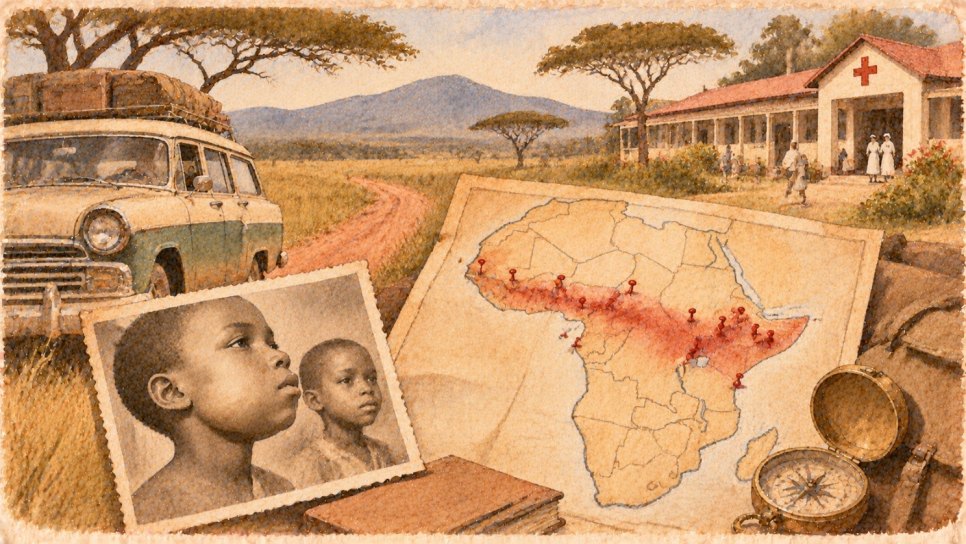
According to Coakley, Burkitt sent more than twelve hundred questionnaires to almost every government and mission hospital in Africa and, over three years, pinned the replies on a map; Magrath speaks of "about a thousand brochures". The map showed a belt: roughly 15 degrees north and south of the equator, with a tail along the east coast. Above about 5,000 feet (about 1,500 metres) the tumour was not seen.
To test the map, Burkitt set out. According to Magrath, on 7 October 1961, in a 1954 Ford station wagon, with two physicians working in Uganda, Ted Williams and Cliff Nelson, he left Kampala; they returned ten weeks later, having covered 10,000 miles and visited hospitals in eight countries. For this "tumour safari" the number of hospitals visited is 56, 57 or 63 depending on the source, and the money spent is 400 or 700 pounds sterling. The figures conflict and I could not resolve them (fact-check notes). What does not conflict is that the budget was very small.
The results pointed to climate. Burkitt first thought altitude was the limit; Haddow of Entebbe argued that the limit was temperature: according to Magrath the tumour occurred where temperatures did not fall below 60 degrees Fahrenheit and annual rainfall was at least 20 inches, and it was absent in arid regions such as Kano. Burkitt published his findings with O'Conor in Cancer in 1961 and, on 20 October 1962, in the British Medical Journal ("Determining the climatic limitations of a children's cancer common in Africa", BMJ 1962;2(5311):1019-1023).
According to Nelson's later recollection (conceptual summary; single source, Coakley), Burkitt tried to avoid having the tumour named after him.
A map is not a cause, and a drug does not reach everyone
The first warning concerns cause. The map suggested an environmental factor; what it was could not be read from the map. According to Magrath, Dalldorf was the first to put the malaria hypothesis in print, in 1964. In the North Mara region of Tanzania, between 1977 and 1982, children aged 1 to 10 were given chloroquine every two weeks; the annual incidence fell from four per 100,000 to under one per 100,000. In relative terms that is a fall of more than three quarters; in absolute terms a difference of more than three per 100,000; the authors called the result "suggestive, not definitive".
The virus link was a separate thread. In 1964 Epstein, Achong and Barr reported virus particles in cultured Burkitt lymphoma cells (Lancet 1964;1:702-703). According to the Henles' commentary, most virologists of the time regarded this virus as "an unimportant passenger". The virus later became known as the Epstein-Barr virus; the full story is in Day 140. According to Hektoen, the virus is found in almost all endemic African cases but in only a share of sporadic cases. This suggests that the virus alone does not explain the tumour (my inference); malaria, virus and climate have been discussed together. The easiest reading of the map was a carrier insect or an environmental agent (my inference); the real picture turned out more complicated.
The second warning concerns treatment and has two sides. There was no radiotherapy in Uganda. According to Magrath, Joseph Burchenal came to Uganda in 1960; a single dose of methotrexate produced dramatic regression in two children; cyclophosphamide was used afterwards as well. According to Coakley, because blood counts were hard to do, Burkitt used low doses (I give no doses). In Mulago's series of 90 patients with jaw tumours, 74 (82 per cent) responded well (Magrath): in relative terms most did, and in absolute terms 16 children (18 per cent) did not respond well. In January 1966, at a conference in Kampala, Burkitt presented twelve patients who had been cured (Coakley). "Responded well" and "cured" are not the same thing; the two figures belong to different yardsticks and cannot be combined.
What remains
- That mapping where a disease is and is not makes the search for a cause more productive
- That the jaw tumour was one clinical picture, later recognised as a lymphoma
- That low-dose combined drugs can obtain a response in a childhood cancer
What falls or is limited
- The idea that "a single climatic factor explains the tumour"
- The assumption that Burkitt was the "first to see" the tumour
- The expectation that the map proved the cause
The path of Burkitt lymphoma: from 1934 to 1964. The axis runs from 1930 to 1970. Green markers are publications whose citation was verified (the 1958 paper, Cancer 1961, BMJ 1962, Lancet 1964); blue markers are dates taken from a secondary source; the amber marker is the safari, whose figures conflict between sources. Events known only by year are drawn mid-year.
I have not built a local link in this article
I found no verified information on the history of Burkitt lymphoma in Türkiye and I did not invent any. As a general inference (my inference), the real legacy of this article is less a drug than a method: bringing the records of different hospitals together on a map and looking at where a disease is common. The same method is still used today to understand regional differences within a country; but the sources this article rests on give no history for Türkiye.
From 1934 to today
What was verified, what conflicts
- The 1958 paper: Br J Surg 1958;46(197):218-223, from the LITFL citation; the Wellcome Collection record (WTI/DPB/E/1/2) gives the publication month as November 1958; the historyofmedicine.com record writes 1958-1959. I could not reach the Wiley page; neither the paper nor its abstract was read.
- Conflict on the number of children: Magrath writes that Burkitt identified 29 more children at Mulago; Hektoen and Coakley write that 41 children were assessed and 29 had histology; Coakley also says the paper covered 38 children. I could not reconcile these and wrote no number in the text.
- The first case: a five-year-old boy, Trowell's request: Magrath, Hektoen and Coakley agree. "Small round cell sarcoma" and the abdominal involvement of the second child are in Magrath only; Hektoen describes the second child as a girl.
- The safari: Magrath writes departure on 7 October 1961, ten weeks, about 57 hospitals and eight countries in a 1954 Ford station wagon, 10,000 miles, and grants of 700 pounds. Coakley writes 63 hospitals, an eight-year-old Ford and 400 pounds, and gives no year; LITFL writes 56 hospitals. The date and figures conflict; hence the amber marker.
- Number of questionnaires: Coakley writes "more than twelve hundred questionnaires" and a 25-pound grant from the Ugandan government; Magrath writes "a thousand brochures". Hektoen writes that Burkitt travelled on a grant of two hundred and fifty pounds. These sums do not agree; they may belong to different items, but I could not work out which is which.
- Belt and climate: 15 degrees, the east-coast tail and the 5,000-foot limit from Coakley; 60 F, 20 inches, Kano and Haddow's view from Magrath. I did not read Haddow's original paper.
- Earlier descriptions: Smith-Elmes 1934, Edington 1956, De Smet 1956 and Thijs 1957 appear by name only in Magrath's reference list and text; I did not read their contents. The statement on Cook is from the historyofmedicine.com record ("did not publish"); I gave no year. LITFL's "first to recognise that they were one disease" is single-sourced; "first" was not said.
- Treatment figures: 74 of 90 responding well (82 per cent), Burchenal's 1960 visit and the regression in two children are from Magrath; twelve cured patients are from Coakley (January 1966). The two figures may belong to different groups; I did not merge them. That radiotherapy was unavailable in Uganda and low doses were used is from Coakley. No doses given.
- Cancer 1961: the citation of O'Conor's second paper (14(2):270-283, 1 March 1961) is from a record page; the pages of Burkitt and O'Conor's first paper ("I. A clinical syndrome") were not verified.
- EBV: the Lancet 1964;1:702-703 citation and the Henles' "unimportant passenger" comment are from a Citation Classic text (authorship inferred from the wording on the page); that Epstein attended Burkitt's lecture in March 1961 is from Magrath, single source. I did not read Epstein's own account.
- Malaria and chloroquine: Dalldorf 1964 and the North Mara study are from Magrath only; I did not read the original studies.
- Türkiye: no verified link was found.
What Does the Smallness of a Chromosome Show?
Today we looked at a map of a disease; tomorrow at a single chromosome under the microscope. Philadelphia, 1960: a small chromosome in leukaemia cells. I will tell the finding of Peter Nowell and David Hungerford, verifying the names, the year and any "first" claims tomorrow.
Author's note: The easy way through this article would have been to say "Burkitt found the link between cancer and a virus". By the sources I have, the virus particles were seen by Epstein, Achong and Barr in 1964; Burkitt's contribution was to recognise a clinical picture, to put it on a map and to follow the first treatment responses. I did not reduce the paper, the number of patients, the safari figures and the grant sums to one clean story; I could not read the full text of Burkitt's 1958 paper and could not reach the PMC copies, so I read Magrath through ecancer.
Sources and Further Reading
- Burkitt D. A sarcoma involving the jaws in African children. Br J Surg 1958;46(197):218-223 (citation from LITFL; Wellcome Collection record gives November 1958; paper not read).
- Burkitt D, O'Conor GT. Malignant lymphoma in African children. I. A clinical syndrome. Cancer 1961;14 (title from the BMJ 1962 reference list; pages not verified); O'Conor GT. II. A pathological entity. Cancer 1961;14(2):270-283 (record page; text not read).
- Burkitt D. Determining the climatic limitations of a children's cancer common in Africa. BMJ 1962;2(5311):1019-1023 (PMC citation page; full text not read).
- Epstein MA, Achong BG, Barr YM. Virus particles in cultured lymphoblasts from Burkitt's lymphoma. Lancet 1964;1:702-703 (citation from a Citation Classic text; paper not read).
- Magrath I. Denis Burkitt and the African lymphoma. ecancermedicalscience 2009;3:159 (ecancer PDF read; review).
- Coakley D. Denis Burkitt. Trinity College Dublin, Trinity Monday discourse, 2011 (tcd.ie PDF read; secondary).
- LITFL. Denis Burkitt, Medical Eponym Library (read; secondary).
- Hektoen International. Denis Parsons Burkitt, 27 June 2022 (read; secondary).
- Wellcome Collection. Burkitt papers, WTI/DPB/E/1/2 (record page read).
- Mukherjee S. The Emperor of All Maladies: A Biography of Cancer. New York: Scribner, 2010. (For general context; the relevant section was not read in this session.)
This article is Day 136 of the "365 Days of Cancer History" series and tells, as a historical event, Denis Burkitt's recognition of a children's jaw tumour in 1957-1958. It is historical-popular content; it is not diagnostic or treatment advice; no drug dose is given. For decisions about your health, consult your physician. Sources have been verified; details resting only on a secondary source or that could not be read are noted in the fact-check notes.
Was this article helpful?
Your feedback helps us improve our content.