Why Does a Mine's Dust Become a Cancer's Address? Wagner, the North Western Cape and Mesothelioma (1960)
In this article
Why Does a Mine's Dust Become a Cancer's Address? Wagner, the North Western Cape and Mesothelioma (1960)
Yesterday we followed a chromosome (Day 137); today we follow the dust of a region. We are back at a map: on Day 136 a children's jaw tumour drew a belt across Africa, and today, in another corner of the same continent, around a mine, a rare tumour of the lining of the lung clusters on a map. The old question of occupational cancer (Pott's chimney sweeps of 1775, Day 99) takes a new form here: is the miner the only person exposed to the dust?
February 1956: the first case
In February 1956 a necropsy specimen reached the Pneumoconiosis Research Unit in Johannesburg. The patient had been admitted on 24 August 1955 and had lost his life on 15 February 1956. Earlier that year, in the Northern Cape, the physician C. A. Sleggs was looking after six patients with marked thickening of the pleura; biopsies from two showed features of mesothelioma. Over the next two years eight more cases came from the same region and five from elsewhere in the country. I took this sequence from the 1960 paper by J. C. Wagner, Sleggs and Paul Marchand.
Two things aroused suspicion of asbestos: asbestos had been found in the lungs of the first case, and ten cases came from a hospital that took in suspected tuberculosis patients from a large asbestos-mining area. A patient with a thickened pleura being taken for tuberculosis is not surprising (my inference). The initial histories showed no work with asbestos. The authors then questioned the patients' past occupations and places of residence; only then did the pattern appear. This is my reading: the question "did you work with asbestos?" had mostly drawn the answer no; the question "where were you born and raised?" produced a map.
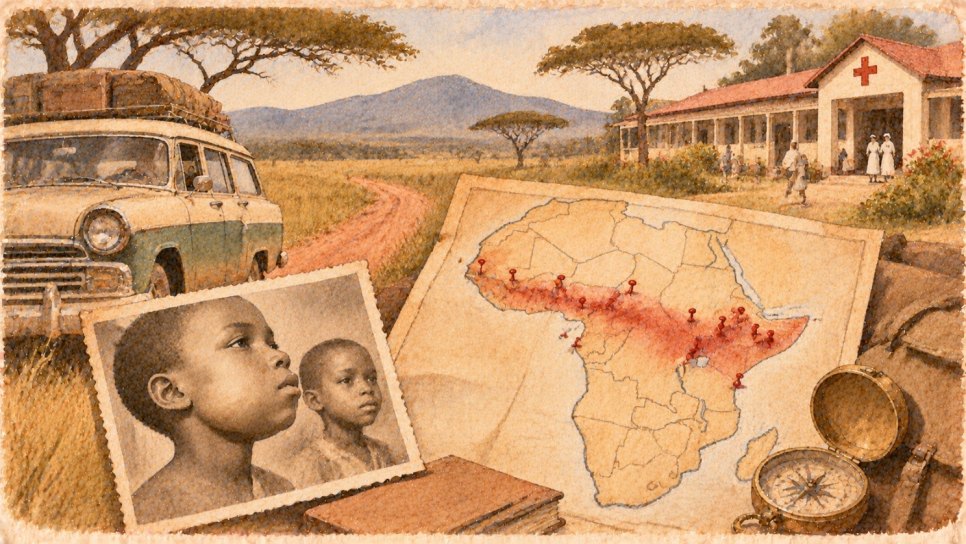
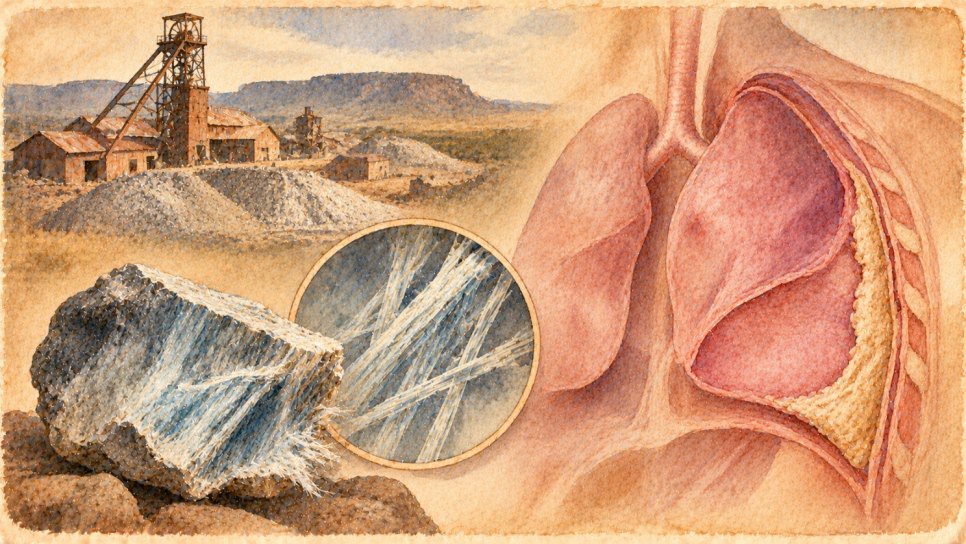
The region is called the "Asbestos Hills"; according to the paper it lies west of Kimberley and covers about 8,000 square miles. The main ore is crocidolite, the blue asbestos known as "Cape blue". The paper writes that mining began at Prieska in 1893 and at Kuruman in 1908, and that mills were set up at Koegas (1915), Kuruman, Griquatown and Prieska.
"Diffuse pleural mesothelioma and asbestos exposure in the North Western Cape Province"
The paper is in volume 17, issue 4, pages 260-271; it was received on 24 April 1960. The authors describe 33 cases: 22 men and 11 women, aged 31 to 68; all were histologically proven diffuse pleural mesothelioma. All but one had probable exposure to crocidolite.
The details deserve a more careful reading. In 8 of the 33 cases asbestos exposure was documented (in six, a definite mining history); in 25 the exposure was circumstantial, for example people born near the mines who admitted dust exposure in childhood. Relatives denied exposure in only one case. The authors put the latency, as a conceptual summary, like this: mesothelioma seems to appear 20 to 40 years or more after exposure to the dust. They say the findings tend to support asbestos as the common factor; but they also state plainly that the evidence is not conclusive. The paper calls itself a preliminary publication. An addendum reports that by the end of June 1960, 47 cases had been identified, that a possible crocidolite association could be established in 45, and that one was a peritoneal mesothelioma.
Mesothelioma
A tumour arising from mesothelial cells, which line internal cavities such as the pleura (the membrane around the lung) or the peritoneum (simplified definition). Wagner's paper enters an argument: Robertson in 1924 had denied that primary tumours of the pleura exist, Willis and Smart and Hinson continued that view, while authors such as Tobiassen (1955) had described primary pleural tumours (according to the paper's citations). According to Bignon, the term "mesothelioma" was first used in 1931 by Klemperer and Rabin (secondary source).
Who had said what before?
Wagner's paper did not come out of a vacuum. Wagner and his colleagues cite Lynch and Smith (1935) as the first report of asbestos-related lung cancer; Doll wrote in 1955 on lung cancer in asbestos workers. According to the paper, Cartier (1952) and van der Schoot (1958) had also reported mesothelioma cases with chrysotile or mixed exposure. So I do not use the phrase "first to link asbestos and mesothelioma" in this article: a secondary source says it, but the paper's own citations make the picture more tangled.
Wagner moved to Llandough Hospital in Wales in 1962; the address on his Nature letter shows this. My reading is that what the Wagner team added in 1960 was a region and a type of fibre: 33 histologically proven cases concentrated in one region; past residences that were questioned; and non-occupational, indirect exposure. Thus living nearby also came onto the table as an exposure. That mining began at Prieska in 1893, read together with the paper's 20-40-year latency estimate, suggests that some cases seen in the 1950s may have been people who breathed dust in childhood (my reading).
A case series is not a risk calculation; the cost arrives decades later
The first limit: the series of 33 cases is a case series. It does not count who was exposed and did not fall ill, so it gives no risk ratio (my inference). The authors themselves write that the pathological evidence is not conclusive and that the latency may not yet have been long enough in some exposed people to produce a tumour. In only eight of the 33 cases was exposure documented directly.
The second limit: the later links are separate studies. On 13 October 1962 in Nature, Wagner reported an experiment in which various forms of asbestos were put into the pleural cavity of 110 young animals (rats, mice, guinea pigs); according to the abstract, the preliminary findings were positive. This is an animal experiment and cannot be generalised to humans; I did not read the full text. Selikoff, Churg and Hammond in JAMA on 6 April 1964 followed 632 insulation workers who had entered the trade before 1943 through 1962; of 255 men who lost their lives, 45 had lung or pleural cancer against about 6.6 expected (roughly 6.8 times; in absolute terms about 18 percent of the 255); four were mesotheliomas, which the authors called "exceedingly high" for so rare a tumour (OSTI abstract).
The third limit: exposure in one setting was not confined to the workplace. Of the 83 patients Newhouse and Thompson studied in London, 31 had occupational exposure; of the 76 with a full history, 36 had no documented occupational or domestic exposure, and about 30.6 percent of those lived within half a mile of an asbestos factory, against 7.6 percent of other patients (summary page; the page does not give the denominators, so these are approximate). Which type of fibre is how dangerous cannot be drawn from this article's sources. How exposure was later limited for the people of the region, and compensation or care, are also absent from these sources.
What remains
- That mesothelioma is treated as a tumour linked to asbestos exposure
- That a tumour can appear decades after exposure
- That exposure is sought not only at the workplace but also at home and in the surroundings
What fell or was limited
- The view that primary tumours of the pleura do not exist
- The assumption that exposure covers only the miner and the worker
- Treating a case series by itself as proof of causation
Links in the asbestos and mesothelioma chain: 1955 to 1965. The axis runs from 1950 to 1970. Green marks are publications or records whose citation details are verified (first case, Wagner 1960, Wagner 1962, Selikoff 1964); blue marks are dates taken from another paper's citation, from a secondary source or from a year recalled without checking. Events known only by year are drawn at mid-year.
Another mineral, another village: Cappadocia
The best-known part of Turkey's mesothelioma history concerns not asbestos but the villages of Cappadocia: the paper in which Barış and colleagues reported an outbreak of pleural mesothelioma in the village of Karain in Anatolia appeared in Thorax in 1978 (title and citation from search results; I did not read the text). That story will be told separately on the planned Day 164; I do not go into detail today. What it shares with the South African story is that a map and a place of residence can be the address of a tumour.
From 1924 to today
What was verified, what conflicts
- How it was read: The citation and abstract of Wagner's paper are from PubMed (PMID 13782506; 33 cases, 22 men and 11 women, aged 31-68, probable crocidolite exposure in all but one). I read the full text from a PDF copy on a law firm's website, through an automated summary; the 8 documented and 25 circumstantial exposures, the addendum of 47 cases, the dates of February 1956, 24 August 1955 and 15 February 1956, and the geographical details come only from that reading. The same summary gave the sub-breakdown of circumstantial exposure in a way that did not add up; I used only the totals.
- "First" claims: A secondary source (the Wagner memoir at occhealth.co.za) says the paper "for the first time" established the relationship between pleural mesothelioma and crocidolite and that it is "the most cited occupational medicine paper of all time"; I verified neither and did not use them. The paper's own citations show that Cartier 1952 and van der Schoot 1958 had earlier reported mesothelioma cases (via the summary).
- The necropsy narrative: The same biographical piece says that in 1956 Wagner found a huge gelatinous tumour in the necropsy of a miner thought to have tuberculosis; I did not identify this with the paper's first case and did not use it. The same source says Wagner presented his findings at the 1959 Johannesburg conference; the paper's Hurwitz 1959 citation shows the conference met in February 1959, and I used only that.
- Klemperer and Rabin, 1931: The "first used" wording is Bignon's claim (1997 IMIG talk); I did not read the original paper.
- Lynch and Smith 1935, Doll 1955, Robertson 1924 and others: reported only as citations in Wagner's paper; I read none of them. Doll's citation (Br J Ind Med 12:81-86) is from memory; it is marked so in the sources list.
- Wagner 1962: Nature 196(4850):180-181, 13 October 1962; only the abstract was read (full text paywalled). I found the abstract's "106 rats" wording open to interpretation, so I did not use that figure and used the 110 animals.
- Selikoff et al. 1964: JAMA 188:22-26; figures from the abstract in the OSTI record; the date of 6 April 1964 from a "landmark papers" page. The volume number was garbled on that page; 188 was taken from the OSTI record.
- Newhouse and Thompson: title, authors and figures from a summary page; the journal, year and page range (Br J Ind Med 22:261-269, 1965) did not appear on the page; the link address shows volume 22, issue 4, page 261, and the year is from memory. The page does not give the denominators of the 30.6 and 7.6 percent figures.
- Wagner's biography: 1923-2000, Asbestos Research Fellow at the Pneumoconiosis Research Unit in 1954; from the occhealth.co.za piece, secondary; the address on the 1962 Nature letter is Llandough Hospital (Penarth).
- Cappadocia: The paper by Barış and colleagues (Thorax 1978;33:181 ff.) is from a title in search results only; not read.
How does a single sentence in a report question a country's habit?
Today we followed a cancer that came out of a region's dust; tomorrow, a report on a country's most widespread habit. January 1964, Washington: the Surgeon General's report on smoking. I will verify the names, the date and the figures tomorrow.
Author's note: The easy way to write this article was "Wagner was the first to show that asbestos causes cancer". The paper calls itself a preliminary publication, says the evidence is not conclusive, and in its own citations lists earlier reports of mesothelioma; certainty came with the later links. I read the full text of Wagner's 1960 paper only through an automated summary, and I looked at the 1962, 1964 and 1965 publications only at abstract level. I did not identify accounts of a miner's life story with the paper's own first case.
Sources and Further Reading
- Wagner JC, Sleggs CA, Marchand P. Diffuse pleural mesothelioma and asbestos exposure in the North Western Cape Province. Br J Ind Med 1960;17(4):260-271. PMID 13782506 (PubMed abstract read; full text read from a PDF copy through an automated summary).
- Wagner JC. Experimental production of mesothelial tumours of the pleura by implantation of dusts in laboratory animals. Nature 1962;196:180-181 (abstract only read).
- Selikoff IJ, Churg J, Hammond EC. Asbestos exposure and neoplasia. JAMA 1964;188:22-26 (abstract in the OSTI record read).
- Newhouse ML, Thompson H. Mesothelioma of pleura and peritoneum following exposure to asbestos in the London area. Br J Ind Med 1965;22(4):261-269 (summary page read; year and page range from memory).
- Doll R. Paper on lung cancer in asbestos workers. Br J Ind Med 1955;12:81-86 (full title not given here; from Wagner's paper's citation; citation from memory; not read).
- Barış YI et al. Paper on an outbreak of pleural mesothelioma in the village of Karain/Ürgüp. Thorax 1978;33(2):181 ff. (from a title in search results; not read).
- Bignon J. Historical overview of malignant mesothelioma (IMIG 1997 talk; reprinted on a law firm's website; read, secondary).
- occhealth.co.za. Biographical piece on J. C. Wagner (PDF; read, secondary).
- Mukherjee S. The Emperor of All Maladies: A Biography of Cancer. New York: Scribner, 2010. (For general context; the relevant part was not read for this article in this session.)
This article is Day 138 of the "365 Days of Cancer History" series and tells, as a historical event, the 1960 study of asbestos and mesothelioma by Wagner and colleagues. It is historical-popular content; it is not a diagnosis or treatment recommendation. Consult your physician for decisions about asbestos exposure or your health. The sources have been checked; details that rest only on secondary sources or could not be read are marked in the fact-check notes.
Was this article helpful?
Your feedback helps us improve our content.