
What Is Personalized Treatment or a Targeted Drug in Cancer? How and When Should It Be Used?

In this article
Personalized treatments, also called precision medicine in recent years, confuse many of us and are difficult for patients and relatives to understand. Targeted drugs sometimes appear almost magical, while at other times disappointing results undermine confidence in cancer treatment. Let us examine precision medicine, or personalized treatment.
There Are Two Important Points to Know
To offer personalized treatment, cancer tissue or circulating tumor DNA is obtained and special methods test suitability for targeted drugs. Precise gene analysis methods, now called molecular pathology, seek regardless of the organ of origin the genetic abnormalities playing a central role in cancer development.
Based on results, a multidisciplinary oncology team reviews existing studies and available targeted drugs to decide whether an appropriate treatment option exists.
Historically, cancer treatment relies on empirical selection of cytotoxic chemotherapy (aiming to kill cancer cells). Treatment choices and study designs are based on the tissue involved (such as lung or breast cancer). More than 50 years of progress through these methods established modern chemotherapy strategies.
In new approaches called precision oncology, next-generation sequencing identifies tumor-specific genetic differences to select treatment independently of the organ.
What Does This Mean?
We previously assumed similar organ cancers in different people had the same biology. New knowledge showed that even one cancer originating in a single organ and spreading to different parts of the same patient’s body can have different genetic characteristics when it settles in different organs (metastasizes).
Over the past 20 years, as personalized targeted drugs were used for similar genetic changes in similar organs, another observation emerged: if the genetic abnormality targeted by a drug is also the main driver of cancer originating in another organ, the same drug may work there too.

An Impressive Example of “Precision Medicine”
Crizotinib (Xalkori), highly successful in ALK-positive advanced lung adenocarcinoma, was found effective in myofibroblastic tumors, a soft tissue cancer previously treated unsuccessfully. A patient with this diagnosis received Crizotinib after ALK positivity was identified in genetic material, with considerable success. With no other treatment options, response continued for 19 months. ALK positivity occurs in only %3-4 of lung adenocarcinomas, but was found in %50 of myofibroblastic tumors, and the drug worked as effectively as in lung cancer.
This patient’s outcome became a new treatment option for myofibroblastic cancer. The treatment course was published in the New England Journal of Medicine. Introducing a new oncology strategy is not easy: changes usually require large trials comparing new treatment with current options. The Crizotinib result in this rare tumor impressed the oncology community.
Existing targeted drugs and, more recently, immunotherapies can therefore effectively treat cancers with particular genetic and structural features, regardless of organ.

One of the Main Questions for Patients and Scientists
Personalized treatments, innovations in immunotherapies , chemotherapy and nonsurgical minimally invasive treatments have produced success in oncology that is difficult to believe. Yet planning treatment for locally advanced and metastatic disease has become equally difficult, requiring multidisciplinary teams. Oncology professionals face more demanding decisions than before. Keeping pace with changing knowledge, translating it into practice, involving multiple specialties in decisions and accessing developing technologies require specialized organization. Such comprehensive organization brings another problem: FINANCE. How, and by whom, will new technologies, molecular tests, expensive targeted drugs or immunotherapies, and sometimes their combinations, be paid for?! This may be the most important question challenging the scientific community.
2 Major Conflicting Studies on Personalized Treatment
One of the most notable clinical trials appeared in Lancet Oncology. Called SHIVA, it was presented at the 2015 ECC Congress in Vienna and attracted our attention.
Between 2012-2014, SHIVA screened 741 patients for 10 available targeted drugs. Regardless of tumor features and organ of origin, activating pathways suitable for targeted treatment were examined. Among 741 patients, 195 had pathways suitable for therapies specific to other cancers rather than their own. They were divided into groups of 99 and 96. One received targeted treatment; the other was divided into two arms receiving physician-selected single or double conventional chemotherapy or observation without treatment. No significant difference emerged, a very disappointing result.
Another comprehensive review found longer overall survival among more than 8000 patients receiving targeted treatment than among other patients. These results came from a meta-analysis of patient outcomes from 570 phase II studies.
Although heterogeneity and pooling many small studies involving different cancers are limitations, this opens a broad window on the subject.
What Guidance Do Personalized Treatment Studies Provide?
- Precision medicineoffers an effective approach by identifying differences between patients through genetic and molecular analyses. Molecular genetic identification of tumor-cell differences is vital for developing new-generation targeted medicines.
- Studies determining personalized treatment’s clinical importance continue.
- Planning clinical trials is one of the greatest challenges in personalized treatment research. Because patients have different genetic abnormalities, traditional trial designs are unsuitable. An effective method developed for precision medicine is called basket and umbrella . This method is illustrated below.
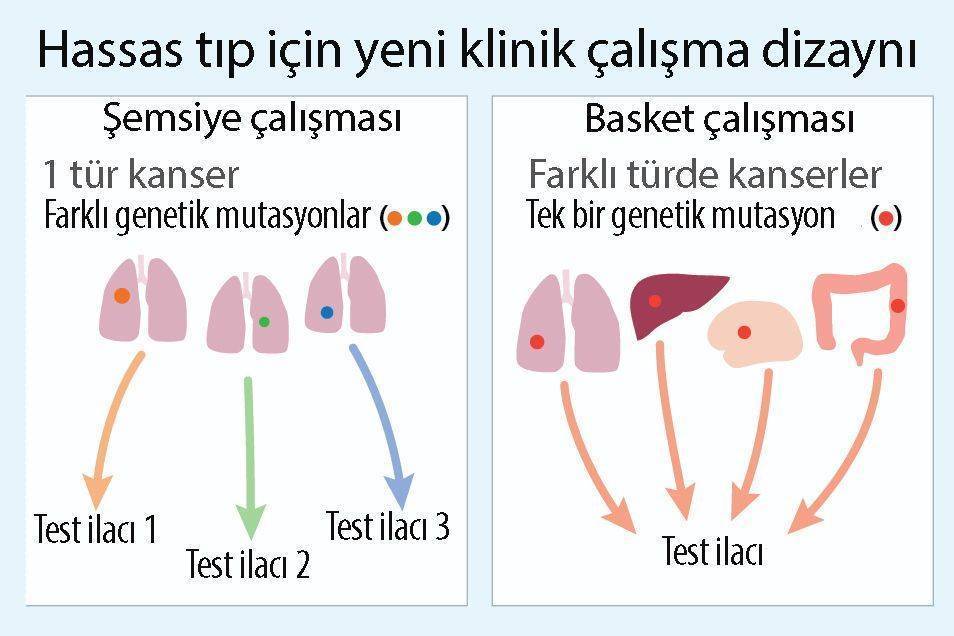
Umbrella studies examine different genetic mutations in a single cancer type, testing medicines specific to them. Basket studies test medicines specific to a single mutationacross different cancer types.
Where Is Personalized Precision or Individualized Medicine Going?
- Modern genetic advances have made precision medicine a rapidly progressing field, also demonstrating the need for a multidisciplinary cancer approach. Problems remain. For example, genetic testing companies lack consistent standards, causing inaccurate results and preventing effective treatment. New genetic abnormalities identified daily also complicate interpretation. Oncologists therefore need to work with molecular genetics specialists competent in cancer genetics.
- Genetic cancer tests are generally chosen when other treatments fail, for reasons including cost and access. Choosing them early in disease may enable effective treatment planning.
- Clinical trials of personalized medicines continue, so widespread clinical use depends on their results.
- Cancer biology is also highly complex and still being clarified. Tumor heterogeneity and rapid mutations make targeted treatment effects harder to understand.
Conclusion
Personalized oncology is a rapidly developing science. Genetic technologies combined with targeted treatments are making cancer care very different and more favorable to patients than before. Yet much remains immature. Translating complex genomic information into practice and offering the appropriate targeted treatment or suitable ongoing trial is not easy in daily practice. Treatment costs now alarm countries. A genetic profile may suggest benefit from an unapproved treatment. The physician and patient then face use of an unapproved drug and potential legal issues, while the patient and family face financial difficulties.
Sources
asco-org
2. Dr Christophe Le Tourneau et. al.
Molecularly targeted therapy based on tumour molecular profiling versus conventional therapy for advanced cancer (SHIVA): a multicentre, open-label, proof-of-concept, randomised, controlled phase 2 trial.
The Lancet Oncology 2015
Was this article helpful?
Your feedback helps us improve our content.




Reader comments
Share your comment
Your name and comment are published only after administrator approval. Your email address is never shown to visitors.
Be the first to comment.