
Abraxane (nab-Paclitaxel): A Nanotechnology-Produced Chemotherapy Drug

In this article
What is Abraxane's mechanism of action?
Abraxane (pronounced ab-rak-san) is designed to kill cancer cells or slow their growth.
Other names for Abraxane
- Albumin-bound paclitaxel
- nab-Paclitaxel
Nanoparticle albumin-bound paclitaxel (nab-paclitaxel)first received approval in 2005 for metastatic breast cancer from the FDA and is a nanoparticle chemotherapy drug. Paclitaxel is an older chemotherapy drug; this is a new formulation of it prepared using nanotechnology . Paclitaxel acts on microtubules, which form the cell skeleton and have important functions during mitotic division . By disrupting the function of these microtubules, it inhibits cancer cell proliferation. It stabilizes microtubules, in other words disrupting their flexibility.
Abraxane has made positive contributions to the treatment of breast, lung, pancreatic, ovarian (female ovary) and cervical cancers. It has FDA approval for treating advanced breast, lung and pancreatic cancer. It also has radiosensitizing properties and may allow the administered radiation dose to be reduced by up to 50%. The molecular structure of this nanotechnology-produced drug can be seen below.
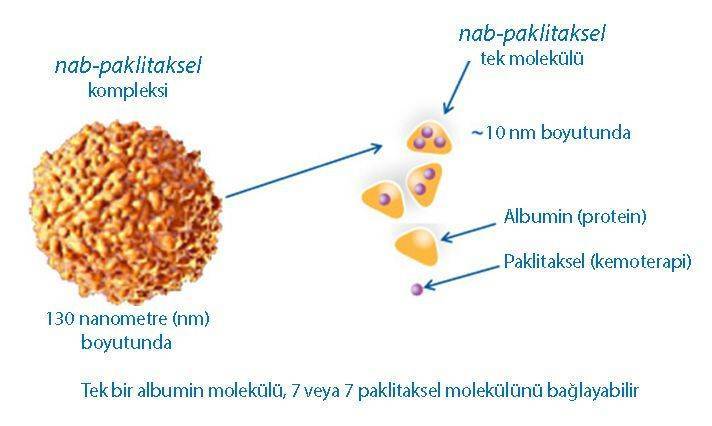
Delivering chemotherapy drugs using nanoparticles can allow the use of certain drugs that cannot be used as small molecules because of serious toxic effects, and improve delivery to the target tumor tissue.
Abraxane administration, dose and schedule
- Abraxane 260mg/m2 is administered intravenously (IV) on day 1, over 30 minutes as a slow infusion.
or
- Abraxane 100mg/m2 or 150mg/m2 is administered slowly into a vein on days 1, 8 and 15 over 30 minutes. Administering medication intravenously over a defined period is called an infusion .
Estimated total duration of Abraxane treatment
- It may take up to 2 hours.
- Infusion times are based on clinical research, but may vary according to physician preference or the patient's tolerance of treatment. Premedication and fluid support may add more time.
- Abraxane treatment is generally given in outpatient chemotherapy units, where patients return home after treatment.
- If Abraxane is given only on day 1, it is usually repeated every 21 days. This sequence is called a cycle . If it is given on days 1, 8 and 15, it is called weekly treatment and this cycle is repeated every 28 days.
- Depending on your physician's recommendation, treatment cycles continue until the drug stops providing benefit and unwanted adverse effects begin to appear.
Abraxane side effects
The side effects most commonly reported with Abraxane in clinical studies are listed below. Side effects sometimes have percentage ranges [example: 23-82% for neutropenia], reflecting differences between clinical studies:
- A decrease in white blood cell count; neutropenia (23-82%)
- Hair Loss (64-90%)
- A pins-and-needles and tingling sensation in the hands and feet (neuropathy) (58-68%)
- Fatigue (34-35%)
- Anemia (low red blood cell count) (34%)
- Nausea (20-33%)
- Diarrhea (27%)
- Infection (24%)
- Muscle or joint pain (myalgia and arthralgia) (19-45%)
- Rapid breathing (12%)
- Fluid retention in the body (edema) (10%)
- Cough (7%)
- Mouth sores (7%)
- Bleeding (due to a decrease in platelet count) (2%)
- Neutropenic fever (fever with a low white blood cell count) (1-2%)
Note: Abraxane almost always causes mild hair loss. The hair loss is not noticeable from a distance and can only be seen on close examination; although a different hairstyle can help conceal some hair loss, a wig or hairpiece is generally unnecessary.
- In clinical studies, at a dose of 100 mg/m2, 7 percent of patients, and at a dose of 100mg/m2, 17 percent of patients, discontinued treatment because of unwanted side effects.
How often is monitoring needed during Abraxane treatment?
Blood tests must be checked before each chemotherapy cycle. Required blood tests are a complete blood count (hemogram) and a comprehensive metabolic panel (biochemistry). Other blood tests may be added as recommended by the physician.
Oncological imaging is performed before treatment and then periodically to assess the response to Abraxane (for example, week 5, week 9, week 15). Bone scans (DEXA), magnetic resonance imaging (MRI) and computed tomography (CT) scans are the imaging procedures used. A chest X-ray may also be performed if there is a lung-related symptom.
How do blood test or imaging results affect treatment?
Depending on the results, your doctor may continue Abraxane as planned, adjust its dose or change treatment.
Things to consider during Abraxane treatment
- Abraxane is manufactured as a powder and must be reconstituted for preparation as an infusion. This can take 20-30 minutes. You should therefore plan your time accordingly when coming to the treatment unit.
- Your oncology pharmacist should check for interactions between your medications.
Individual drug label information
Albumin protein-bound Paclitaxel (Abraxane)
- Abraxane is an intravenous infusion.
- Extreme caution is advised in patients whose white blood cells known as neutrophils are below a certain level. Blood counts should be checked before each infusion.
- Dose adjustments may be needed in patients with liver dysfunction, low white blood cells, low platelets, nerve damage or poor liver function.
- It may interact with certain antifungal (fungal treatment) and stroke treatment medications. Ask your doctor or pharmacist to review your medications for possible interactions.
- Interaction with grapefruit and grapefruit juicemay increase blood levels of Abraxane. This may increase the risk of other side effects. You should not eat grapefruit or blood oranges during treatment.
- Although rare, it may cause lung damage.
- Abraxane is known to harm the fetus. Female patients should therefore avoid pregnancy while using this medication.
Sources
2) Gradishar WJ, Krasnojon D, Cheporov S, et al. Significantly longer progression-free survival with nab-paclitaxel compared with docetaxel as first-line therapy for metastatic breast cancer. J Clin Oncol. 2009;27:3611-3619.
Was this article helpful?
Your feedback helps us improve our content.




Reader comments
Share your comment
Your name and comment are published only after administrator approval. Your email address is never shown to visitors.
Be the first to comment.