Cancer in 1941: Strengths and Limits of Surgery, Radiotherapy and Hormonal Therapy, Halsted to Huggins | Day 114
In this article
Cancer on the Threshold of 1941: Three Methods, Three Limits
On Day 113 we saw the scale that puts a number on a patient's day; that scale belongs to the late 1940s. Today we wind the clock back to 1941, the year of Huggins's prostate papers (Day 112). We ask a single question: in that year, what did a physician have in hand for a patient with cancer? On Day 100 we weighed the two pillars of surgery and radiotherapy and the third one that was sprouting. Fourteen posts later, the third pillar has a name, and the limit of each pillar is easier to see.
An imagined consulting room
This paragraph is an imaginative reconstruction, not a documented event. Say that in 1941, in any large city, a physician has test results open on the desk. The patient has a mass. The physician has three options: remove the mass and the tissue around it by operation, apply X-rays or radium, or, if the tumour depends on a hormone, remove the source of that hormone. A fourth option, a drug that is given into the blood and reaches every corner of the body, is not on that desk. The whole subject of this post is the absence of that fourth option.
Each of the three tools has a history in this series. Surgery: Wertheim's radical hysterectomy (Day 93), Patey's "cut less" mastectomy (Day 104), Graham's lung operation (Day 107), the reconnection of the oesophagus inside the chest (Day 111). Radiotherapy: Röntgen's rays and radium (Days 92, 94 and 95). Hormonal therapy: the line running from Beatson to Huggins (Days 91, 105, 110 and 112). Today we do not retell them; we set them side by side and look at something they share.
Halsted's 1894 balance sheet
In surgery, the yardstick was set in 1894 by William Halsted's series of radical mastectomies at Johns Hopkins. Published in the Annals of Surgery (volume 20, pages 497-555), the series covers 50 radical mastectomies and 26 incomplete operations performed between June 1889 and January 1894. According to Halsted, no patient was lost to the operation itself. Of the 46 patients whose long-term course could be assessed, 73 percent had neither local nor regional recurrence, and 93 percent had no local recurrence. Three patients had local and eight had regional recurrence. Some patients were left with problems of the arm.
For local control these figures were impressive, and for decades they served as a yardstick. But the question the number answered was "did the tumour come back in the same place?" The question "is something growing elsewhere in the patient's body?" was one the operation neither asked nor answered. As we saw on Day 104, over the following half century surgery turned from "cutting more" to "cutting less"; yet no operation went looking for cells that could not be seen during the operation.
Coutard and fractionated dosing
A long course instead of one large dose
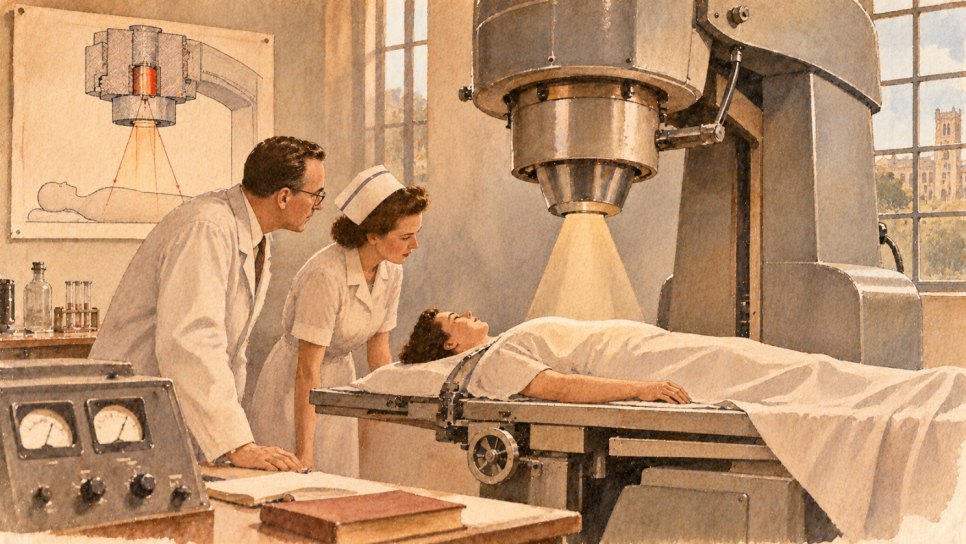
The basic problem in radiotherapy was to deliver an adequate dose to the tumour without exceeding what the skin and mucosa could bear. According to a 1996 historical summary by Willers and Beck-Bornholdt, Henri Coutard in Paris progressively lengthened the overall time of radiation treatment for head and neck cancers. The same summary notes that this work can be regarded as the basis of the conventional 6-7 week overall time still used today. In Zurich, Zuppinger and Holthusen had preferred shorter schedules in the 1920s and 1930s. The authors add the other side of the picture at once: the evidence of that period is weak, and because Coutard's raw data are not available, his results cannot be tested independently.
This tells us two things. First, one of the best-established principles of radiotherapy (dividing the dose over days) was born not of a strong experiment but of clinical intuition and accumulated observation. Second, that intuition was later supported by laboratory findings as well; but that story belongs to later days of this series.
A paper from Zurich cites a figure reported by Coutard: 52 percent of the patients who remained free of local disease had lost their lives to distant metastases by the end of the eighth year. I could not verify the citation of that paper, so I carry the figure not as established fact but as a clue. If it is right, its meaning is this: radiation can silence a tumour where it sits, but it has no say over cells that had already set out elsewhere in the body. It is a structure similar to what Halsted saw in surgery.
The third pillar and its narrow door
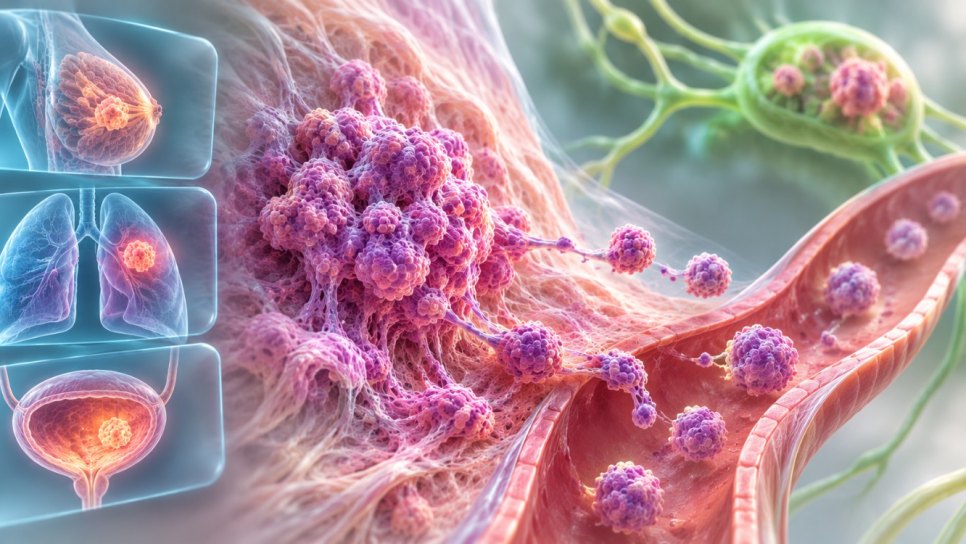
Hormonal therapy was the first method to speak to the whole body of a person with cancer: removing the ovary or the testis changes the hormone level in the blood and can act wherever the tumour is. Beatson tried this in breast cancer in 1896; we told the riddle of the "one third" on Day 91. Huggins and Hodges showed the same principle in prostate cancer in 1941, with a measurable chemical marker (Day 112). But two limits of the method were clear from the start: it worked only in hormone-dependent tumours, and its effect was mostly temporary. Moreover, the hormone itself does not directly destroy the tumour cell; it only changes how the cell is fed.
LOCAL CONTROL AND SYSTEMIC DISEASE: TWO DIFFERENT QUESTIONS
Local control means that the tumour does not grow back where it was. Surgery and radiotherapy described their successes by this yardstick.
Systemic disease means that, at diagnosis or after treatment, unseen cells have travelled elsewhere through blood or lymph. In 1941, apart from a few hormone-dependent tumours, there was no method that answered this question. The idea goes back to Ehrlich's dream of the "magic bullet" (Day 96); but that dream had no concrete drug for cancer yet.
An attempt at a balance sheet
I could not find a solid nationwide survival figure for the early 1940s. The "one in five" statement that circulates on this subject had an unclear basis, so I did not write it. The consistent data we do have come from the End Results Group within the National Cancer Institute: a compilation from more than 100 hospitals covering about 400,000 white patients. According to it, five-year survival in colon cancer rose from 31 percent in 1940-49 to 46 percent in 1955-59, and in rectal cancer from 28 to 40 percent. In absolute terms the rise is 15 points for colon and 12 for rectum; in relative terms about 48 percent for colon and about 43 percent for rectum.
It would be wrong to read this rise as the success of a single treatment. The series consists of selected hospitals and only white patients; five-year survival does not mean cure; and earlier diagnosis can make survival look longer independently of treatment. Even so, the figures show one thing: even the tools of 1941 made a difference when they were applied better and reached patients earlier. The second source of progress, informing the public, is the subject of the scene below.
THE COST: EACH METHOD'S OWN BILL
The cost of surgery was not only operative risk: even in Halsted's series some patients were left with arm problems; on Day 104 we took up that burden under the principle of "cutting less". The cost of radiotherapy was shown by the health of its pioneers (Grubbé, Day 92; Curie, Day 95). The cost of hormonal therapy was an irreversible operation or vascular risk (Days 110 and 112).
The sources of this post also leave something missing: there is no data on which patients could reach these tools and which could not. The question of inequality remains open.
The volunteers' campaign of education
The American Cancer Society, first named the American Society for the Control of Cancer, was founded in New York in 1913 by 10 physicians and five laypeople. In 1936, on the proposal of Marjorie G. Illig, a volunteer "Women's Field Army" began: members wore khaki uniforms with rank insignia, raised money and informed the public. According to the society's own records, about 15,000 people were working in cancer control across the country in 1935; by the end of 1938 that number had grown about tenfold. The society took its present name in 1945. In 1946 Mary Lasker and her colleagues raised more than 4 million dollars, of which 1 million went to a research programme. The message was the same then as now: notice early, reach treatment in time. The military language belongs to the period; this series does not use it in its own narration.
What remains
- Surgery, radiotherapy and hormonal therapy are still at the core of treatment today
- Spreading the radiation dose over time: the idea of fractionation
- The value of early diagnosis and public education
What fell away or was overcome
- The expectation of cure from local methods alone
- Schedules without raw data settling into certainty
- Radical operation as the only yardstick
The three tools of 1941 and the missing fourth. Green boxes show what was in hand, red boxes the limit of each. Below, what did not yet exist that year: a drug that enters the blood and reaches everywhere.
What was the situation in Turkey in 1941?
I could not reach verified information on cancer treatment in Turkey in 1941, so I am not drawing a local link. The general inference is this: the three methods in this post were known internationally in the same period, but how far a patient in any given country could reach them is a separate research subject. In the part of the series devoted to Turkey this question will be taken up, with its sources.
FROM 1894 TO 1946
WHAT WAS VERIFIED, WHAT REMAINS OPEN
- Halsted 1894: The citation and figures (50 radical mastectomies, 26 incomplete operations, 46 assessable patients, 73 and 93 percent, no loss of life to the operation) were taken from the summary page of an embryology encyclopaedia. The original article was not read.
- Coutard: "Progressively lengthened the time" and the 6-7 week basis come from the 1996 German-language summary by Willers HB and Beck-Bornholdt HP (PubMed 8928059). The "52 percent" figure is information a Zurich paper, whose citation could not be verified, passes on from Coutard; it should not be accepted as certain.
- End Results figures: Colon 31 percent (1940-49) and 46 percent (1955-59), rectum 28 and 40 percent; the hospital and patient numbers come from a secondary reprint, and the text for the first period was garbled. The relative percentages are my own calculation. The original National Cancer Institute publication was not read.
- The Cancer Society: The founding (1913), the Women's Field Army (1936), the volunteer numbers and the 1945 renaming come from the society's own history page. The society places the first major campaign in 1946, a company history in 1945; this post writes only "1945-46".
- The "one in five" claim: The statement that five-year survival in the 1930s was about one in five was attributed in a discussion article to a former official of the national institute, with no basis shown; it was not used.
- Out of scope: Chemotherapy (tomorrow's subject) and diagnosis (Day 103) are not covered in this post; the situation in Turkey in 1941 could not be verified.
"JD" and the Secret Trial of Goodman and Gilman (1942)
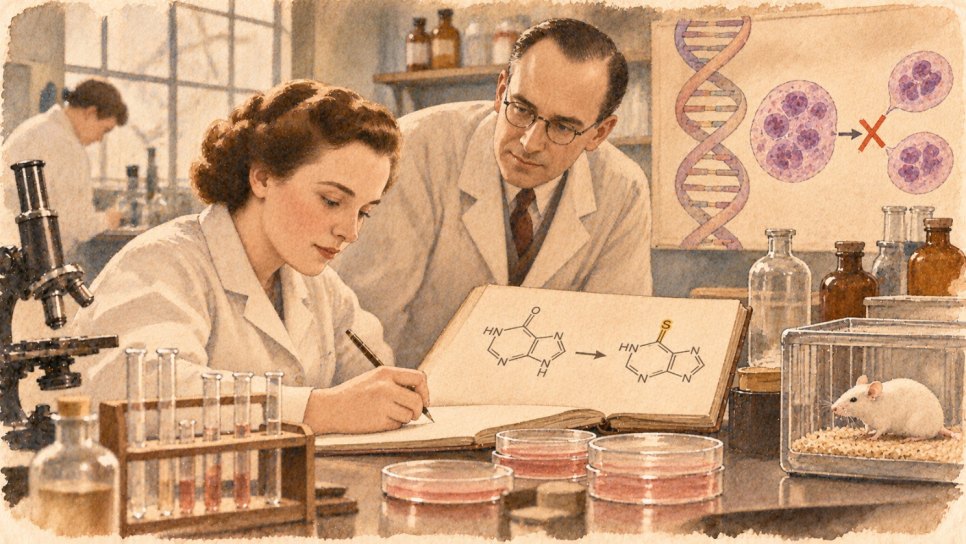
Today we drew the limit of three tools and saw that what lay beyond it was cells circulating in the blood. Tomorrow we go to the trial that first crossed that limit: nitrogen mustard, given under secrecy in the conditions of the Second World War by two pharmacologists at Yale to a patient with advanced lymphoma. I will re-check the patient's identity and the dates, including the plan's 27 August 1942, against sources before writing.
Author's note: This post is a panorama: instead of telling a new event it sets three lines we already know side by side and shows the gap in the chronology. I took a few figures (Coutard's 52 percent, the End Results rates) from secondary pages and did not overstate their certainty; they are marked in the fact-check box. I could not write a nationwide survival figure for the period with confidence and chose not to write one. Also, the Day 113 Karnofsky post was a step ahead in the chronology; the series now returns to 1942-43.
Sources and further reading
- Halsted WS. The results of operations for the cure of cancer of the breast performed at the Johns Hopkins Hospital from June, 1889, to January, 1894. Ann Surg 1894;20:497-555.
- Willers H, Beck-Bornholdt HP. Historical experiences in trying different overall treatment times in x-ray therapy of malignant head and neck tumors in the 1920s and 1930s. 1996 (PubMed 8928059; German-language abstract).
- National Cancer Institute, End Results Group. Progress Against Cancer: long-term survival rates (presentation at the Sixth National Cancer Conference; secondary reprint).
- American Cancer Society. Our History (cancer.org history page).
- Huggins C, Hodges CV. Studies on prostatic cancer. I. Cancer Res 1941;1:293-297.
- Mukherjee S. The Emperor of All Maladies: A Biography of Cancer. New York: Scribner, 2010.
This post is Day 114 of the "365 Days of Cancer History" series and treats the strength and limits of surgery, radiotherapy and hormonal therapy as of 1941 as a historical balance sheet. It is a historical-popular account, not advice on diagnosis or treatment. For your own health, consult your physician. Sources have been verified; details resting only on secondary sources are marked in the fact-check notes.
Was this article helpful?
Your feedback helps us improve our content.