The Year the Secrecy Lifted: The 1946 Publication of Nitrogen Mustard

In this article
The Year the Secrecy Lifted: The 1946 Publication of Nitrogen Mustard
On Day 119 we followed a secret of 1945, the trace that radiation leaves in the human body years later. Today we return to another secret of the same years: the nitrogen mustard we saw in a hospital and in a harbor on Days 115 and 116 was published for the first time in 1946 and came before the eyes of the medical world. A publication is not a moment of discovery; it is the moment a concealed piece of knowledge is put on the record, and so both what it says and how it says it matter. This piece tells what those publications said, what they could not say, and which ones I could not read myself.
5 April: a review
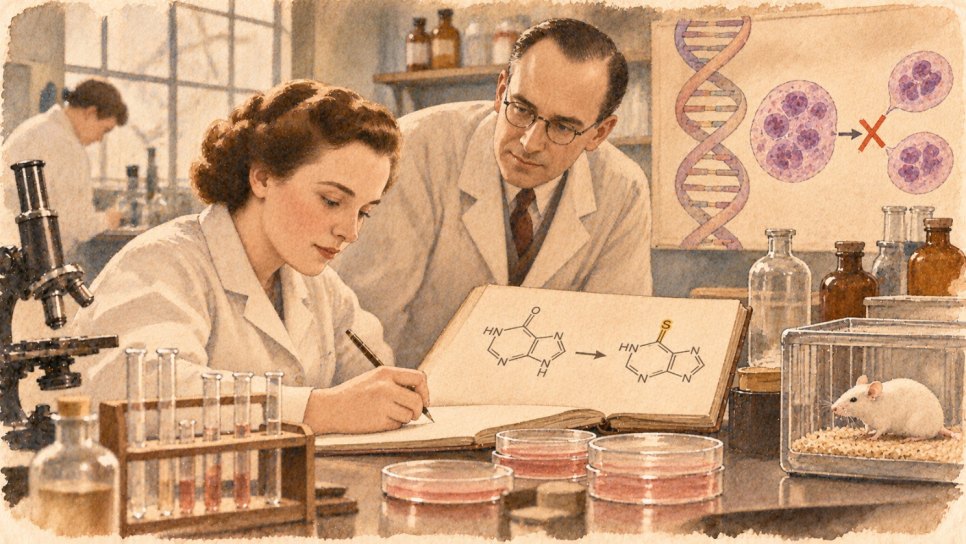
The first of the three documents was not a patient series but a review. Alfred Gilman and Frederick S. Philips's "The Biological Actions and Therapeutic Applications of the B-Chloroethyl Amines and Sulfides," published in Science on 5 April 1946, is a broad account of chemistry and pharmacology spread over 28 pages (volume 103, issue 2675, pp. 409-436). According to a secondary account, the paper says the compounds damage the cell nucleus and that their tissue effects closely resemble those of X-rays, that is, they are "radiomimetic"; the same account reports that the authors said about 150 patients had been treated to that date, while the data were still under secrecy restrictions. I could not read the paper itself; these sentences come from a secondary source.
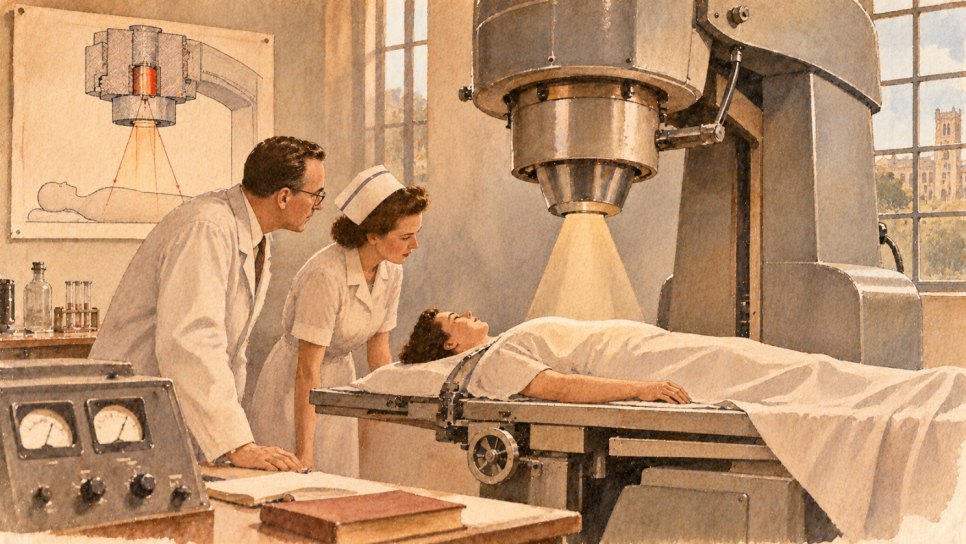
The radiomimetic idea forges a new link in this series: on Days 92-95 we saw that radiation could shrink tumors, and on Day 119 that its cost was measured years later. The question here was: could a drug that, like radiation, damages rapidly dividing cells, bone marrow and lymphoid tissue, target the same group of cells in treatment? That was a hypothesis; proof would come with patient data.
The "official statement"
In June, JAMA (volume 131, issue 8, pp. 656-658) published "Nitrogen mustards in the treatment of neoplastic disease: official statement," signed Cornelius P. Rhoads. The byline shows the Committee on Growth of the National Research Council (NRC). According to the visible abstract, the studies assessing clinical use had been supported by the US Army Chemical Warfare Service and several research committees; only two compounds had been examined for this purpose (tris(β-chloroethyl)amine hydrochloride and methyl-bis(β-chloroethyl)amine hydrochloride), and the work had begun under a contract with Yale and was later continued at the University of Chicago Medical School. The rest of the text is behind a paywall; I do not know its content and do not guess. We met Rhoads on Day 116 in the Bari context; here his name marks the institutional frame of the publication.
21 September: 67 patients
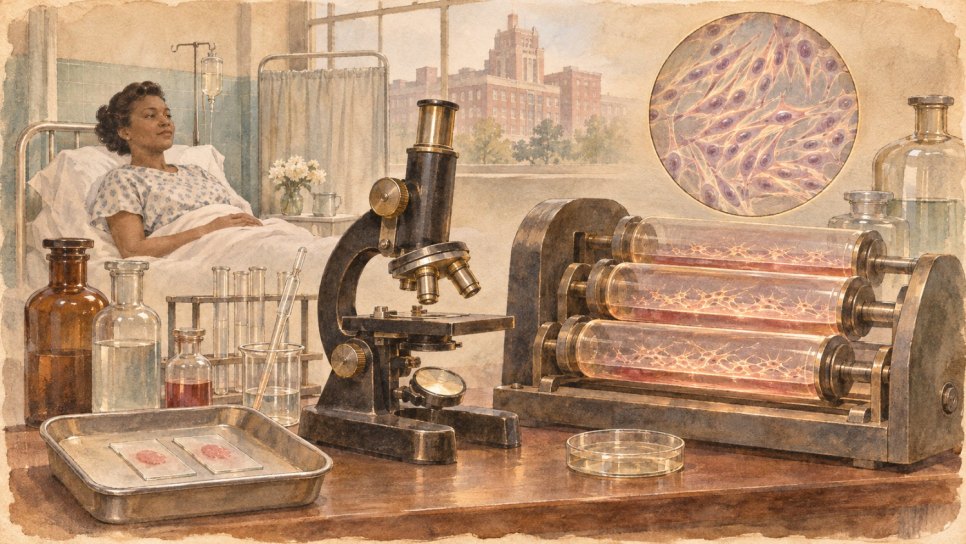
The third document was patient data. Louis S. Goodman, Maxwell M. Wintrobe, William Dameshek, Morton J. Goodman, Alfred Gilman and Margaret T. McLennan published "Nitrogen mustard therapy" in JAMA (volume 132, issue 3, pp. 126-132) on 21 September 1946. The title names the two compounds (methyl-bis(β-chloroethyl)amine hydrochloride and tris(β-chloroethyl)amine hydrochloride) and the disease groups (Hodgkin's disease, lymphosarcoma, leukemia and certain allied and miscellaneous disorders). The publication is reported to be a "preliminary" communication and a companion to the review.
The 67 patients in total were gathered at four centers: seven treated at New Haven Hospital by Goodman and Gilman; 34 at Salt Lake County General Hospital by Wintrobe and McLennan; 16 in Boston by Dameshek; and 10 in Portland, Oregon by M. J. Goodman. A secondary account reports that most patients had previously had X-ray treatment and were in advanced disease, and that "several dramatic responses" were seen, especially in Hodgkin's disease (conceptual summary). I give no response rates because I could not read them in the paper itself. A historical review summarizes the results thus: the regressions were brief and incomplete (DeVita and Chu, conceptual summary), and the literature of the 1950s was pessimistic for that reason.
Three documents, three readers
The language of the three publications is not the same, and this is my reading. The Science review speaks to chemists and pharmacologists: it describes the structure of the compounds, their action in the cell and the tissue damage. Rhoads's statement speaks in the voice of a committee, recording how the work was supported and which two compounds were examined; it is a kind of official minute. The JAMA series addresses practicing physicians and hematologists: it says what was tried in which disease and what was seen. A secondary account calls Wintrobe and Dameshek leading academic hematologists of the day; two centers carried the clinical weight of the series beyond Yale.
This triple shows how a drug came out into publication: first the mechanism and chemistry, then the institutional frame, and last the patient data. The patient data may have come last because of the secrecy, but the sources do not say so openly; I report only the order. A review says that other centers independently reported similar findings the same year, but I could not verify those citations (see the fact-check box).
What came next? Mechlorethamine is cited as the first chemical agent approved for cancer on 15 March 1949; in later years it was used in combination with other drugs in Hodgkin's disease. A news-magazine article says the MOPP regimen was pioneered by Vincent DeVita in the mid-1960s; that story is the subject of a separate day. What matters here is that the 1946 publications are one of the recorded links of that chain; the continuation of the chain had not yet been written.
The case series and the problem of the yardstick
A case series is a type of report that records how individual patients responded and has no comparison group. The strength of a series is that it shows a drug does something in the body; its limit is that it cannot separate whether the effect came from the treatment or from the natural course of the disease.
Response in those years was measured largely by the shrinking of nodes followed by hand and eye; there was not yet a scale that turned the patient's daily function into a number. On Day 113 we saw how Karnofsky's 1948-49 scale filled that gap.
The price: toxicity, uncertainty and consent
A review reports that giving nitrogen mustard into a vein was difficult, that staff had to avoid skin contact and inhalation, and that leakage of the drug outside the vein could cause burns and vein damage. That the drug suppresses rapidly dividing cells, bone marrow among them, is known from the blood-count falls we saw on Days 115 and 116. The first series published in 1946 also consisted largely of patients who had no other option left.
I could not see consent addressed in any of these publications in the sources; so I do not write what the patients said or knew. As I promised on Day 115, informed consent will be taken up later in the series together with Nuremberg. The publication also carries a price in expectation: a drug that appears for the first time in a medical journal spreads hope quickly and becomes an option for patients and physicians, while the series itself recorded short-lived regressions. I do not belittle the drug's value here; I only note that publication and expectation are different things. And publication is not proof: a series of 67 patients does not show that a drug truly provides a benefit, it only records an effect.
What remains
- The record that a chemical agent could produce measurable regression in lymphoma and Hodgkin's disease
- The radiomimetic idea: a drug that, like radiation, targets rapidly dividing cells
- The joint publication of patient data gathered at several centers
What fell or was limited
- The expectation that the regressions would be lasting (they stayed brief and incomplete)
- Assuming that a series without a comparison group shows the benefit of a drug
- Thinking that secrecy did not prevent knowledge from being recorded accurately and completely
Three documents of one year. The axis shows 1946; the ticks are three-month intervals. Orange boxes show the 1946 publications, red the secrecy period, green the approval. 1942-45 and 1949 are off scale and placed at the ends of the axis.
The publication's route to Turkey
I could not find a verified source on when and by whom these 1946 publications were read in Turkey; so I give no date or institution. The general inference is this: the publication of knowledge does not mean it is reached everywhere in the world at the same time; the interval between publication and clinical practice varies from country to country. The Turkey-specific detail will be taken up, with sources, in the series' Turkey part.
From 1942 to today
What was confirmed and what conflicts
- The Science paper: the citation (volume 103, issue 2675, pp. 409-436, 5 April 1946, doi:10.1126/science.103.2675.409) is from a record page; the authors are not listed on that page, and the names Gilman and Philips rest on the citation of Day 115 and on a review. One review writes "Phillips"; I used "Philips." The word radiomimetic and "about 150 patients" are from a secondary source; I did not read the paper.
- The Rhoads statement: the citation (JAMA 131(8):656-658, 22 June 1946, doi:10.1001/jama.1946.02870250010003) is from a record page; only the visible abstract was read. One review wrongly writes the name as "Rhoades"; I used Rhoads. The rest of the text and its content were not verified.
- The Goodman et al. paper: the citation (JAMA 132(3):126-132, 21 September 1946, doi:10.1001/jama.1946.02870380008004), the 67 patients and the center distribution (7, 34, 16, 10) are from a record page; the results could not be read because of the paywall. "Several dramatic responses, especially in Hodgkin's disease" and "most had previously received X-rays" are from a secondary source (conceptual summary).
- Durability: "the regressions were brief and incomplete" is from DeVita and Chu 2008 (conceptual summary); I did not read the whole article.
- Other 1946 publications: a review says that Jacobson of Chicago and Wilkinson and Fletcher of Manchester independently reported similar findings; I did not verify their citations and did not include them in the text.
- Patient details: JD's date and identity were taken up on Day 115; one Yale page gives the first patient as December 1942 and a 48-year-old silversmith, while the Yale account I used on Day 115 gives August 1942 and age 47. I did not resolve this conflict again.
- The date secrecy lifted: sources say "secret until 1946"; none gives the exact day of the lifting. I built the piece on the publications, not on a date.
- Mechlorethamine approval: 15 March 1949 and "the first chemical agent approved for cancer" are from a news-magazine article; I did not check the licensing document.
- Chemical name: that methyl-bis(β-chloroethyl)amine hydrochloride is mechlorethamine is general chemical knowledge; the source pages do not state it explicitly.
- Out of scope: the mechanism of action (alkylation), the later drug family, Karnofsky's 1948-49 work and mechlorethamine's place in MOPP. They can be taken up on separate days.
The Lesson of Nuremberg: Informed Consent (1947)
Today and on Day 115 we left a gap in the sources about what patients knew. Tomorrow we look at that question from Nuremberg: what was said in 1947, and in which text was the physician's duty to patients written? I will verify dates and sources before writing.
Author's note: What I most tried to avoid in this piece was turning the sentence "the first results were published" into a story of success. I could verify only the citations and visible abstracts of the three documents; I took the results from secondary sources and separated which ones in the fact-check box. The number of patients and the centers are enough to see the difference between a review and the language of response; but I gave no figures for response rates without reading them myself.
Sources and further reading
- Gilman A, Philips FS. The biological actions and therapeutic applications of the B-chloroethyl amines and sulfides. Science 1946;103(2675):409-436. doi:10.1126/science.103.2675.409. (Paper not read; citation from a record page.)
- Rhoads CP. Nitrogen mustards in the treatment of neoplastic disease: official statement. JAMA 1946;131(8):656-658. doi:10.1001/jama.1946.02870250010003. (Only the visible abstract was read.)
- Goodman LS, Wintrobe MM, Dameshek W, Goodman MJ, Gilman A, McLennan MT. Nitrogen mustard therapy. JAMA 1946;132(3):126-132. doi:10.1001/jama.1946.02870380008004. (Only the citation and abstract portion were read.)
- DeVita VT Jr, Chu E. A history of cancer chemotherapy. Cancer Res 2008;68(21):8643-8653 (full text not read; the portion on a citing page was used).
- Landmark perspective: Nitrogen mustard therapy. JAMA 1984;251(17):2262-2263 (PubMed record); the reprint of the 1946 paper is cited as JAMA 1984;251:2255-2261.
- Yale School of Medicine and Yale News. News and history pages on the birth of chemotherapy at Yale (2011 and after); the mdedge (2009) article "First FDA-approved chemo agent turns 60."
- Mukherjee S. The Emperor of All Maladies: A Biography of Cancer. New York: Scribner, 2010. (Not separately verified for this piece.)
This piece is Day 120 of the "365 Days of Cancer History" series and tells the 1946 publications on nitrogen mustard as a historical event. It is historical-popular content and not diagnostic or treatment advice. Consult your physician for decisions about your health. Sources have been verified; details resting on a secondary source alone are marked in the fact-check notes.
Was this article helpful?
Your feedback helps us improve our content.