Esophageal Cancer Surgery History: Adams and Phemister’s 1938 Esophagectomy and the “First” Debate
In this article
The Shadow of a Synthetic Hormone: DES and Edward Charles Dodds in 1938
On day 109 a law in Washington made cancer research a national task. This time we return to London, to the Courtauld Institute of Biochemistry at the Middlesex Hospital. On day 105 we saw Lacassagne produce tumors in male mice with estrone, and we boiled his warning down to two words: dose and delay. In 1938 a biochemist's team introduced a molecule that resembled the natural hormone but was not a steroid, was cheap and could be taken by mouth. The molecule helped some patients with advanced cancer; in pregnancy it was widely used without evidence of benefit; and its cost appeared a generation later, years afterward.
Was the phenanthrene nucleus essential?
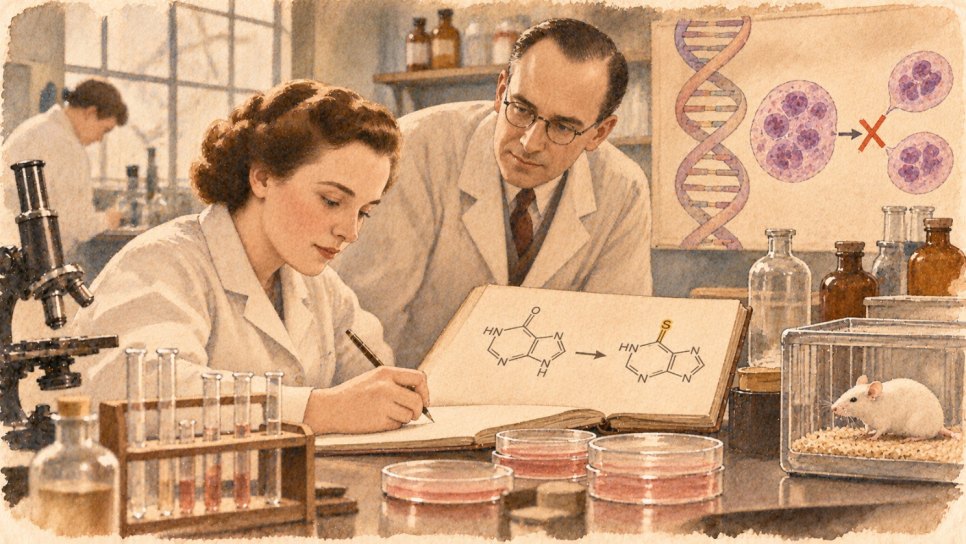
The isolation of estrone by Doisy and Butenandt in 1929 (day 105) had also raised a chemical question. Estrone was a steroid; inside its four-ring skeleton lay a three-ring structure called phenanthrene. The plausible assumption among chemists was that estrogenic activity depended on this skeleton. In London, Edward Charles Dodds (1899-1973) and his team put the assumption to the test. Dodds was a Liverpool-born biochemist and headed the Courtauld Institute of Biochemistry.
The first steps still lay within the phenanthrene world. In 1933-34 the synthetic compounds that Cook, Dodds and colleagues introduced were phenanthrene or 1:2:5:6-dibenzanthracene derivatives. In May 1935 the work turned into a priority dispute. When E. Friedmann proposed in Nature a general rule linking structure to activity, Cook and Dodds replied: they wrote that Blum and Bergmann were the first to observe the estrogenic action of synthetic compounds and that they themselves had confirmed it afterward; they also objected to the rule, because some diols derived from dibenzanthracene had no activity and others very high activity.
On 13 June 1936 Dodds and Wilfrid Lawson published a short letter in Nature titled "Synthetic oestrogenic agents without the phenanthrene nucleus". We could reach only its abstract; it says that the active compounds of earlier work were phenanthrene or dibenzanthracene derivatives. The conclusion we draw from the title is that it was beginning to be shown that activity did not depend on this nucleus; because we did not read the full text, this is an inference.
A letter with four signatures
Two years later the road stretched to Oxford: Dodds worked with Robert Robinson, head of the Dyson Perrins Laboratory. According to the Embryo Project, Lawson wrote the formula and Robinson's student Leon Goldberg synthesized the compound.
"Oestrogenic activity of certain synthetic compounds"
In the issue of Nature dated 5 February 1938 (volume 141, issue 3562, pages 247-248) a letter with four signatures appeared: E. C. Dodds, L. Goldberg, W. Lawson and R. Robinson. In conceptual summary, the authors describe how, in their two earlier publications, they had studied the estrogenic action of diphenylethane derivatives; how adding an ethylene bond between the alpha and beta carbon atoms markedly raised the activity; and how stilbene derivatives showed notable activity. This line led to the compound that secondary sources call diethylstilbestrol (DES; "stilboestrol" in Britain). We did not verify every detail of the letter from the full text; the information tying DES's structure to this letter rests on secondary sources.
A NON-STEROID ESTROGEN —
What changed? It became clear that a steroid skeleton was not needed for estrogenic action, and that a simpler molecule could elicit the same biological response. Today we explain this by the shape fit between a hormone and its receptor; in 1938 the concept of a receptor did not exist, and that explanation came later.
Why did it matter? DES was active by mouth and cost far less to make than natural estrogens: the Embryo Project gives about 2 dollars per gram against about 300 dollars (a single source; see the fact-check note below). A cheap hormone that was easy to administer was attractive to physicians and manufacturers alike; that attraction shaped the second half of the story.
Everyone's drug
That DES was not patented is written in two sources, but the reason is told differently. The DES Action site says it was never patented; the Embryo Project writes that it could not be patented because it was made in a publicly funded laboratory. We could not verify this against a primary document; the outcome is shared: many drug companies sold the same molecule under many brand names.
In the United States the FDA approved DES in 1941 for menopausal symptoms, suppression of postpartum lactation, gonorrheal vaginitis and atrophic vaginitis (Embryo Project). Cancer and pregnancy were not on that list. Use in pregnancy spread from the second half of the 1940s; when that use was formally approved is contradictory across sources (see the fact-check note), and the story is told in the "cost" box below.
Can withdrawing a hormone and giving one both cause tumors to regress?
The hormone idea in breast cancer had begun on day 91 with Beatson's removal of the ovaries: withdrawing the source of the hormone made some tumors regress. On day 105 Lacassagne had shown the opposite: too much hormone could produce tumors in a susceptible mouse.
In September 1944 the British Medical Journal (volume 2, pages 393-398) carried the article by Paterson, Watkinson, Haddow and Koller titled "Influence of synthetic oestrogens on advanced malignant disease". Later reviews cite Haddow's team as those who showed that, although estrogen was known to stimulate cancer, a high dose could be useful against some breast cancers, that is, who brought out the "estrogen paradox". According to one review, in high-dose series of the 1950s about a third of postmenopausal women with spread breast cancer responded; the same review also notes that about 70 percent of tumors do not respond.
The idea returned in 2009: Ellis and colleagues in JAMA (19 August 2009) compared 6 mg and 30 mg of estradiol in 66 postmenopausal women with advanced breast cancer resistant to an aromatase inhibitor; about 30 percent clinical benefit was reported in both groups. According to one review, cells long deprived of estrogen can go into apoptosis (programmed cell death) when given estrogen.
In prostate cancer, DES together with orchiectomy was for a long time the basis of hormone therapy. In 1967 the U.S. Veterans Administration cooperative group (VACURG) reported that 5 mg of DES a day significantly increased cardiovascular loss of life; later VACURG studies reported that 1 mg a day had similar activity with markedly fewer cardiovascular side effects. The main story of hormonal treatment of the prostate will come on day 112, with Huggins's 1941 work. According to the Embryo Project, tamoxifen replaced DES in breast cancer in 1977.
COST: A HORMONE USED IN PREGNANCY WITHOUT EVIDENCE OF BENEFIT —
In the late 1940s Smith and Smith in Boston reported that DES might reduce miscarriage and pregnancy complications (studies dated 1946, 1948 and 1949). This group consisted of women with a history of bleeding or recurrent pregnancy loss; it was later understood that the hormone measurements did not measure the intended hormone. In November 1953 in Chicago, Dieckmann and colleagues published in the American Journal of Obstetrics and Gynecology a placebo-controlled study in healthy pregnant women: 840 women received DES and 806 received placebo. DES did not reduce miscarriage, preterm birth or toxemia of pregnancy, nor did it reduce perinatal loss of life. Even so, the drug continued to be prescribed to pregnant women.
On 22 April 1971 Herbst, Ulfelder and Poskanzer in the New England Journal of Medicine (volume 284, pages 878-881) reported clear cell adenocarcinoma of the vagina in eight young women. Seven of them were cases that Herbst and Scully had reported earlier; four controls were chosen for each case. According to a secondary summary, the mothers of all seven earlier cases had taken DES during pregnancy. This was a rare tumor. The mothers had taken the hormone in pregnancy; the tumors appeared when the daughters were in their late teens and early twenties, that is, years after the pregnancy. Lacassagne's warning about "delay" now showed itself in the next generation.
Relative and absolute effect must be stated together. According to the NCI, in daughters exposed to DES in the womb this tumor is about 40 times more frequent than in the unexposed; in absolute terms it develops in about 1 of every 1,000 DES daughters. The same institute reports that between 1940 and 1971, 5-10 million people in the United States (pregnant women and their children) were exposed. With its bulletin of November 1971 the FDA warned physicians not to use DES in pregnant women; the drug was never banned. The increase in breast cancer risk is inconsistent across studies.
What remains
- The knowledge that estrogenic action does not depend on a steroid skeleton
- The "paradox" that a hormone can both stimulate a tumor and make some tumors regress (Haddow 1944, Ellis 2009)
- The principle of a placebo-controlled study first, wide use afterward
What fell or was surpassed
- DES to prevent miscarriage in pregnancy
- 5 mg a day of DES in prostate cancer (cardiovascular cost, 1967)
- DES as standard treatment in breast cancer (tamoxifen in 1977)
One molecule, two paths. DES, which emerged from the 1938 letter, gave a limited, dose-dependent response in cancer treatment; in pregnancy no evidence of benefit was found in 1953, and in 1971 it was linked to a tumor in the next generation.
What remains of this story today?
We could not establish a verified specific link between this story and Türkiye; the inference is general. Whether a mother used a hormone in pregnancy, and in which years, is information a patient can give her physician; anyone who thinks she may have been exposed to DES in the womb should discuss it with her physician. This piece is not advice but a historical reminder.
THIRTY-EIGHT YEARS
WHAT WAS CONFIRMED IN THIS PIECE AND WHAT REMAINS OPEN
- Nature citation: Dodds, Goldberg, Lawson and Robinson, Nature 141 (3562), 247-248, issue date 5 February 1938 (DOI 10.1038/141247b0); the page's online record also shows "1 March 1938", which is an archiving date. Only the summary of the introduction was read; DES's structure and Goldberg's synthesis rest on a secondary source (Embryo Project). Lawson's first name is "Wilfrid" in the 1936 citation and "Wilfred" in the Embryo Project; the citation's spelling was used.
- 1936 letter: Nature 137 (3476), 996, 13 June 1936 (DOI 10.1038/137996a0). Only the abstract was read; the inference of an "active substance without phenanthrene" rests on the title and abstract.
- Priority: According to Cook and Dodds's letter of 11 May 1935, the first to observe the estrogenic action of synthetic compounds was Blum and Bergmann; this conflicts with the account of Friedmann, with whom they were arguing. The claim "first synthetic estrogen" was therefore not used.
- Dodds: the years of his chair and directorship (1924; 1925 and 1927) and the dates of his knighthood and baronetcy (1954 and 1964; only 1964) conflict among sources; they were not used.
- Patent and cost: DES Action says "never patented"; the Embryo Project says "could not be patented because it was made in a publicly funded laboratory"; the reason is unclear, the outcome is the same. The 2 dollars / 300 dollars per gram figure appears only in the Embryo Project.
- FDA: the 1941 approval rests on the Embryo Project. The DES Action timeline writes that use in pregnancy was approved in 1947; that year does not appear on the Embryo Project page and could not be verified. For the November 1971 bulletin, DES Action writes that the drug was "never banned" and the Embryo Project that it was a "ban"; the wording "warning" and "contraindicated" was used. Whether the link was shown in 1970 (Herbst and Scully, seven cases) or in 1971 (eight cases) is muddled across sources; the two were kept apart.
- Herbst 1971: NEJM 284:878-881; the date of 22 April was derived from the article identifier. Eight patients, four controls per case, the age description and the DES history of the earlier seven mothers were taken from a secondary summary.
- Exposed: NCI and CDC 5-10 million people; Fink (1978) 2-4 million women. 1 in 1,000 and about 40-fold come from the NCI page.
- Smith and Dieckmann: the Smith studies (1946, 1948, 1949) were not read in the primary article. Dieckmann (AJOG 66:1062-1081, November 1953): 840/806 and the summary of results come from a secondary page; the numbers of miscarriages and preterm births could not be verified.
- Haddow 1944, VACURG, Ellis 2009: BMJ 1944;2(4368):393-398; the author order on that page is Paterson, Watkinson, Haddow, Koller. The one-third and 70 percent figures, the VACURG findings, and the 66 women and about 30 percent benefit in the Ellis study were taken from secondary reviews or a news page; primary reports were not read, and no volume or page is given for Ellis.
Reconnecting the Gullet: Adams, Phemister and Esophagectomy
On day 107 we told of the operation in which Graham removed a lung inside the chest. In 1938 two surgeons tried to remove a cancer from the lower chest part of the esophagus and join the remaining piece to the stomach. Tomorrow we will see how this operation entered the record, why the claim of "first" must be read with care, and what it cost.
Author's note: In this piece we kept two responsibilities apart. The first is the hormone itself: DES's chemistry in 1938 was clean and instructive; the requirement of a steroid skeleton fell. The second is the practice: that a drug without evidence of benefit in pregnancy was prescribed for years concerns how the success of a molecule came to be treated as enough to use it everywhere. We could not work out from our sources to what extent Dodds supported use in pregnancy; we wrote no judgment about him.
Sources and Further Reading
- Dodds EC, Goldberg L, Lawson W, Robinson R. Oestrogenic activity of certain synthetic compounds. Nature 1938;141(3562):247-248. doi:10.1038/141247b0.
- Dodds EC, Lawson W. Synthetic oestrogenic agents without the phenanthrene nucleus. Nature 1936;137(3476):996. doi:10.1038/137996a0.
- Cook JW, Dodds EC. Chemistry of oestrogenic substances (reply letter). Nature 1935;135(3419):793.
- Paterson E, Watkinson JM, Haddow A, Koller PC. Influence of synthetic oestrogens on advanced malignant disease. Br Med J 1944;2(4368):393-398.
- Dieckmann WJ et al. Does the administration of diethylstilbestrol during pregnancy have therapeutic value? Am J Obstet Gynecol 1953;66(5):1062-1081.
- Herbst AL, Ulfelder H, Poskanzer DC. Adenocarcinoma of the vagina: association of maternal stilbestrol therapy with tumor appearance in young women. N Engl J Med 1971;284:878-881.
- Ellis MJ et al. Lower-dose vs high-dose oral estradiol therapy of hormone receptor-positive, aromatase inhibitor-resistant advanced breast cancer: a phase 2 randomized study. JAMA, 19 August 2009.
- National Cancer Institute. DES fact sheet (cancer.gov).
- Embryo Project Encyclopedia (Arizona State University). Edward Charles Dodds (1899-1973); Diethylstilbestrol (DES) in the US.
- Mukherjee S. The Emperor of All Maladies: A Biography of Cancer. New York: Scribner, 2010. (General framework.)
This piece is day 110 of the "365 Days of Cancer History" series. The letter published in Nature on 5 February 1938 reported the work leading to the non-steroid estrogen known as diethylstilbestrol (DES); the molecule's use in cancer treatment and in pregnancy gave different outcomes. The text is prepared from a historical-popular perspective; it contains no diagnostic or treatment advice, and you should consult your physician about your own health. The information rests on primary articles and reliable secondary sources; details resting only on secondary sources are marked in the fact-check notes.
Was this article helpful?
Your feedback helps us improve our content.