Esophageal Cancer Surgery History: Adams and Phemister’s 1938 Esophagectomy and the “First” Debate
In this article
Reconnecting the Esophagus: Adams, Phemister and the Esophagectomy of 1938
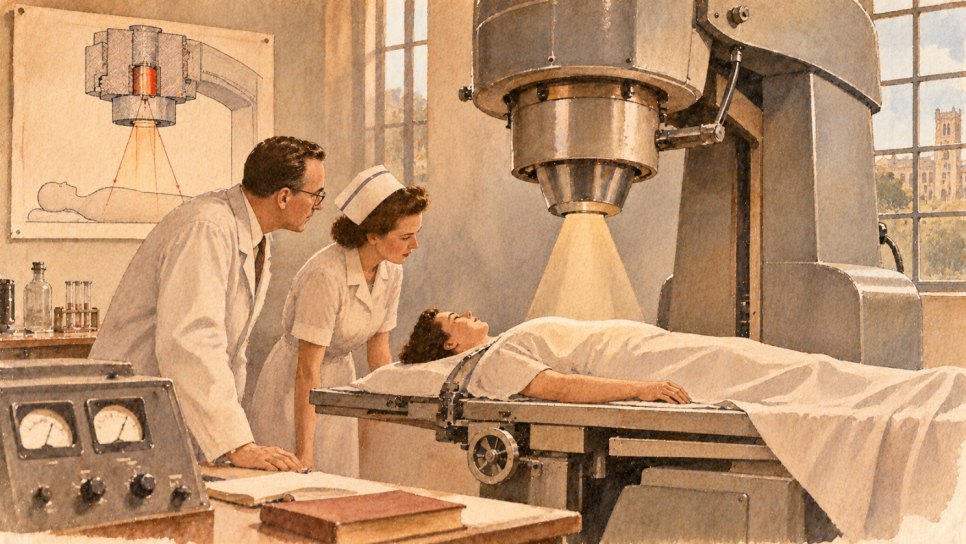
On day 110 we followed one molecule out of a London laboratory. Today we turn to surgeons. On day 107 Graham opened the chest and removed a lung; it was now known that one could operate inside the chest. But another organ that runs through the chest, the esophagus, posed a far more stubborn problem: removing it was hard, and once it was removed, joining it back together almost never held. In 1938 two surgeons removed a cancer from the lower chest portion of the esophagus, joined the remaining piece to the stomach inside the chest, and the patient lived for years. Was this the "first"? That is today's question, and the answer depends on who is counted as first and on what is called "success".
Why was this such a hard operation?
The esophagus begins in the neck, runs through the middle of the chest, passes the diaphragm and opens into the stomach. Removing a cancer inside the chest means dividing the tube into two ends: one left in the neck or chest above, the stomach below. For the patient to swallow again the two ends have to be joined; in surgery this join is called an anastomosis.
The features that make this difficult in the esophagus are listed in anatomy textbooks: unlike the intestine it has no outer serosal covering, sutures tear through the muscle easily, and the blood supply varies from segment to segment along the tube. Saliva and food leaking from a join can cause a severe infection in the chest (mediastinitis). On top of that, the collapse of the lung when the chest is opened and the problems of anesthesia doubled the surgeon's burden in an era when antibiotics were not yet widely available.
Can one live without joining the ends?
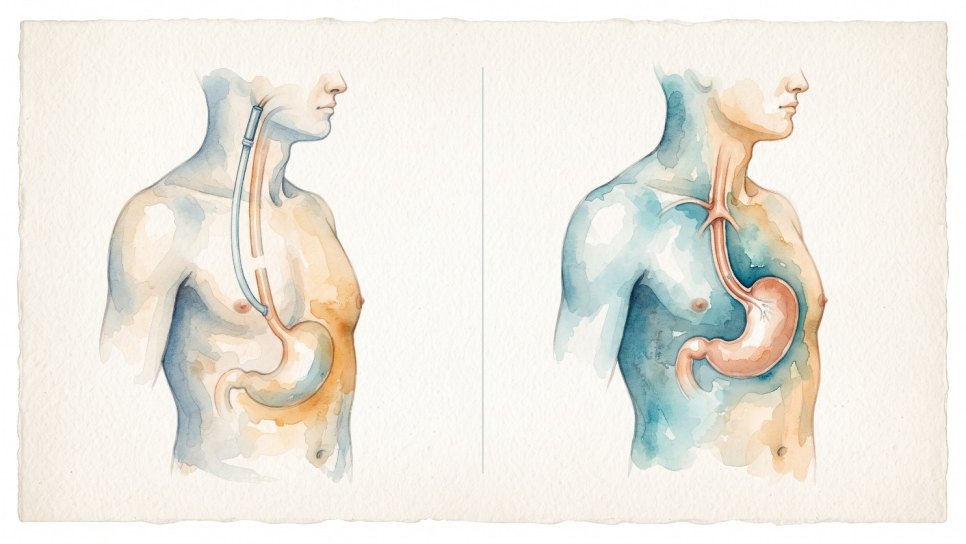
The first recorded successful removal of the chest portion of the esophagus was a solution that avoided the join altogether. Franz Torek (1861-1938), working in New York, removed a cancer of the thoracic esophagus on 14 March 1913; the title of his report in Surgery, Gynecology and Obstetrics calls it "the first successful case". In Torek's method the upper end was brought out through the skin of the neck, and swallowed food was carried to the stomach through a rubber tube that ran outside the body. The patient lived. According to the Garrison-Morton bibliography, a report in the Archives of Surgery in 1925 stated that the patient was still alive; other sources give the total survival as 12 or 13 years (see the fact-check note).
The method kept the patient alive but left her or him tied to a tube for life. Over the following twenty years surgeons tried to join the tube from the inside. Most attempts ended in a leak at the join.
A join on the inside
"Carcinoma of the Lower Thoracic Esophagus"
The article by W. Adams and Phemister, published in the Journal of Thoracic Surgery (1938, volume 7, issue 6, pages 621-632), is recorded under the title "Carcinoma of the Lower Thoracic Esophagus". We could not reach the article itself. According to what secondary sources relate, the operation took place on 26 January 1938: the chest was opened, the cancerous lower esophagus was removed, and the stomach was drawn up into the chest and joined to the remaining esophagus there. The patient survived the operation and lived for years. The length of survival is given as about 10 years in one source and 8 years in another.
The meaning of this case lies less in one patient's long life than in showing that a method was possible: remove the segment carrying the tumor, pull the stomach upward, rebuild swallowing from the inside. Torek's tube was a permanent workaround; the aim of this method was that the patient would eat and drink by mouth, not through a tube.
Why 1938? Three developments are usually mentioned together as general background: operations that open the chest, as we saw on day 107, had become feasible; anesthetic techniques had advanced; and the sulfonamides of the 1930s had made infection easier to manage. We cannot separate with our sources which of these weighed most; this should be read as a background note that we did not test against a separate source.
ANASTOMOSIS: JOINING TWO ENDS —
What changed? The two ends of a removed piece of organ are sewn to each other, or to another organ, so that nothing leaks. In the esophagus, pulling the stomach up into the chest and joining it to the remaining end is the surgical form of this idea.
Why did it matter? Because the success of the operation has two parts: "the patient comes out of the operation alive" and "the patient can swallow". If the tumor is removed but the patient cannot swallow, or the join leaks, the operation has failed. Throughout history both criteria have had to be met together.
Why must the word "first" be read with care?
This story contains at least three "first" claims, and none cancels the others. Torek reported the first case in which the chest esophagus was removed and the patient lived, but no join was made (1913). Ohsawa of Kyoto, according to sources, attempted a join between esophagus and stomach inside the chest before Adams and Phemister. The date of Ohsawa's attempts varies from source to source: 1925, 1929, 1932 or 1933; the size of the series is given as 14 or 16 cases, with a loss of life of about 50 percent. Because we could not read the primary article, we cannot treat these as settled. Marshall also reported a similar success in a year given as 1937 or 1938; the year conflicts in the sources.
The share of Adams and Phemister is that they were the best-cited "successful, surviving, in-detail reported" case in Western literature. We cannot explain from these sources why Ohsawa's earlier series was not cited in the West to the same degree; language, journal or poor results are guesses, not evidence. This repeats a motif of the series: the "rejected pioneer". The question here is not who was right, but in which language, in which journal and with how many cases a community of readers was persuaded.
So the sentence "Adams and Phemister performed the first successful esophagectomy" is too certain as historical information. The more honest sentence is this: according to common accounts, they were among the first to report in detail, and with long follow-up, an operation regarded as successful, with an intrathoracic join, for cancer of the lower thoracic esophagus in Western literature.
COST: ONE CASE IS NOT A RULE —
The first successful cases do not erase the cost of the operation. In Ohsawa's series the reported loss of life approached about half, according to sources. According to secondary accounts most attempts between 1913 and 1938 ended in failure; the exact proportion could not be verified. One patient's long survival does not tell us whether the tumor recurred or how well the patient could swallow; what we have is only that the patient lived for years.
Today's figures are very different from 1938. In a 15-year series from one Manchester center (772 patients, 531 operated, 449 resected; Thorax 1981) the operative loss of life among those resected was 7.6 percent; in the last 120 resections only three patients lost their lives. Five-year survival was projected at 18 percent, ten-year at 12 percent. In other words, the operation's own risk fell; the long-term course of the disease was still grave in most patients.
These figures come from one center and one period; they cannot be compared directly with the single case of 1938 or with another country's data. Swallowing problems, difficulty eating and quality of life after the operation are also commonly reported costs.
What remains
- The idea that the esophagus can be removed and joined to the stomach inside the chest
- That success in surgery means both surviving and being able to swallow
- The principle of moving from a single case to a series and reporting results in numbers
What fell or was surpassed
- Swallowing through a permanent external tube (Torek's method)
- Building the "first successful case" story on a single name
- The tendency to rely on surgery alone: in later years many centers added chemotherapy and radiotherapy to the operation
This picture recalls a rule we have followed since the start of the series: the date of an operation begins less on the day of the first successful case than on the day its results are reported honestly and in numbers. The cases of Torek and of Adams and Phemister showed the door; how many went through it, and how many came back, became clear only in years of serial reports.
From outside to inside. In 1913 Torek removed the esophagus and provided swallowing through an external tube; Ohsawa's attempts at an intrathoracic join and the case reported by Adams and Phemister in 1938 tried to rebuild swallowing from the inside. The cost of every step was a high early loss of life and single cases.
Traces of lower esophageal cancer in Türkiye
We could not establish a verified, specific link between this story and Türkiye; the inference is general. A study comparing esophageal cancer data from the Eastern Anatolia and Eastern Black Sea regions (found on onkder.org) examined 135 patients for Eastern Anatolia between 1996 and 2010 and 47 patients for the Eastern Black Sea between 1999 and 2013. The female-to-male ratio was 1.1 to 1 in Eastern Anatolia and 2.9 to 1 in the Eastern Black Sea; in both regions the tumors were most often in the lower esophagus, the very region targeted by the 1938 operation. Five-year survival is reported as 13.4 percent in Eastern Anatolia and 6.6 percent in the Eastern Black Sea. The study does not calculate incidence on a population denominator, so saying "more frequent in one region" means only looking at patient numbers. This is a historical context note, not advice.
FROM 1913 TO 1981
WHAT WAS CONFIRMED IN THIS PIECE AND WHAT REMAINS OPEN
- Adams and Phemister: the citation (J Thorac Surg 1938;7(6):621-632, "Carcinoma of the Lower Thoracic Esophagus") was confirmed from the reference list of Postlethwait's 1983 review. The article itself could not be read; the date of 26 January 1938, Chicago and the operative details rest on secondary sources. The first name of one author appears in sources as "William"; the initial W. from the reference list was used. Survival is about 10 years in one source and 8 in another; both are secondary.
- Torek: the citation (Surg Gynecol Obstet 1913;16:614-617) and the statement that the patient was still living in a 1925 report come from the History of Medicine / Garrison-Morton record. The operation date of 14 March 1913 and the total survival were taken from secondary sources; the duration conflicts (12 or 13 years). Torek's life years (1861-1938) are given in the same record; the New York detail rests on general biography and was not re-verified for this piece.
- Ohsawa: the year (1925, 1929, 1932 or 1933), the size of the series (14 or 16) and the loss-of-life rate (about 50 percent) are inconsistent across sources; the primary article was not read. For this reason no "first" claim was made.
- Marshall: 1937 or 1938; the conflict could not be resolved.
- Dark and colleagues: J. F. Dark, H. Mousalli, R. Vaughan, "Surgical treatment of carcinoma of the oesophagus", Thorax volume 36, issue 12, starting at page 891; the year 1981 was inferred from the volume number. The figures (772/531/449; 9.2 percent overall, 7.6 percent among resections; three in the last 120; 5-year 18 percent, 10-year 12 percent) were taken from the journal's page summary.
- Background note: the sentence on conditions before 1938 (chest operations, anesthesia, sulfonamides) is general medical-history knowledge; it was not tested against a separate source in this piece.
- Left out of scope: it is said that resections of the cervical esophagus reach back to the 1870s (Czerny) and that experimental attempts in the early 1900s (Dobromyslov) are cited; they were not included because they could not be verified against a primary source. The statement that most attempts between 1913 and 1938 failed is a secondary account; no number could be given.
- Türkiye data: the author and journal citation of the study on the onkder.org page (Eastern Anatolia 1996-2010, 135 patients; Eastern Black Sea 1999-2013, 47 patients) could not be extracted from the page. The study did not calculate regional incidence on a population denominator, and no significance test appears on the page. The survival figures (13.4 and 6.6 percent) are not broken down by type of treatment.
The Prostate's Chain: Huggins and Hormonal Therapy in 1941
On day 110 we touched on DES in prostate cancer and said the real story belongs to Huggins. Tomorrow we return to the same city, Chicago: how a urologist showed in 1941 that prostate cancer can depend on male hormones, how the hormone axis that began with Beatson on day 91 connects to it, and what this approach cost.
Author's note: In writing this piece we had to separate two meanings of "first": the first case that entered the record, and the first case that was read, cited and spread. They are not always the same person. Because we could not read Ohsawa from the primary article, we could not give him the weight he deserves; this is a gap on our part, and the piece should be corrected when one of the sources comes into our hands.
Sources and Further Reading
- Adams W, Phemister D. Carcinoma of the lower thoracic esophagus. J Thorac Surg 1938;7(6):621-632.
- Torek F. The first successful case of resection of the thoracic portion of the oesophagus for carcinoma. Surg Gynecol Obstet 1913;16:614-617. (Citation: historyofmedicine.com, entry 4045.)
- Dark JF, Mousalli H, Vaughan R. Surgical treatment of carcinoma of the oesophagus. Thorax volume 36, issue 12, p. 891 (thorax.bmj.com).
- Postlethwait RW. Carcinoma of the thoracic esophagus. Surg Clin North Am 1983;63(4):933-940. doi:10.1016/s0039-6109(16)43094-x.
- Comparison of esophageal cancer in the Eastern Anatolia and Eastern Black Sea regions. onkder.org, study page.
- Mukherjee S. The Emperor of All Maladies: A Biography of Cancer. New York: Scribner, 2010. (General framework.)
This piece is day 111 of the "365 Days of Cancer History" series. The operation reported by Adams and Phemister in 1938, which removed the tumor-bearing piece of the lower thoracic esophagus and joined the stomach inside the chest, is often cited as a turning point in the history of esophageal surgery. The text has been prepared from a historical-popular point of view; it contains no diagnosis or treatment advice, so consult your physician about your own health. The information rests on primary articles and reliable secondary sources; details resting only on secondary sources are marked in the fact-check notes.
Was this article helpful?
Your feedback helps us improve our content.