How Does One Sentence in a Report Call a Nation's Habit into Question? The Surgeon General and Smoking (1964)
In this article
How Does One Sentence in a Report Call a Nation's Habit into Question? The Surgeon General and Smoking (1964)
Yesterday we followed the dust of one mining region (Day 138); today we follow a country's most common habit. On Day 125 we told of two separate studies from 1950: Doll and Hill, and Wynder and Graham. Today's question is how that evidence reached a committee's table fourteen years later, and what the sentence the committee wrote rested on.
23 May 1962: a question at a press conference
According to Proctor's 2024 book review, President Kennedy's creation of the committee followed a question about smoking and cancer at a press conference on 23 May 1962. The National Library of Medicine (NLM) page describes a longer preparation: in June 1961 the American Cancer Society, the American Heart Association, the National Tuberculosis Association and the American Public Health Association had written to Kennedy asking for a national commission. Surgeon General Luther Terry announced the committee on 7 June 1962.
The selection process is a scene in itself. According to the NLM, four voluntary medical organizations, the FDA, the Federal Trade Commission, the American Medical Association and the Tobacco Institute were invited to propose candidates; only people who had not previously taken a public stand on tobacco were eligible. Proctor writes that cigarette makers had a veto over everyone proposed, and that half of the members smoked and half did not. In the end there were ten members: Stanhope Bayne-Jones, Walter Burdette, William Cochran, Emmanuel Farber, Louis Fieser, Jacob Furth, John Hickam, Charles LeMaistre, Leonard Schuman and Maurice Seevers; the chair was Terry.
The first executive director was Herman Kraybill of the National Cancer Institute. According to Proctor, Kraybill was removed under pressure from industry lawyers because in 1962 he told a journalist that the evidence "definitely suggests" tobacco is a health hazard; Wikipedia says he resigned.
"Smoking and Health: Report of the Advisory Committee to the Surgeon General of the United States"
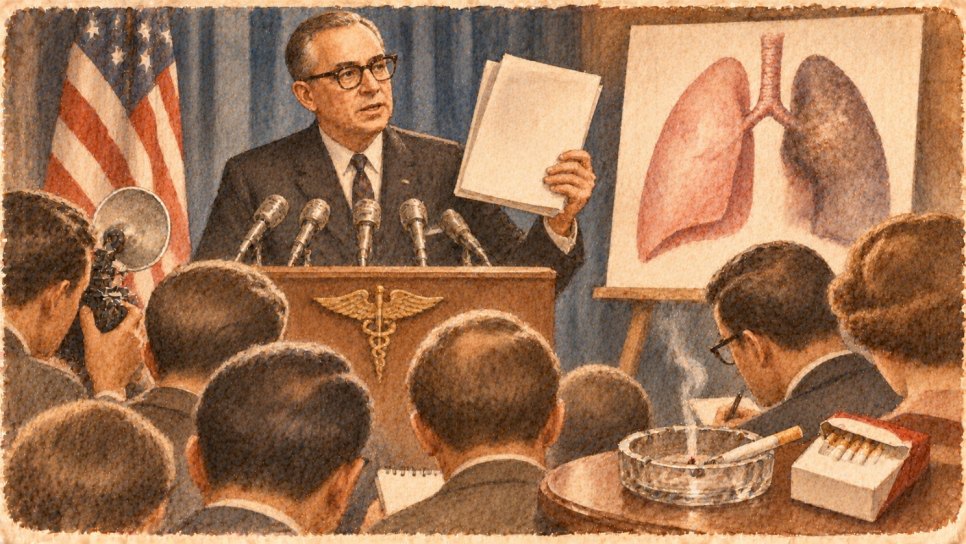
Terry presented the main points of the report at a press conference in Washington on 11 January 1964. According to the NLM, a Saturday was chosen to limit the effect on the stock market and to get the widest coverage in the Sunday papers; Proctor recalls the fall in tobacco shares after the December 1953 mouse-skin experiment of Wynder, Graham and Croninger. The report ran to about 387 pages (The Pump Handle). The committee had done no new experiments; it evaluated animal studies, clinical and autopsy studies, and retrospective and prospective epidemiological studies. The NLM, the CDC and the NIH Record say more than 7,000 articles and about 150 consultants; Time magazine wrote "about 8,000" that same year.
The concluding statements, as the 1989 Surgeon General's report quotes them, run as follows: cigarette smoking is "causally related" to lung cancer in men; the data for women, "though less extensive, point in the same direction"; smoking is a cause of laryngeal cancer in men; it is the most important cause of chronic bronchitis; male smokers had a 70 percent excess rate of lives lost compared with men who had never smoked; and smoking is a health hazard "of sufficient importance" to "warrant appropriate remedial action". Time reports that the committee was unanimous on this last sentence.
Criteria of causation
The difference between association and cause was the most lasting contribution of this report. According to the 1989 report, the committee judged an association causal only when the evidence was consistent, strong, specific, supportive of the appropriate temporal relationships, and coherent. Bradford Hill's talk "The environment and disease: association or causation?" appeared the following year, 1965, in the Proceedings of the Royal Society of Medicine (58(5):295-300); it presented nine viewpoints (I write the number from memory; I did not read the text in this session).
Meetings in the basement and seven follow-up studies
According to the NIH Record, the staff offices were on C Level of the new NLM building, three floors underground. The full committee met in a makeshift enclosure the staff called the "bullpen", under six feet high, open at top and bottom, with no doors. The members had full-time academic jobs and usually met Friday to Saturday, later sometimes Sunday and Monday. Donald Shopland, assigned to the work at 18, recalled "a few ugly words" and "more than a few shouting matches" in the debates (as reported by the NIH Record).
The core of the evidence differed from the case-control studies of Day 125: it pooled seven prospective studies that followed people who were not ill for years. According to The Pump Handle, these included about 34,000 British doctors of Doll and Hill and about 188,000 American men of Hammond and Horn. In the pooled follow-up there were 26,233 observed lives lost among smokers against 15,654 expected for their age; the ratio is 1.68. By my arithmetic the difference is 10,579 excess lives lost. Time reports the lung cancer rate of life loss as "almost 11 times" that of non-smokers, bronchitis and emphysema as 6.1 times, laryngeal cancer 5.4 times, stomach and duodenal ulcers 2.8 times, bladder cancer 1.9 times and coronary artery disease 1.7 times.
A review is not new science; ratios are not an individual's fate
First limit: the report was not new experiments but a juried review of existing publications (Proctor). None of the committee members was an expert on smoking and health (according to the book Proctor reviews), and according to the NLM nobody came from psychology or the social sciences. Second limit: the ratios are relative and at group level. 1.68 means 26,233 observed against 15,654 expected in the pooled follow-up; I did not read the follow-up time or the number of person-years, so I cannot turn it into an annual individual risk. I also did not find an absolute lung cancer figure in the sources I read. Third limit: the committee did not consider the data sufficient to label coronary heart disease and emphysema causal, even though the associations were "significant" (1989 account); for coronary disease it wrote that it was "more prudent from the public health viewpoint" to assume the association has causative meaning than to suspend judgment until no uncertainty remains (The Pump Handle).
Fourth limit, the committee's own mistake: it called tobacco use "habituation" rather than addiction. The 1989 report says this is how it was viewed in 1964 and that later evidence showed cigarettes to be addicting; Proctor too counts it among the report's errors. Fifth limit, about outcomes: adult smoking fell from over 40 percent in 1960 to about 11 percent today (NIH Record). My sources do not separate how much of this decline belongs to the report and how much to later laws, prices and other factors; I do not present the report as the sole cause.
What remained
- Weighing the evidence as a whole rather than study by study
- Looking for several criteria of causation together
- An independent expert panel writing a public, annual report
What fell or was limited
- Calling smoking "habituation", not addiction
- Public belief in causation staying a minority view: Gallup 44 percent in 1958, 78 percent in 1968 (NLM)
- Treating waiting until the evidence is complete as the only reasonable stance
The road to the report and after it: 1950 to 1969. The axis runs from 1950 to 1970. Green marks are dates confirmed in more than one source or in an institutional page (7 June 1962, November 1962, 11 January 1964); blue marks come from a single secondary source, from a year only, or from a date whose day is not confirmed. Dates known only by year are drawn mid-year and those known only by month mid-month.
I draw no direct line from the report to Turkey
My sources do not show what effect the 1964 report had in Turkey that year; I will not invent a local link. What can be verified is this: Turkey's first anti-tobacco law, Law No. 4207, was adopted on 7 November 1996 (Official Gazette 26 November 1996, issue 22829); Turkey ratified the WHO Framework Convention on Tobacco Control in 2004; Law No. 5727 of 3 January 2008 amended Law 4207, and a 2012 document of the WHO Regional Office for Europe reports this as a smoking ban in all public places, hospitality venues included. A general inference (my reading): the chain "independent evidence panel, then legal measure" is familiar in these laws as well; but the sources do not show the link between the Turkish process and the report.
From 1950 to today
What was verified and what conflicts
- Reading limit: I did not read the report itself in this session. All accounts are secondary: the NLM Profiles in Science page, the NIH Record, the CDC history page, Time (17 January 1964, only the first page of the article, via an automated summary), The Pump Handle (2012), Proctor's 2024 book review, and the quotations in chapters 1 and 2 of the 1989 Surgeon General's report. The "concluding statements" come from the 1989 account.
- Lung cancer ratio: Time (1964) and The Pump Handle say "almost 11 times". The NLM page says "9-10 times for average smokers, at least 20 times for heavy smokers"; the NIH Record and Wikipedia summarize "10 to 20 times". I could not reconcile these; "almost 11 times" is written only as Time's account.
- Overall life loss: the NLM and the 1989 account say "70 percent excess"; The Pump Handle gives 1.68 and 26,233 / 15,654 (the quotient is 1.676; that is 68 percent). I wrote both. The length of the pooled follow-up and the person-years are not in the sources I read.
- Number of articles: NLM, CDC, NIH Record: over 7,000. Time (1964): about 8,000. I do not know which counting method each rests on.
- Kraybill: Proctor says "removed under pressure from industry lawyers", Wikipedia says "resigned"; the post was then left unfilled (Wikipedia). Proctor also writes that the committee began with 11 people; I did not resolve it.
- Dates: 7 June 1962 for the committee's announcement (NLM); the NIH Record says the committee convened in November 1962, and the NLM says the work ran from November 1962 to January 1964. I did not use The Pump Handle's "began in January 1962". 23 May 1962 for the question to Kennedy is from Proctor only. November 1962 is drawn mid-month in the figure; I do not know the day.
- Location of the press conference: the AP photo caption says "news conference in Washington". I could not verify the often-cited "State Department auditorium" detail and did not use it.
- RCP 1962: the figures are from the RCP history blog; the page does not give the month of the report, so I did not put it in the figure.
- Hill 1965: the citation was verified from the PMC page (PMID 14283879); the number "nine viewpoints" is from memory, the text was not read.
- Turkey: the adoption date of Law 4207 (7 November 1996) and its Official Gazette citation are from the text on alomaliye.com; the page shows Articles 1, 2 and 3 amended by Law 5727 of 3 January 2008. The FCTC ratification (2004) and the 2008 ban are from the summary of the WHO Europe document; I did not read the full text and wrote no dates of entry into force.
- Doll-Hill and Hammond-Horn: the figures of 34,000 doctors and 188,000 men are from The Pump Handle; I did not read the original papers.
What does it look like to search for a virus inside a lymphoma?
Today we followed a country's habit; tomorrow we will look inside a single tumor cell. 1964, London: Burkitt lymphoma cells and the electron microscope. You may remember that on Day 136 we drew Burkitt's map; tomorrow we go to the cellular counterpart of that map. I will verify the names, dates and details tomorrow.
Author's note: The easy path for this article was to write "the report ended smoking" or "the report showed it for the first time". Both would have been wrong: the report came two years after the British report of 1962, contained no new experiments, and carried an error such as the "habituation" label; its strength lay in an independent panel weighing the existing evidence and gathering it into a single sentence. I did not read the report itself and took everything from secondary sources and the 1989 account; this is written in the fact-check box.
Sources and Further Reading
- U.S. Public Health Service. Smoking and Health: Report of the Advisory Committee to the Surgeon General of the United States. PHS Publication No. 1103. Washington, DC: U.S. Department of Health, Education, and Welfare, 1964 (citation from the Wikipedia page; the report itself was not read; concluding statements from the 1989 account).
- National Library of Medicine, Profiles in Science. The 1964 Report on Smoking and Health. profiles.nlm.nih.gov/spotlight/nn/feature/smoking (read).
- Proctor RN. The Making of the 1964 Surgeon General's Report on Smoking and Health. Am J Public Health 2024;114(11):1143-1145. doi:10.2105/AJPH.2024.307825 (review of LeMaistre, Shopland et al., Clearing the Air; read).
- NIH Record. Historic Public Health Report Marks 60th Anniversary. 16 February 2024 (read).
- Centers for Disease Control and Prevention. A History of the Surgeon General's Reports on Smoking and Health (read).
- Time. Smoking: The Government Report. 17 January 1964 (first page only, read through an automated summary).
- The Pump Handle. Public Health Classic: Surgeon General's 1964 Report on Smoking and Health. 2 October 2012 (read, secondary).
- Hill AB. The environment and disease: association or causation? Proc R Soc Med 1965;58(5):295-300. PMID 14283879 (citation verified; text not read).
- World Health Organization Regional Office for Europe. Tobacco control in Turkey: story of commitment and leadership. Copenhagen, 2012 (abstract read); Law No. 4207 on the Prevention and Control of the Harms of Tobacco Products, text on alomaliye.com (read).
- Royal College of Physicians. Smoke signals: the significance of the 1962 Smoking and health report for the RCP. history.rcp.ac.uk (read).
- Mukherjee S. The Emperor of All Maladies: A Biography of Cancer. New York: Scribner, 2010 (for general context; the relevant part was not read in this session).
This article is Day 139 of the series "A History of Cancer in 365 Days" and tells the story of the 1964 Surgeon General's report as a historical event. It is historical-popular content, not diagnostic or treatment advice. For quitting smoking and decisions about your health, consult your doctor. The sources have been verified; details resting only on a secondary source or that could not be read are marked in the fact-check notes.
Was this article helpful?
Your feedback helps us improve our content.