What Does It Look Like to Search a Tumour Cell for a Virus? Epstein, Barr, Achong and Burkitt Lymphoma (1964)
In this article
What Does It Look Like to Search a Tumour Cell for a Virus? Epstein, Barr, Achong and Burkitt Lymphoma (1964)
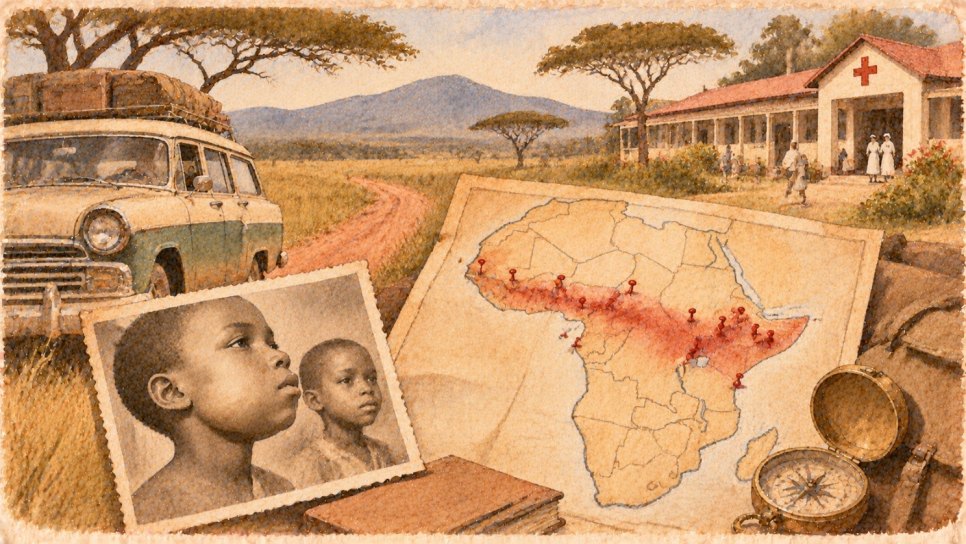
Yesterday we watched the habit of a whole country (Day 139); today we look inside a single tumour cell. On Day 136 we drew Denis Burkitt's map of Africa: a jaw tumour in children clustered along the malaria belt. The cellular counterpart of that map appeared under an electron microscope in London. On Day 97, describing Rous's chicken sarcoma virus, we said "most cancers are not viral"; today's story does not break that sentence, it shows its limits.
March 1961: a lecture at the Middlesex Hospital
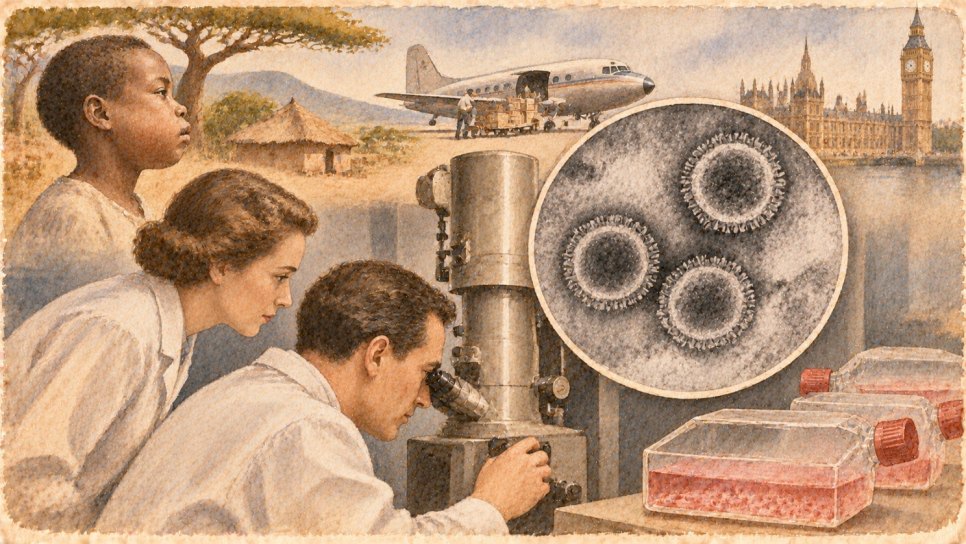
According to Cancer Research UK's 2014 article, Burkitt gave a talk in London on 22 March 1961, and Anthony Epstein was in the audience. Rickinson's commemorative speech and the University of Bristol's 2024 article give the venue as the Middlesex Hospital; Burkitt was a surgeon at a mission hospital in Uganda and described this tumour in children in tropical Africa. According to Wikipedia, Epstein was then working on viruses that cause cancer in chickens and shifted his research to a search for a viral origin of Burkitt's tumour (a continuation of the Rous line on Day 97). According to Gruffat and Manet, Epstein suggested the tumour might be caused by an insect-borne virus.
Rickinson reports that he had gained his electron microscopy experience during a sabbatical at the Rockefeller Institute in New York. The Bristol article says Epstein searched tumour samples for a virus for about two years with his newly appointed doctoral student Yvonne Barr and found nothing; Rickinson likewise says the first results from African samples were negative.
December 1963: fog and a cloudy tube
In the story as told, a biopsy sample flown from Kampala was diverted to Manchester because of fog (Bristol, Gruffat and Manet). In London the preservative fluid looked cloudy, which usually signals bacterial contamination. Looking under the microscope, Epstein saw that the cloudiness was not contamination but cells that had detached from the tumour. According to Gruffat and Manet, this led him to suspension culture, which worked where plate culture had failed; in CRUK's words, the long journey had loosened some tumour cells. Rickinson writes that in December 1963, after about two years of work, one tumour yielded a cell line able to grow in culture, and that it was named "EB1" after Epstein and Barr.
The sources do not agree on the date: Wikipedia places the discovery in February 1964, while Gruffat and Manet put the fog episode in December 1963 and enough cells for electron microscopy a few weeks later. In the diagram I drew December 1963 with an amber marker to show the conflict.
"Virus particles in cultured lymphoblasts from Burkitt's lymphoma"
The short note by Epstein, Achong and Barr appeared in volume 1 of The Lancet, pages 702-703 (this is the author order: Epstein, Achong, Barr). The Garrison-Morton entry says the paper reported "herpes-like virus particles" in cells from Burkitt's tumour. According to Rickinson, Epstein saw herpesvirus-like particles in EB1 cells, but only a small fraction of the cells were infected. The Bristol article says the discovery was reported in The Lancet three years and a week after the lecture.
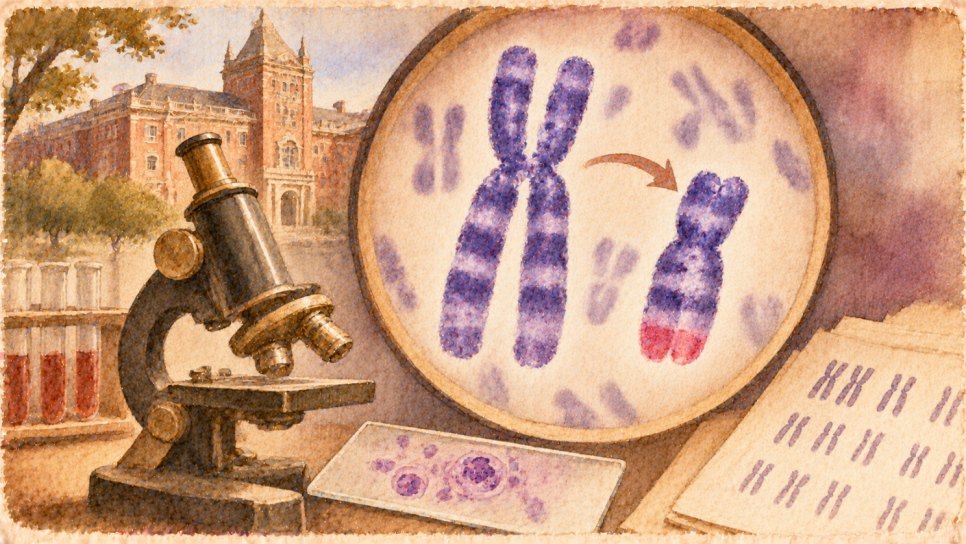
I have not read the text of the Lancet note. The limits come from the same team's detailed paper in the Journal of Experimental Medicine, published on 1 May 1965 (121(5):761-770): both the EB1 and EB2 lines, from two different biopsies, contained a virus of the same appearance; it was seen in about 1-2% of cells, as immature (about 75 mµ) and mature (110-115 mµ) particles; the authors report "some indication" that particles mature by budding through the cell membrane. All attempts to isolate and identify the virus failed, and the authors describe it as "unknown, unidentified". No detectable effect was seen in chick embryos, newborn hamsters and mice, or in nine tissue culture systems.
Latent infection
A virus can sit silently in a cell for years without multiplying and, often, without causing disease (delayed or latent infection; simplified definition). According to Rickinson, molecular methods showed the EBV genome as a latent infection in every African Burkitt lymphoma examined. So seeing particles in 1-2% of cells does not rule out that the genome sits silently in most of the rest.
Rivals, an "unknown virus" and the serology in Philadelphia
Epstein's team was not alone in this field in 1964. According to the reference list of the JEM paper, Dalldorf and Bergamini reported unidentified filterable agents from malignant lymphomas in African children; Bell and colleagues wrote that they had isolated a reovirus from a Burkitt case; and Epstein, Woodall and Thomson reported lymphoblastic lymphoma in African green monkeys given Burkitt biopsy material. I have not read any of these publications; I only pass on the citations as listed. So "a virus was found in Burkitt's tumour" did not have a single right answer in 1964; what set Epstein's team apart was the particles seen in a cell line, and what they were remained unknown.
According to Gruffat and Manet, Gertrude and Werner Henle of the Children's Hospital in Philadelphia used patient sera against the known human herpesviruses to show that the new virus was different from them, and named it after the EB1 line. Rickinson also writes that the Henle team showed the virus to be distinct from the three known human herpesviruses and proposed the name "EB virus"; neither gives the date of the naming. CRUK says it was officially called EBV in 1965, yet the JEM paper of the same year still calls the virus "unknown"; I have left this conflict for the fact-check box.
In 1968 the Henles and Volker Diehl published in the Proceedings of the National Academy of Sciences (59:94-101) the relation of the Burkitt tumour-associated herpes-type virus to infectious mononucleosis; the Garrison-Morton entry summarises this as showing that EBV causes mononucleosis. According to Gruffat and Manet, this was demonstrated when a laboratory worker who had not previously been infected fell ill and seroconverted.
Seeing a virus particle is not showing a cause; a virus everyone carries is not the cause of every cancer
First limit: what was obtained in 1964 was particles seen in 1-2% of the cells of cultured cell lines. A virus that could not be isolated, could not be identified and had no effect in animals (JEM 1965) cannot be said to be the cause of the tumour; what had been shown at that stage was "a virus exists", not "this is the cause of the tumour" (my reading). Second limit, relative and absolute effect read together: CRUK writes that about 9 in 10 adults in America are seropositive for EBV; in a Yozgat study of 2,323 people measuring EBV VCA IgG (author and year are not given on the catalogue page), overall seropositivity was 82.2%. So meeting the virus is usual for almost everyone, whereas Burkitt lymphoma is rare; I could not find the absolute incidence of Burkitt lymphoma in the sources I read.
Third limit, the virus alone is not enough: CRUK writes that genes, diet and other infections also play a part; the discovery at the Karolinska Institute in 1976 of a chromosome change involving the c-myc gene is also part of the story (CRUK; it connects to the translocation line of Day 137). Fourth limit, naming and labour: the virus carries the names of two of the three people. Bert Achong (1928-1996) helped with the electron microscopy, and sources describe Barr (1932-2016) as a "research assistant" (Rickinson, Gruffat and Manet) or a "doctoral student" (Bristol); I could not resolve the conflict. Fifth limit, the vaccine: Rickinson writes that Epstein worked on an EBV vaccine from the 1970s and that large pharmaceutical companies are testing vaccine candidates in clinical trials; the sources of this article do not mention an approved EBV vaccine.
What remained
- Growing a tumour cell line in suspension culture and examining it under the electron microscope
- Using serology to tell the new virus from the known ones (the Henles)
- The virus's link to infectious mononucleosis too: not only an "African tumour virus"
What fell or was limited
- The phrase "unknown, unidentified virus" (it was named after 1965)
- Treating the sight of a particle as showing a cause
- Tying Burkitt lymphoma to the virus alone: other factors are also cited
The road to the discovery of the Epstein-Barr virus: 1958 to 1973. The axis runs from 1955 to 1975. Green markers are dates found in several sources or in records with verified citations (March 1961, March 1964, 1 May 1965, 1968); the amber marker is a date on which sources conflict (December 1963 versus February 1964); blue markers come from a single secondary source or from the year alone. Dates known only by year are drawn mid-year, dates known only by month mid-month.
A seroprevalence measurement from Yozgat
My sources show no local link to this discovery in Turkey in 1964, and I do not invent one. There is a verifiable data point: in Yozgat, EBV VCA IgG seroprevalence was measured by ELISA in 2,323 people aged from 6 months to 96 years; overall seropositivity was 82.2%, 60.2% at 6 months-2 years, 70.2% at 3-5 years, 89.9% at 20-29 years; 85.5% in women and 79.1% in men. Positivity rose with the number of siblings; housing, income, place of residence and daycare attendance were not associated with it (only the abstract of a thesis catalogue; author and year are not on the page, and I did not read the full text). My inference: early encounter with the virus is very common in Turkey too, and EBV's link to cancer should be read as the rare consequence of a common infection.
From 1958 to today
What is verified, what conflicts
- Reading limit: I did not read the text of the Lancet note; only its citation (Garrison-Morton entry: Epstein, Achong, Barr; Lancet 1:702-3, 1964) and secondary accounts. Of the 1965 JEM paper (PMC) only the page summary was read. All other reports come from CRUK (2014), the University of Bristol (2024), Rickinson's commemorative speech (undated), Gruffat and Manet (médecine/sciences 2024; in French) and EA4HP (2021).
- Lancet date: CRUK says "March 1964". In Gruffat and Manet's reference list the issue is printed as "15"; it may be the day, I could not verify it. Reading "three years and a week later" (Bristol) together with 22 March 1961 gives 28 March 1964, but that is my inference; in the text I wrote only "March 1964".
- Discovery date: Rickinson and Gruffat-Manet describe the fog and the cell line in December 1963; Wikipedia places the discovery in February 1964. Shown with the amber marker.
- The fog story: The diversion of the Kampala biopsy to Manchester appears in Bristol, CRUK and Gruffat-Manet; details vary, and I wrote the common core.
- Barr's role: Bristol says "doctoral student", Rickinson and Gruffat-Manet say "research assistant", Wikipedia says both student and co-discoverer. Unresolved.
- The "first human tumour virus" claim: CRUK and Rickinson call EBV the "first human tumour virus"; Garrison-Morton says "first human cancer virus". The JEM 1965 wording "unknown, unidentified" and the failure to isolate weaken the claim for 1964. I did not adopt the "first" claim here; the rival reports (Bell reovirus, Dalldorf-Bergamini) were taken only from JEM citations and not read.
- Naming: CRUK says "officially EBV in 1965"; Gruffat-Manet and Rickinson write that the Henles named it, without a date. The JEM paper of the same year (May 1965) leaves the virus unnamed.
- Burkitt's lecture: March 1961 and the Middlesex Hospital appear in several sources; 22 March only in CRUK.
- Yozgat data: author, year and university are not on the catalogue page; the title and figures come from there.
- Epstein's life: born 18 May 1921, passed away on 6 February 2024 aged 102 (Wikipedia; Bristol says the news was announced on 21 February 2024). Royal Society fellowship 1979 and knighthood 1991 from Gruffat-Manet.
- c-myc 1976, stomach cancer 1991 and 2009: from CRUK only; details not read.
Why does a bacterium stop dividing?
Today we searched a tumour cell for a virus; tomorrow we go to a cancer drug born from bacteria that stopped dividing in an electric field. The early 1960s, Michigan State University: platinum electrodes and Barnett Rosenberg. You may remember that on Day 96 we described Ehrlich's idea of the "magic bullet"; tomorrow we will see how that idea was reborn from an unexpected source. I will verify the names, dates and details tomorrow.
Author's note: The easy route for this article was to say "Epstein proved the first human cancer virus". What was shown in 1964 was particles seen in a cell line at a rate of 1-2%, which could not be isolated or identified; by the authors' own words the virus was "unknown". Most adults carry the virus and cancer is rare, which is why the serology and molecular work of the following decades carried the real weight of the evidence. I did not read the Lancet note itself; I say so in the fact-check box.
Sources and Further Reading
- Epstein MA, Achong BG, Barr YM. Virus particles in cultured lymphoblasts from Burkitt's lymphoma. Lancet 1964;1:702-703 (citation from the Garrison-Morton entry; text not read).
- Epstein MA, Henle G, Achong BG, Barr YM. Morphological and biological studies on a virus in cultured lymphoblasts from Burkitt's lymphoma. J Exp Med 1965;121(5):761-770. doi:10.1084/jem.121.5.761. PMID 14278230 (PMC page summary read).
- Henle G, Henle W, Diehl V. Relation of Burkitt's tumor-associated herpes-type virus to infectious mononucleosis. Proc Natl Acad Sci USA 1968;59:94-101 (Garrison-Morton entry read).
- Cancer Research UK. 50 years of Epstein-Barr virus. Emma Smith, 26 March 2014 (read).
- University of Bristol. Professor Sir Anthony Epstein CBE FRS, 1921-2024. February 2024 (read).
- Rickinson A. Sir Anthony Epstein FRS: Oxford blue plaque unveiling speech, oxonblueplaques.org.uk (undated; read).
- Gruffat H, Manet E. Sir Anthony Epstein (1921-2024): le découvreur du virus d'Epstein-Barr. médecine/sciences 2024;40(8-9):665-669 (in French; read).
- EA4HP. Prof. Sir Anthony Epstein, born on May 18th 1921. european-association-for-haematopathology.org, 11 May 2021 (read).
- Yozgat ilinde farklı yaş gruplarında Epstein-Barr virüs immünglobulin G seroprevalansının belirlenmesi (Determination of Epstein-Barr virus immunoglobulin G seroprevalence in different age groups in Yozgat province). Açık Bilim (YÖK), thesis catalogue entry (abstract read; no author or year).
- Mukherjee S. The Emperor of All Maladies: A Biography of Cancer. New York: Scribner, 2010 (general context; the relevant section was not read in this session).
This article is Day 140 of the "365 Days of Cancer History" series and tells the discovery of the Epstein-Barr virus as a historical event. It is historical-popular content, not a diagnosis or treatment recommendation. For decisions about infection, blood results and your health, consult your physician. The sources are verified; details that rest on a secondary source alone or could not be read are marked in the fact-check notes.
Was this article helpful?
Your feedback helps us improve our content.