Huggins and Hodges 1941: Hormone Therapy for Prostate Cancer, Castration and the 1966 Nobel Prize | Day 112
In this article
The Prostate's Chain: Huggins, Hodges and Hormonal Therapy in 1941
Half a milliliter of serum was enough for each measurement. On day 111 we watched a surgeon in Chicago join the esophagus to the stomach inside the chest; today, in the same city and at the same university, we watch a surgeon look only at blood samples and at one question: if prostate cancer depends on male hormones, can that dependence be measured and cut? On day 91 Beatson's removal of the ovaries showed us the hormone line in breast cancer, on day 105 Lacassagne's estrogen-induced tumors in mice, on day 110 the DES molecule. Today that line is tied, for the first time, to a response measured with a blood test.
The trace of spread cancer in the blood
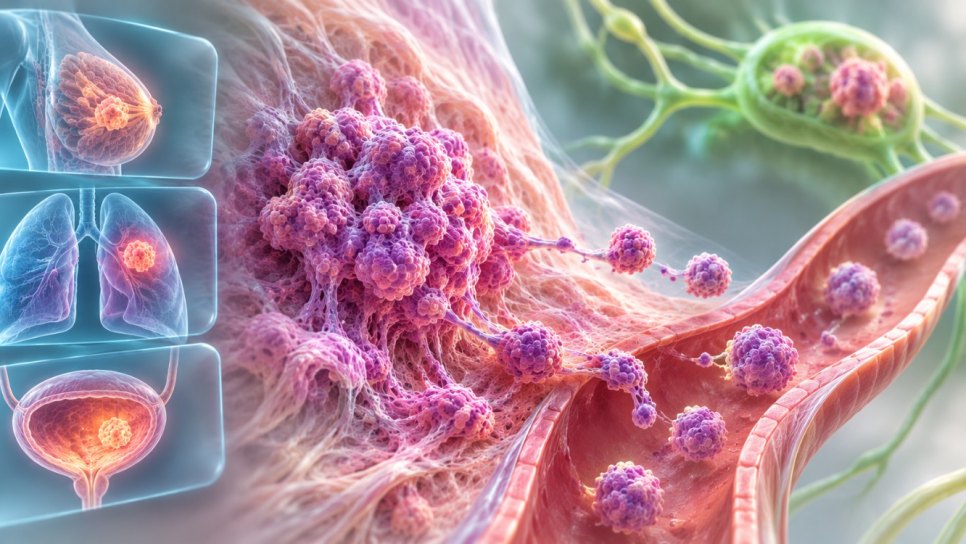
The prostate is a gland below the bladder that produces part of the fluid that nourishes sperm. Its growth depends on male hormones (androgens). Cancerous prostate cells often spread to bone; a bone metastasis means pain and fractures. Before 1941 there was no effective treatment for spread disease.
The two supports of the work appear separately in the sources. The first was an observation: in 1938 Gutman and Gutman reported that the enzyme acid phosphatase was raised in the blood of many patients with spread prostate cancer. The second was a concept: the 1949 review by Brendler and colleagues cites "Huggins' concept", the view that prostate cancer is an overgrowth of adult prostatic epithelial cells that shrink when androgens fall. According to the Nobel lecture Huggins thought that serum acid phosphatase showed the activity of the spread cancer cells. So an idea and a measurement were in hand; what was missing was an intervention that would really shrink the tumor.
Charles Brenton Huggins (1901-1997) was born in Halifax, graduated from Harvard, joined the University of Chicago in 1927 and was professor of surgery from 1936 to 1962 (Nobel biography).
Does withdrawing androgen make the tumor regress?
"Studies on prostatic cancer. I."
In 1941 Charles B. Huggins and Clarence V. Hodges published in volume 1 of Cancer Research (pages 293-297) the paper titled "Studies on prostatic cancer. I. The effect of castration, of estrogen, and of androgen injection on serum phosphatases in metastatic carcinoma of the prostate". The title gives us three interventions and one measure: removal of the testes (castration, orchiectomy), estrogen and androgen injection; the measure is serum phosphatases in patients with spread prostate cancer. We did not reach the full text; for detail we relied on Huggins's 1966 lecture and the 1949 review. A second paper appeared in August 1941 in the Archives of Surgery (volume 43, page 209) under Huggins, Stevens and Hodges and dealt with castration in clinical patients; a third was published the same year in the Journal of Urology (volume 46, page 997) under Huggins, Scott and Hodges.
According to the Nobel lecture the first series consisted of the orchiectomy of 21 patients with far advanced metastases. The lecture summarizes that orchiectomy or phenolic estrogens led to regression of human prostate cancer, whereas the male hormone testosterone increased the growth rate of the tumor in untreated cases. The 1949 review conveys the same line: the finding was later verified by others (Herbst 1941, Alyea and Henderson 1942) and gave the research "great impetus".
The 1949 review mentions the third paper of 1941 as a study on fever, desoxycorticosterone and estrogen. The same review also writes that Huggins and Hodges gave androgen, in smaller amounts and for a shorter time, to three previously castrated patients with metastatic disease. This was a step that tested from the opposite direction the idea that androgen stimulates the tumor; we could not find its detailed results in our sources.
Was this the first hormonal treatment? No: the recorded beginning of systemic hormonal treatment is Beatson, whom we told on day 91 (1895-96). Huggins's share is that he made the dependence measurable in the prostate and showed the response with a series. It is said that before Huggins castration had been tried in prostate disease; because we could not verify this, we made no claim of a "first".
ANDROGEN DEPRIVATION: CUTTING THE DEPENDENCE —
What changed? The growth of some cancers depends on a hormone; when the source of the hormone is withdrawn or its action blocked, the tumor may shrink. In prostate cancer that hormone is androgen, and in 1941 the ways of doing it were removing the testes or giving estrogen.
Why did it matter? Because for the first time cancer was treated not by removing a gland but by targeting a hormone dependence. This was the prostate counterpart of the line that began with Beatson on day 91; the difference was that the response could be followed with a blood test.
The limit of the finding
The 1949 review writes that with castration or estrogen a "remarkable regression" was seen clinically, but that the improvement was temporary and "no actual cures have ever been recorded". Autopsy studies had found extensive involvement of the prostate, bone and soft tissue even in patients who appeared to have no recurrence. According to the same source serum acid phosphatase was already normal in about 35 percent of widespread cases; so the marker was not a good measure for everyone.
Huggins's 1966 lecture accepts the same limit: despite marked regressions, many patients stopped benefiting from hormonal treatment; overall, survival was extended and painful hours were fewer. In the first series of 21 patients only four lived longer than 12 years. In absolute terms that is about one in five of these 21; for a relative comparison we have no comparison group, because at the time there was no other treatment for spread disease.
COST: A STEP THAT CANNOT BE UNDONE AND A LONG BILL —
The 1941 method was removal of the testes: an operation that cannot be undone and that permanently changes a person's life and sexual function. The cost of the estrogen alternative, as we saw on day 110, was cardiovascular risk.
Today's treatment provides hormone deprivation with drugs (androgen deprivation therapy, ADT) instead of removing the testes; but the cost has not gone away. A 2021 Canadian Urological Association guideline lists it: bone density loss at 12 months of 2.5 percent at the femoral neck and 4.0 percent at the lumbar spine; five-year fracture incidence of 19 percent with ADT versus 13 percent without; a 16-28 percent increase in new diabetes in population studies; a hazard ratio of 1.17 for cardiovascular loss of life in observational data; loss of libido, according to the guideline, in up to 90 percent of men. Cognitive changes are reported in 25-50 percent, but the guideline finds the evidence for causality weak.
More important still, the response to treatment is temporary: after a while the tumor learns to grow despite the absence of hormone (castration-resistant disease). This is, largely, the present-day name for the recurrence Huggins saw in 1941; read it as an interpretation.
What remains
- The idea that prostate cancer can depend on androgen and that the dependence can be cut
- The thought of following treatment response with a blood marker
- That androgen deprivation is still the basic hormonal approach
What fell or was surpassed
- Orchiectomy as the only way
- High-dose estrogen (DES) as the first choice
- The expectation that "hormonal therapy cures": even the 1949 review wrote that no actual cure had been recorded
A measured dependence. Gutman and Gutman's marker of 1938, Huggins and Hodges's 1941 results with castration and estrogen, and the 1966 Nobel Prize form one line. At the end of the line is the cost: a temporary response and the bone, vascular and metabolic burdens of ADT.
Where does prostate cancer stand in Türkiye?
We could not establish a verified, specific link between this story and Türkiye; the inference is general. We could not reach national figures for this piece. The local data we have come from a study of cancer cases reported in Amasya between 2013 and 2017 (Topaktaş, Karakuş, Yakşi; Turkish Journal of Public Health 2023): prostate cancer is the third most common cancer in men, after lung cancer. It rests on the reports of a single province and does not represent the country. For a patient, knowing that he is receiving hormonal therapy and needs to be followed for bone health, the heart and vessels, and sugar is a practical need more than historical knowledge; this piece is a historical reminder, not advice.
FROM 1896 TO 2021
WHAT WAS CONFIRMED IN THIS PIECE AND WHAT REMAINS OPEN
- Citations: Huggins and Hodges, Cancer Res 1941;1:293-297 (title confirmed from the History of Medicine record). Huggins, Stevens, Hodges, Arch Surg 1941;43:209 (August) and Huggins, Scott, Hodges, J Urol 1941;46:997 were taken from the first footnote of the 1949 review. The full texts of the papers were not read.
- Main results: 21 patients, regression with orchiectomy or phenolic estrogens, testosterone increasing the growth rate, loss of response in many patients despite marked regression, and only four patients living longer than 12 years were taken from the summary of the Nobel lecture (13 December 1966). The lecture text was read through an automatic summarizing tool; which group the "four patients" belong to should be checked once more against the original PDF.
- Acid phosphatase and Gutman: Gutman and Gutman 1938 and the "half a milliliter of serum" detail were taken from the lecture. The title of the paper says only "serum phosphatases"; it does not name acid phosphatase separately. The interpretation that acid phosphatase "shows the activity of spread cells" is Huggins's; today PSA has largely taken over this role, a point not included in the piece.
- 1949 review: Brendler, Chase, Scott (1949), "Prostatic cancer: further investigation of hormonal relationships" (Brady Urological Institute historical papers archive). "Remarkable regression", "no actual cures recorded", the 35 percent figure and the verifications by Herbst 1941 and Alyea and Henderson 1942 come from here; the journal citation of the review could not be extracted from the page.
- Huggins: birth and passing dates, Chicago posts (from 1927) and professorship years (1936-1962) from the Nobel biography. The Nobel citation ("for his discoveries concerning hormonal treatment of prostatic cancer") is in the History of Medicine record; the sharing with Rous rests on the day 97 piece.
- ADT side effects: Kokorovic et al., Can Urol Assoc J 2021;15(6):E307-22. The figures were taken from the guideline's summary; the bone, diabetes and cardiovascular figures rest on observational and meta-analysis data, and an individual's risk cannot be derived from them.
- Türkiye: Topaktaş B, Karakuş B, Yakşi N. Turk J Public Health 2023;21(1):113-126. Amasya, 2013-2017; prostate cancer third in men (after lung, ahead of stomach). The national ranking and rate are not on the page; they were not included.
- Left out of scope: it is said that castration had been tried in prostate growth before Huggins; because it could not be verified it was not included. Huggins's later work on rat breast tumors and the replacement of orchiectomy by LHRH agents (Nobel 1977) were also left out.
Karnofsky's Scale: Putting a Number on a Patient's Daily Life
On day 112 we saw the effect of a treatment measured with a blood test. Tomorrow we turn to another measurement question of a physician: how can we turn into a number how well a patient lives today, whether he can eat on his own, whether she can go to work? Before writing we will verify the year the scale was published and its first use, because the date in the plan file may not be the date of publication.
Author's note: In this piece we did not diminish Huggins's achievement, but we did not hide a fact either: what was found in 1941 was not a cure but proof that a dependence can be cut, and the same work showed the unavoidable limit of this treatment. Keeping the two together in the writing of history also sheds light on what a patient should expect from treatment today. Because we could not read the full texts of the papers, we relayed the detailed results through the lecture and the review; this is a gap.
Sources and Further Reading
- Huggins C, Hodges CV. Studies on prostatic cancer. I. The effect of castration, of estrogen, and of androgen injection on serum phosphatases in metastatic carcinoma of the prostate. Cancer Res 1941;1:293-297.
- Huggins C, Stevens RE, Hodges CV. Studies on prostatic cancer. II. The effects of castration on advanced carcinoma of the prostate gland. Arch Surg 1941;43:209. (Citation: footnote of Brendler et al. 1949.)
- Huggins CB. Endocrine-induced regression of cancers. Nobel lecture, 13 December 1966 (nobelprize.org).
- Brendler H, Chase WE, Scott WW. Prostatic cancer: further investigation of hormonal relationships, 1949 (Brady Urological Institute historical papers archive, hopkinsmedicine.org).
- Kokorovic A, So AI, Serag H et al. Canadian Urological Association guideline on androgen deprivation therapy: adverse events and management strategies. Can Urol Assoc J 2021;15(6):E307-22.
- Topaktaş B, Karakuş B, Yakşi N. Clinical and epidemiological characteristics of cancer cases reported between 2013-2017 in Amasya. Turk J Public Health 2023;21(1):113-126.
- Mukherjee S. The Emperor of All Maladies: A Biography of Cancer. New York: Scribner, 2010. (General framework.)
This piece is day 112 of the "365 Days of Cancer History" series. The regression with castration and estrogen in spread prostate cancer reported in 1941 by Charles B. Huggins and Clarence V. Hodges is among the turning points in the history of hormonal treatment of cancer; for these studies Huggins shared the 1966 Nobel Prize in Physiology or Medicine with Rous. The text has been prepared from a historical-popular point of view; it contains no diagnosis or treatment advice, so consult your physician about your own health. The information rests on primary articles and reliable secondary sources; details resting only on secondary sources are marked in the fact-check notes.
Was this article helpful?
Your feedback helps us improve our content.