
Immunotherapy and Targeted-Drug Combination as First-Line Treatment for Stage 4 Kidney Cancer

In this article
For a quick introduction to the topic, our infographic poster summarizing treatment of stage 4 kidney canceris worth looking at.
Immune system checkpoints include PD-L1, which is blocked by an immunotherapy drug, avelumab (Bavencio) , combined with a targeted pill that acts as a tyrosine kinase inhibitor, axitinib (Inlyta) . The combination significantly improved progression-free survival in previously untreated patients with advanced (stage 4) renal cell carcinoma, as shown in results from the ESMO 2018 Congress, where results were presented for JAVELIN Renal 101 , a study named this, phase-3 clinical trial which demonstrated this benefit.
In advanced kidney cancer, despite the many treatment options available, the 5-year survival rate is around % 10. This led in recent years to the idea of combining targeted drugs and immunotherapies, new treatments that have far surpassed chemotherapy in kidney cancer treatment.
Study details
886 patients with metastatic kidney cancer were enrolled in the study after being divided into 3 prognostic groups (predicting the course of their disease)—favorable, intermediate and poor risk—and received immunotherapy+targeted therapy or targeted therapy alone as first-line treatment.
Avelumab was administered every two weeks at 10 mg / kg + oral axitinib twice daily at 5 mg to 442 patients. In the control arm, 444 patients received once-daily 50 mg sunitinib for 4 weeks followed by a 2-week break. In the study, the primary (main) endpoints in PD-L1-positive patients were progression-free survival for up to 30 months and overall survival for up to 5 years.

Summary of the study results
- Median progression-free survival (keeping the disease under control with treatment) in PD-L1-positive patients was 13.8 months in those receiving avelumab + axitinib, compared with 7.2 months in those receiving sunitinib (Sutent), another targeted drug, alone.
- Regardless of PD-L1 level, median progression-free survival was 13.8 versus 8.4 months, respectively.
- In PD-L1-positive patients, the immunotherapy combination reduced the risk of disease worsening by % 39, while regardless of PD-L1 level, it reduced this risk by % 31.
- Objective response rates to treatment were % 55.2 versus % 25.5.
- Grade 3 or higher treatment-emergent side effects occurred in % 71 in both arms, while treatment discontinuation due to side effects was % 22 in the combination arm and % 13 in the targeted-therapy-only arm.
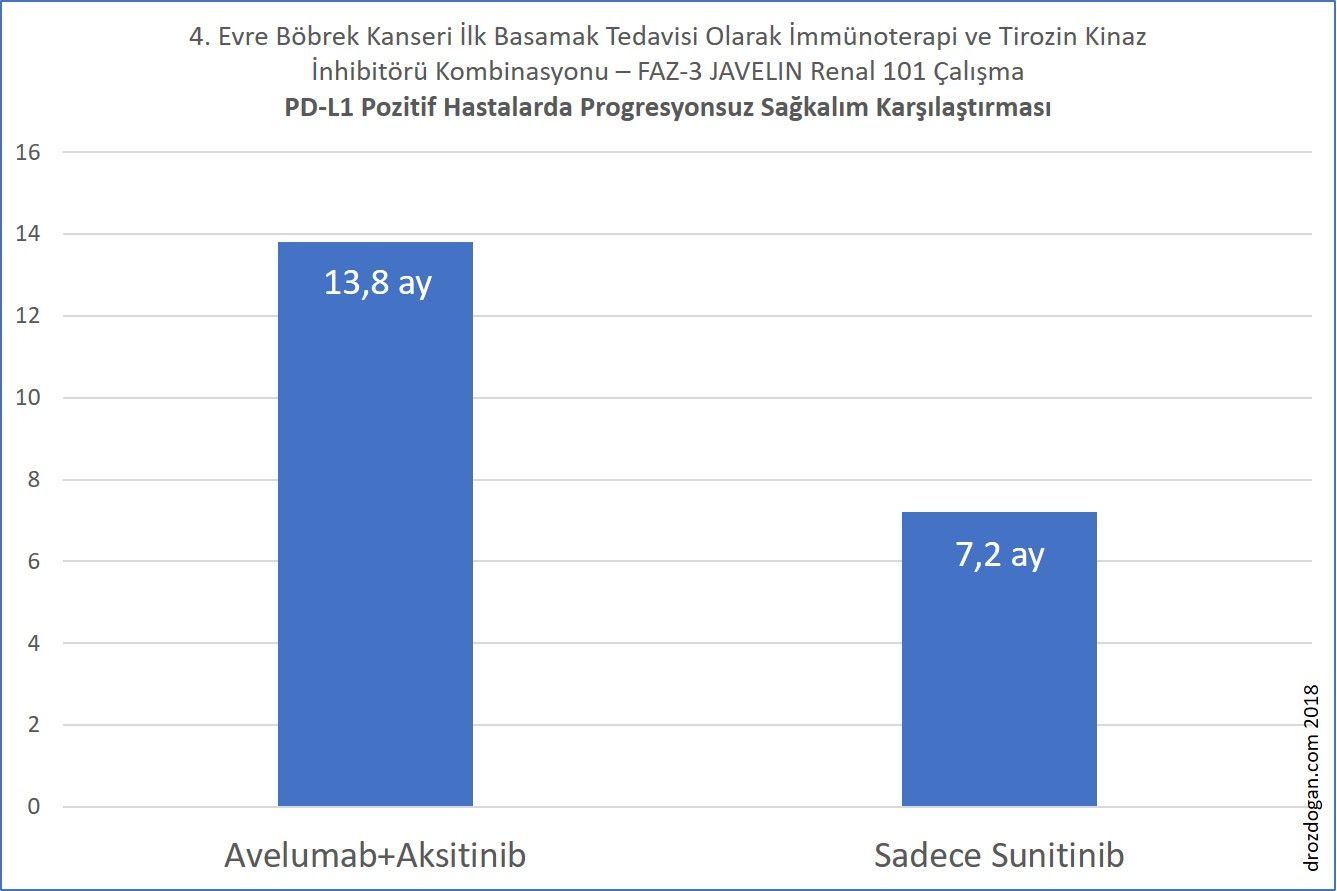
JAVELIN Renal 101 is the first phase-3 clinical trial with positive results to combine immunotherapy and a targeted tyrosine kinase inhibitor as first-line treatment for advanced kidney cancer.
The benefit of this immunotherapy + targeted-drug combination treatment was demonstrated in all kidney cancer subgroups participating in the study and in tumors whose cells were either positive or negative for PD-L1.
Conclusion
These data represent the best results that a combination of immunotherapy and targeted therapy has achieved in cancer treatment to date. Response rates are superior to those of other standard first-line treatments for advanced kidney cancer, and progression-free survival is very good for a randomized phase-3 clinical trial. For first-line treatment of metastatic kidney cancer, this approach proposes giving effective new drug combinations earlier, but its clinical application will probably follow demonstration of the effect of progression-free survival results on overall survival.
Sources
JAVELIN Renal 101: A randomized, phase III study of avelumab + axitinib vs sunitinib as first-line treatment of advanced renal cell carcinoma (aRCC).
ESMO 2018 Congress, Abstract LBA6_PR
Was this article helpful?
Your feedback helps us improve our content.




Reader comments
Share your comment
Your name and comment are published only after administrator approval. Your email address is never shown to visitors.
Be the first to comment.