Jimmy Fund: A Radio Broadcast, a Child and a Foundation (1948)
In this article
Jimmy Fund: A Radio Broadcast, a Child and a Foundation (1948)
On day 122 we followed the paper that came out of Farber's basement laboratory, with its sixteen children and ten temporary remissions. Today we look at another question that laboratory faced: where would the money come from? The answer came twelve days before the paper, on the evening of Saturday, 22 May 1948, on a radio program. This piece is not about science but about the history of how science is financed, and about a child's name, and a secret that name kept longer than the illness lasted.
A small laboratory, a charity from the world of entertainment
Farber worked in a small laboratory in the basement of Boston Children's Hospital (day 122). Beside the scientific problem there was a budget problem: a hospital laboratory needed money to sustain a program that a single physician had built around childhood leukemia. Help came from the Variety Club of New England, a charity founded by people from the entertainment business. According to SABR, the club's executive director Bill Koster and George Schwartz set out to raise support for Farber's work; the $45,536 the club collected (a figure found only in SABR) led to the founding of the Children's Cancer Research Foundation (CCRF), today part of the Dana-Farber Cancer Institute.
The exact founding date of the foundation is scattered across the sources: Dana-Farber's timeline says Farber founded it in 1947; ASCO Post says a "Children's Cancer Research Fund" was launched together with the Variety Club in early 1948; Tecan's funding history gives 1948; and the same Dana-Farber timeline places its incorporation in Massachusetts, as Children's Cancer Research Foundation, Inc., in 1951. I am not forcing these to agree; I have set them out in the fact-check box.
A live broadcast from a hospital room
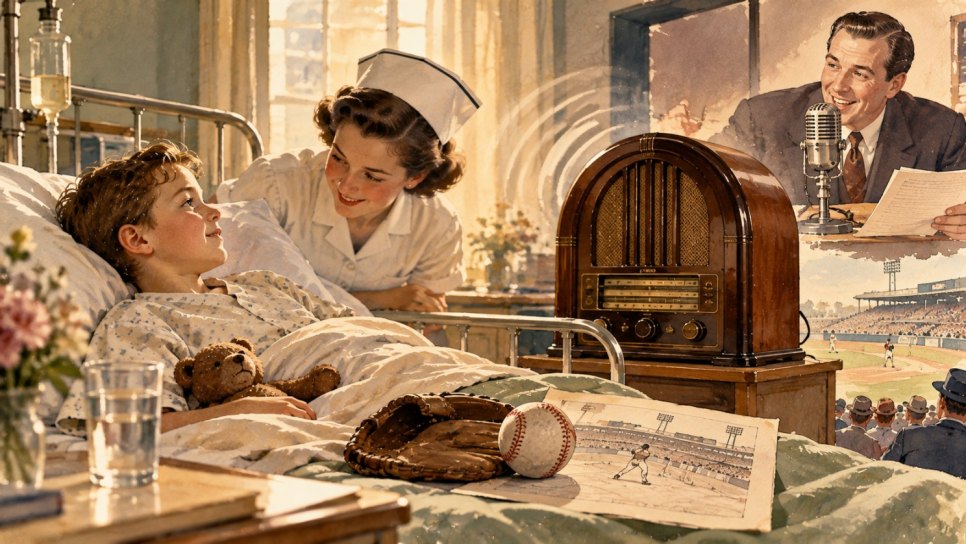
That evening, Truth or Consequences, a popular radio quiz show, linked up live with a room in Boston Children's Hospital. The host, Ralph Edwards, was in California. In the room was a twelve-year-old boy; Braves players are reported to have visited the room (Wikipedia, citing the New York Times; Warren Spahn, Eddie Stanky and Phil Masi). The boy sang a song on air; which song it was varies between sources. Edwards asked listeners for $20,000 so that the boy could be given a television set and watch the Braves play. The Braves' manager, Billy Southworth, declared the next day's doubleheader "Jimmy's Day".
The next day, 23 May 1948, the Braves beat the Cubs in both games (SABR: 8-5 and 12-4; 31,693 spectators). The goal was reached by 28 May (according to Sports Illustrated). By the end of summer the total had reached $231,485.51 according to SABR: about 11.6 times the goal. The foundation came to be known by the boy's pseudonym: the Jimmy Fund.
Note the timing: Farber's aminopterin paper appeared in the New England Journal of Medicine on 3 June 1948, twelve days after the radio broadcast (day 122). Sixteen children and ten temporary remissions were the figures behind that evening's appeal; the appeal, however, put forward not those numbers but the face of a single child.
The child behind the name
The boy's real name, as recorded, was Carl Einar Gustafson. He was a farmer's son from the town of New Sweden, Maine. His diagnosis was a lymphoma: Dana-Farber says "lymphoma", Wikipedia says "intestinal non-Hodgkin lymphoma", and SABR writes "Burkitt's non-Hodgkin lymphoma". Burkitt described the lymphoma in 1958 (to come in a later installment), so I read SABR's label as a name applied afterwards.
Why was he chosen? According to Tecan's funding history, Koster and Farber were looking for a hopeful patient the public would take to heart; most of the children with leukemia on the ward were too weak to appear on radio or before the public, and most of them lost their lives within months of diagnosis. Gustafson was a child with lymphoma, not leukemia. Who gave him the name "Jimmy" differs between sources: SABR says Farber did, Wikipedia says Edwards did. Both say the aim was to protect the child's privacy.
The patient ambassador: one face, one donation
The shape of the Jimmy Fund ties the need of many nameless patients to a single child whose story is told. Nobody wants to buy a television for an abstract figure of "childhood cancer"; everyone wants to buy one for a boy who is a Braves fan. The ratio between goal and total (about 11.6 times) shows the strength of that tie. The money went to research and care; according to Dana-Farber's timeline, the four-story Jimmy Fund Building was completed in 1952.
Here I set a limit: Farber's aminopterin paper (day 122) was the product of a trial that began in December 1947, before the radio broadcast. So I do not write that the Jimmy Fund financed that paper; the sources I read do not give a detailed breakdown of how the foundation's money was allocated.
Cost and limits: a chosen face, an untold diagnosis
The first cost is the selection itself: a hopeful face was chosen because most children lay in a picture that offered little hope. Gustafson entered remission; according to Tecan, most of the children with leukemia on the same ward lost their lives within a few months. Wikipedia says only "remission", not "recovered"; I do not use that word either. The story of a charity is told as a story of hope, and that frame leaves in shadow the stories of patients whose course was heavier.
The second is the untold diagnosis. According to Sports Illustrated, Edwards said on air that the child had cancer but did not know it (I give this as a conceptual summary). His identity also stayed hidden for about fifty years; it came out in 1998. Seen by the consent standard of day 121, the question of using a child who did not know his diagnosis on a national broadcast, and of the family's role in it, remains open; the sources I examined do not say how the child or his family agreed to the broadcast, and I am not inventing it. To judge the question by the norms of 1948 would also be anachronistic; I am only saying that I leave it open.
The third is the numbers: a goal of $20,000, an end-of-summer total of $231,485.51 (SABR), "about 231 thousand" (Tecan), "more than 200 thousand" (Yankee), or "nearly a quarter of a million" (Dana-Farber). Four sources describing the same event round it four ways. I have separated them in the fact-check box.
On day 121 we discussed the lesson of Nuremberg: a person taking part in research must know what they are taking part in. The Jimmy Fund was not an experiment but a fundraising campaign; yet the same question is asked here in a different form. A child's illness is used on a national radio broadcast, and the child, as the story goes, does not know the name of that illness. How informed the permission obtained from the family was, and how far, is not in the records. The campaign did good work and the child does not appear to have been harmed by it; but justifying it with "the outcome was good" does not settle the ethical question, it only leaves it postponed.
What remains
- The model of raising donations through a named patient: the Jimmy Fund continues today
- The bond between a sports club and a children's cancer foundation: the Red Sox since 1953
- The basement laboratory gaining public and community support
What fell or was limited
- The child's identity staying hidden for half a century (revealed in 1998)
- The idea that a single hopeful face can stand for all patients
- The assumption that the foundation has a single founding date (sources point to 1947, 1948 and 1951)
From radio to a building. The axis covers 1946-1954; the marks are yearly intervals. Orange boxes show institution-building (founding of the foundation, incorporation, the building), green boxes show giving and partnership (the radio broadcast, the Red Sox). Because the foundation's founding year conflicts across the sources, the 1947 box carries the note "date disputed".
Which patient gets told?
I could not find a verified source on any trace of this story in Türkiye; I am not inventing a local tie. I can write a general inference: raising money for research or care through one patient's story raises, in every country, the question of which patients are considered "tellable". The Jimmy Fund is an early and striking example; the question itself is not peculiar to 1948 or to Boston.
From 1947 to today
What was confirmed, what conflicts
- Date of the broadcast: 22 May 1948, Saturday. Consistent with Dana-Farber, Sports Illustrated and SABR's date for the doubleheader (23 May); I also confirmed from the calendar that it was a Saturday.
- Program and host: Truth or Consequences, Ralph Edwards (SABR, Sports Illustrated). Players: the visit of Warren Spahn, Eddie Stanky and Phil Masi appears in Wikipedia citing the New York Times and the New England Historical Society; I did not open the primary source, and in the text I attribute it to Wikipedia.
- The child: Carl Einar Gustafson, age 12, New Sweden, Maine (SABR, Sports Illustrated). The birth date (18 August 1935) appears only in Wikipedia and without a source; I did not use it.
- Diagnosis: Dana-Farber "lymphoma"; Wikipedia "intestinal non-Hodgkin lymphoma"; SABR "Burkitt's non-Hodgkin lymphoma" and, for this type, a severe course in about 85 percent. Because Burkitt lymphoma was described in 1958, treat this label as applied afterwards. The 85 percent figure appears only in SABR and its source is unclear; I did not use it.
- Pseudonym: SABR "Dr. Farber called the boy 'Jimmy'"; Wikipedia "Edwards gave the pseudonym Jimmy on air". Conflicting.
- Amounts: Goal $20,000 (Sports Illustrated, SABR, Tecan). Total $231,485.51 (SABR, and in the body text of Wikipedia without citation); "231 thousand" (Tecan); "more than 200 thousand" (Yankee, Wikipedia's Jimmy Fund page); "nearly a quarter of a million" (Dana-Farber). That the goal was met by 28 May is in Sports Illustrated alone.
- Variety Club: The $45,536 and the personal names (Bill Koster, George Schwartz) are from SABR; Sports Illustrated writes "George Swartz". Single-source information.
- History of the foundation: Dana-Farber's timeline "1947: Farber founds the CCRF" and "1951: incorporated as Children's Cancer Research Foundation, Inc."; Sports Illustrated "1947, with the help of the Variety Club"; ASCO Post "began in 1947, Children's Cancer Research Fund in early 1948"; Tecan "in 1948 Koster and Farber started the fund". Different dates and names.
- Farber and the child's condition: Sports Illustrated writes that Farber knew of the child's condition; Wikipedia writes that Dana-Farber staff assumed the child had lost his life. The two conflict. Wikipedia says only "remission"; I did not write "recovered" either.
- Revealing of the identity: 1998 (Sports Illustrated, Yankee, ESPN, Wikipedia). According to Wikipedia his sister wrote a letter to the foundation in 1997 and Gustafson phoned in 1998; Yankee says "March 1998". The exact day conflicts.
- Date he lost his life: Wikipedia 21 January 2001, age 65, stroke, Caribou, Maine (citing the New York Times); the ESPN Classic page itself is dated 19 November 2003. Because of this conflict I gave no date in the text; 2001 looks more likely.
- Building and Red Sox: 1952 (the building) and 1953 (the Braves' move to Milwaukee, the Red Sox taking it on) from Dana-Farber's own timeline.
- The song: Yankee gives "Take Me Out to the Ballgame", Tecan and Wikipedia a Braves team song; I did not name a song in the text.
- Out of scope: The item-by-item breakdown of the money and the financing of Farber's 1948 paper. The sources I read do not give it; the one certain point is that the radio money came after the paper's work.
Mechlorethamine: The First Approval (1949)
In the sources, mechlorethamine is cited as the first drug approved for cancer treatment; the date is 1949. But what did that year's "approval" measure, for which patients was it given, and what was asked of it? Tomorrow I will tell this once dates and sources are verified.
Author's note: The Jimmy Fund is usually presented as a sweet story; without erasing its sweetness, I wanted to write the chosen face and the untold diagnosis too. Almost the whole account comes from newspaper and charity histories, that is, secondary sources; I did not see the primary record (the radio recording, the foundation's papers). I have separated every conflicting figure and date in the box.
Sources and Further Reading
- Dana-Farber Cancer Institute. Milestones in the History of Dana-Farber and the Jimmy Fund (dana-farber.org/about/history/timeline).
- Dana-Farber Cancer Institute. Sidney Farber, MD (dana-farber.org/about/history/sidney-farber).
- SABR Games Project. May 23, 1948: Boston Braves win two for Jimmy Fund (sabr.org/gamesproj).
- Sports Illustrated Vault. A charity that hits homers: the Jimmy Fund began in 1948 with a hospital visit by the Boston Braves, 1 June 1998 (vault.si.com).
- Yankee Magazine. 1948 Broadcast That Launched Jimmy Fund (newengland.com/yankee/magazine/jimmyfund).
- Tecan. The very short history of cancer research funding, part 2 (tecan.com/blog).
- ESPN Classic. Gustafson instrumental in Jimmy Fund success (espn.com/classic).
- Farber S, Diamond LK, Mercer RD, Sylvester RF Jr, Wolff JA. Temporary remissions in acute leukemia in children produced by folic acid antagonist, 4-aminopteroyl-glutamic acid (aminopterin). N Engl J Med 1948;238(23):787-793 (used on day 122; here only for the date).
- Mukherjee S. The Emperor of All Maladies: A Biography of Cancer. New York: Scribner, 2010. (Not separately verified for this piece.)
This piece is day 123 of the "365 Days of Cancer History" series and recounts the birth of the Jimmy Fund as a historical event. It is popular history; it is not a diagnostic or treatment recommendation. Consult your physician for decisions about your health. Sources have been verified; details that rest only on a secondary source are marked in the fact-check notes.
Was this article helpful?
Your feedback helps us improve our content.