
Kadcyla Receives FDA Approval for Adjuvant (Protective) Treatment of HER2-Positive Early-Stage Breast Cancer

In this article
The United States Food and Drug Administration (FDA), on 3 May 2019, approved treatment for HER2-positive early-stage breast cancer in the postoperative adjuvant (protective) setting with ado-trastuzumab emtansine (Kadcyla) . To use Kadcyla in early-stage breast cancer, the patient must have residual cancer after receiving taxane- and trastuzumab-based neoadjuvant (preoperative tumor-shrinking) treatment.
The approval is based on data from KATHERINE, a trial in HER2-positive early breast cancer involving 1486 patients, a phase-3 clinical trial evaluating the safety and effectiveness of Kadcyla and trastuzumab as adjuvant therapy.
Summary results;
- After a median follow-up of 40 months, a statistically significant improvement was demonstrated in patients receiving Kadcyla compared with trastuzumab (hazard ratio [HR] 0.50, % 95 CI 0.39-0.64; P <.0001).
- In addition, at 3 years, % 88.3 of those receiving Kadcyla and % 77 of the trastuzumab group had no breast cancer recurrence.
Side effects: The most common side effects associated with Kadcyla were weakness, nausea, increased liver enzymes (ALT, AST), musculoskeletal pain, bleeding, thrombocytopenia, headache, peripheral neuropathy and arthralgia.
Kadcyla, an HER2-targeted antibody and microtubule inhibitor conjugate, previously had FDA approval for treating patients with HER2-positive metastatic breast cancer.
What Is Trastuzumab Emtansine and How Does It Work?
Also called T-DM1 , ado-trastuzumab emtansineconsists of a combination of two different drugs:
- T: trastuzumab (a targeted smart drug)
- DM1: a chemotherapy drug acting on the cell’s skeleton, the microtubules
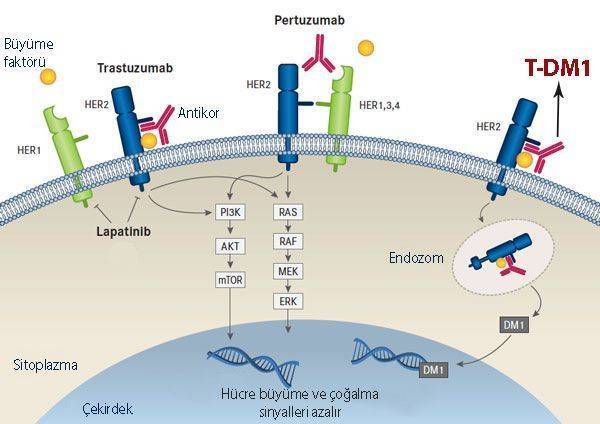
Explanation of the image: Kadcyla targets a receptor on the surface of breast cancer cells known as human epidermal growth factor receptor 2 (HER-2). After binding to this protein receptor, it enters the cells and releases a chemical called DM-1 that stops the cell from growing or dividing.
Details of the KATHERINE Study
- A very large clinical trial was conducted involving approximately 1500 patients with HER2-positive breast cancer.
- All patients had HER2-positive early breast cancer at diagnosis. Tumor size was T1 to T4, nodal stage was N0 to N3, and they had no metastasis (see breast cancer staging). Patients with stage T1aN0 or T1bN0 were not enrolled. In addition, patients who had completed anthracycline -containing or anthracycline-free taxane chemotherapy and neoadjuvant treatment including at least 9 weeks of trastuzumab, but had residual disease in the breast or axilla (armpit) at surgery, were included. Patients were then randomized into two arms to receive 14 postoperative cycles of adjuvant treatment (one group T-DM1 and the other trastuzumab).
- In an early analysis, in the T-DM1 group, of 743 patients, 91 (% 12) experienced cancer recurrence or death; in the trastuzumab group, of 743 patients, 165 (% 22) experienced these outcomes (see the figure below).

- At year 3, cancer-free rates in the T-DM1 group were % 88 and in the trastuzumab group % 77. This % 11 difference is highly noteworthy for early-stage breast cancer (see the figure below).

- The benefit of T-DM1;
- was similar both in hormone receptor-positive and -negative patients
- and at different levels of residual disease
- and in those receiving single or dual anti-HER2-targeted treatment in the neoadjuvant regimen.
- More importantly, distant organ metastases occurred in patients receiving T-DM1, with 78 patients (% 10.5) affected, and in 118 patients (% 15.9) receiving trastuzumab. However, no difference was found in brain metastases.
- Longer follow-up is required to determine the overall survival benefit. Median follow-up is currently approximately 41 months. At this point, the T-DM1 group had 42 deaths and the trastuzumab group 56.
The most common (≥ %25) side effects with Kadcyla were fatigue, nausea, increased transaminases (ALT, AST), musculoskeletal pain, bleeding, thrombocytopenia, headache, peripheral neuropathy and arthralgia.
The recommended ado-trastuzumab emtansine dose, unless disease recurs or unacceptable toxicity occurs, is given for a total of 14 cycles, once every 3 weeks (a 21-day cycle), as an intravenous infusion of 3,6 mg/kg.
Sources
fda.gov - 03 May 2019
Was this article helpful?
Your feedback helps us improve our content.




Reader comments
Share your comment
Your name and comment are published only after administrator approval. Your email address is never shown to visitors.
Be the first to comment.