Makale başlığı (77): The Secret of Bari Harbor: John Harvey, Stewart Alexander and 2 December 1943
In this article
The Secret of Bari Harbor: John Harvey, Stewart Alexander and 2 December 1943
On Day 115 we followed J.D.'s story at Yale; according to Yale records he lost his life on 1 December 1942. One year and one day later, on the evening of 2 December 1943, in a port on the Adriatic coast, the same family of drugs met the human body again, this time not in a laboratory but in an unplanned accident. Today's piece tests how much of the claim that this accident was "the birthplace of chemotherapy" actually holds.
A ship loaded with a secret
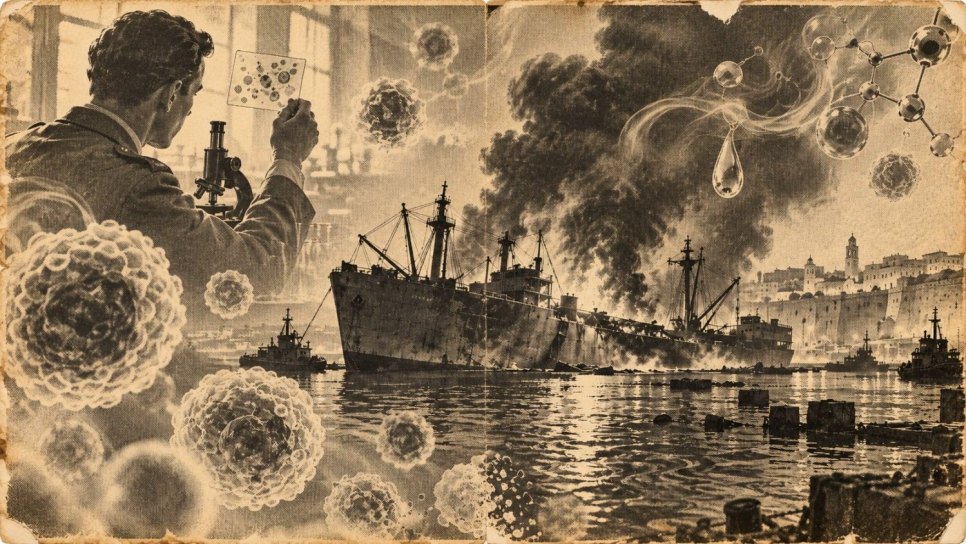
At the end of 1943 Bari was one of the supply ports for the Allied armies advancing in Italy. According to the sources, about thirty Allied ships lay crowded in the harbor. On the evening of 2 December, around half past seven, German Ju 88 bombers attacked; the raid lasted about twenty minutes. The Allied command had not expected an attack on this port, and the press later called the event "a little Pearl Harbor." How many ships were lost differs between sources (see the fact-check box), but the loss was very large.
One of the ships in the harbor was the Liberty-type cargo ship John Harvey, which had arrived four days earlier. According to the accounts, it carried about 2,000 mustard-gas bombs of 100 pounds each. America had sent these bombs to the theater so that it could respond if Germany used chemical weapons; the destination was most likely Foggia. The bombs were not fused, but when the ship was hit it exploded, the casings broke, and the liquid inside mixed with the fuel oil on the surface of the harbor water.
The secret was as much the silence surrounding the cargo as the cargo itself. It is reported that harbor officials knew about the bombs but could not say so; a request to unload the ship with priority was turned down on grounds of secrecy. Because the risk of a chemical agent was not known, nobody warned those who had fallen into the water.
The casualties and a physician's blood counts
Casualties who looked clean, then worsened
The sailors pulled from the water were coated in oil. They were first assessed as cases of immersion and blast injury; many were wrapped in blankets and laid down in their wet, oily clothes. Within hours skin burns and blisters appeared. About eighteen hours after the raid the first unexplained loss of life occurred; within two days fourteen more people had lost their lives. The physicians in the hospitals did not know what they were dealing with.
Allied Force Headquarters in Algiers sent a 29-year-old medical officer trained in chemical agents, Lieutenant Colonel Stewart F. Alexander, to Bari. Alexander arrived on 7 December. According to the figures reported, of 534 people admitted to Allied hospitals, 281 had symptoms consistent with mustard gas. Alexander concluded that the burns resulted from mustard mixed into the oil on the harbor surface; a 100-pound American bomb casing found by a diver pointed to the John Harvey as the source. He is also described as reaching the same conclusion by comparing the ships' positions with the severity of the casualties.
The observation that ties this piece to the series was a different one. Alexander saw a second wave of lost lives on the eighth and ninth days and recorded that white-cell counts, especially lymphocytes, were falling. He had seen this pattern in 1942 in rabbits given nitrogen mustard at Edgewood Arsenal. It is reported that this rabbit study began on 13 April 1942 and was reported on 30 June 1942. He sent his first findings to headquarters on 11 December; his preliminary report of 27 December was classified at once.
The interpretation of why this observation mattered is mine: J.D. was a single patient, and the physicians had chosen the dose. Bari, through a terrible accident, showed in many people, through counts followed over days, that the same agent suppressed blood cells and lymphoid tissue selectively. But it was not an experiment; the exposure came through skin and vapor, in unknown doses.
LYMPHOPENIA AND BONE MARROW SUPPRESSION
Lymphopenia is a fall in the number of lymphocytes in the blood. Mustard compounds damage rapidly dividing cells, especially cells of the bone marrow and lymphoid tissue; the fall in blood counts is the outwardly visible trace of this effect.
That this observation opened a door to tumor treatment was a hypothesis, not proof: a substance that harms rapidly dividing cells may also harm rapidly dividing malignant lymphocytes. Testing of the hypothesis had begun at Yale in 1942 (Day 115); Bari added human data to it, but did not prove it by itself.
THE COST: THE MEASURE OF SILENCE
This knowledge is the residue of an accident for which no consent was given. The casualties were not volunteers in an experiment; most did not even know what they had encountered. Secrecy meant that physicians treated their patients not for a known agent but for an unknown danger.
It is reported that Churchill did not accept that there was mustard gas in the harbor, while Eisenhower accepted Alexander's diagnosis; the mustard diagnosis was struck from patient files and a general phrase pointing to the attack was written in its place. The records are therefore incomplete: the number of exposed civilians is unknown, and it is said that some of those who fled the city may have lost their lives without receiving care. Estimates of civilian losses range from hundreds to about a thousand.
What remains
- The observation, in a large group, that mustard compounds lower white-cell and lymphocyte counts in humans
- Alexander's report: the Military Surgeon paper published in 1947
- That accident data supported the treatment hypothesis without proving it alone
What fell or was overcome
- The "Bari started chemotherapy" narrative
- Secrecy and erased records: physicians treated without knowing the agent
- The unknown exposure dose: no guide for a therapeutic dose
Twenty-five days in Bari. The axis runs from 2 December 1943 to 27 December; small ticks mark weeks. The dates are at day level, independent of the conflicting hours and numbers in the sources; scale approximate.
Bari did not start chemotherapy; it added a witness
In popular accounts Bari is the place where chemotherapy was born; one book's subtitle even presents the event as the secret disaster that "launched the War on Cancer." One historian who disputes this calls the story a "myth," and his main ground is timing: the first human trial at Yale had taken place about fifteen months before Bari, in 1942 (Day 115). So Bari cannot be the scene where the idea of treatment emerged; at most it added further human data to an idea that already existed.
Alexander's own story fits the motif of the "rejected pioneer." It is reported that after the 1942 rabbit study he proposed nitrogen mustard for lymphoma, and that the proposal was turned down as having "no contribution to the war effort." A paper he submitted after the war was rejected because scientists had already published similar results, and he also declined a post at Sloan Kettering. All this rests on a single secondary account; I have not read the primary documents.
Alexander's superior, Colonel Cornelius P. Rhoads, head of the Medical Division of the Chemical Warfare Service, was also director of the cancer hospital in New York. Rhoads is reported to have praised the report as "a landmark in the history of mustard poisoning." That in 1945 he persuaded Sloan and Kettering to support a cancer institute is the institutional leg of the link between wartime chemistry and civilian oncology. My interpretation: Bari's real function was not to discover an idea but to strengthen the hand of the institutions that believed in it.
What followed took the familiar path. The Yale results were published in 1946 (Day 115). Alexander's report appeared in 1947. Mechlorethamine was approved for cancer on 15 March 1949; that part is the subject of a separate piece. The lesson of this story divides in two: the same agent, in one planned scene (Yale) and one unplanned one (Bari), showed the same selective pressure on blood cells; but the price of the second was paid by hundreds of casualties whose names are mostly not remembered.
Bari and Turkey
I could not find a verified link between the Bari raid and the history of oncology in Turkey, so I do not construct one. The general inference is this: stories of how a chemical agent entered medicine reach countries and hospitals years later, through the published literature. The part of the series devoted to Turkey will trace this route with sources.
FROM 1942 TO 2020
WHAT WAS CONFIRMED, WHAT CONFLICTS
- Time of the raid: given as 19.20 (a health-service site), 19.30 (US Naval Institute Proceedings, 1967) and 19.35 (Smithsonian); duration "about 20 minutes." The text says "around half past seven."
- Ship losses: vary between 16 (Proceedings), 17 (Smithsonian and History) and 27-28 (HistoryNet and an NCI book chapter). No exact figure was used. For military losses of life too there are conflicting statements, from "more than 1,000" to "about 2,000 soldiers and civilians."
- Mustard casualties and lives lost: 617 casualties, 83 lost (Proceedings; History says "more than 617"); 628 casualties, 69 lost in the first two weeks (a health-service site). The exact figure is unknown; those lightly affected may not have gone to hospital. No figures are given in the text.
- Bomb type and number: 2,000 bombs of 100 pounds each; one source says M47A2, another M41-A1. My own arithmetic: 2,000 x 100 pounds is about 100 short tons, which is the load one source gives as "about 100 tons."
- Alexander's reports: first findings 11 December, preliminary report 27 December 1943 (Smithsonian); no date is given for the "Final Report." The citation is Military Surgeon 1947;101:1-17 (from an institutional bibliography); another page says 417-421. I took the first. I did not read the full text.
- Autopsy accounts: some accounts say lymph nodes "dissolved" at autopsy; another source does not mention autopsy at all. The text includes only the blood-count observation; autopsy details could not be verified.
- Alexander's age and training: one source gives 29 years and training in chemical agents; another page says he was a cardiologist. I could not verify the latter, so I left it out.
- The "myth" debate: the HistoryNet author (Daniel B. Moskowitz; the publication date on the page conflicts, 2018 and 2019) rejects the claim that Bari started chemotherapy; he gives J.D. as 48, whereas Yale's 2011 report says 47 (Day 115). Conant's book, in its subtitle, calls the event the disaster that "launched" the War on Cancer. I took the path between: Bari is a layer of evidence, not the origin.
- Secrecy details: Churchill's denial, Eisenhower's acceptance of the diagnosis and the replacement of the mustard diagnosis in patient files come from popular publications based on Conant (Smithsonian, History). Churchill's reason is reported as Alexander's own guess. I did not read the primary documents.
- Alexander's rejected proposals: the 1942 proposal and the rejection of the postwar paper come from an NCI book chapter citing Conant; I did not read the book.
- Closing a citation: Gilman and Philips, Science 1946;103:409-436, which I had flagged on Day 115 as needing verification, is recorded in PubMed with this range (PMID 17751251); there is also a duplicate record of the same paper listed as 409-15.
- Out of scope: the mechlorethamine approval (1949) and the language of staging will be treated in separate pieces.
The Language of Staging
Today we looked for the first traces of a drug and saw a physician looking for numbers to answer "how ill is this patient?" Tomorrow we ask the same question of cancer itself: how did it become possible for physicians to say, in a common language, how far a disease has spread? Who started it, when, and out of what concern, I will test against the sources before writing.
Author's note: The story of Bari is one of the most embellished scenes in the history of chemotherapy. Here I tried to avoid two traps: inflating the event into "the birth of chemotherapy" and dismissing it as worthless. My sources are mostly popular and secondary; I did not read the primary report, Alexander's paper, or Conant's book. For this reason many numbers were deliberately left out of the text, and the conflicts are set out openly in the fact-check box.
Sources and further reading
- Alexander SF. Medical report of the Bari Harbor mustard casualties. Military Surgeon 1947;101:1-17. (Citation taken from an institutional bibliography; full text not read.)
- Conant J. The Great Secret: The Classified World War II Disaster that Launched the War on Cancer. New York: W. W. Norton, 2020. (Book not read; its content is relayed through secondary publications.)
- Moskowitz DB. HistoryNet online article: the "myth" debate on mustard gas and the origin of chemotherapy (publication year on the page: 2018 or 2019).
- US Naval Institute Proceedings, September 1967, "The Bari Incident" (online archive page).
- Smithsonian Magazine, "Bombing and Breakthrough" (online article; an account based on Conant's work).
- Mukherjee S. The Emperor of All Maladies: A Biography of Cancer. New York: Scribner, 2010. (The passage on Bari was not separately verified for this piece.)
This piece is Day 116 of the "365 Days of Cancer History" series and recounts the 1943 Bari harbor incident as a historical event. It is a historical-popular account and not a recommendation for diagnosis or treatment. For your own health, consult your physician. The sources have been checked; details resting only on a secondary source are marked in the fact-check notes.
Was this article helpful?
Your feedback helps us improve our content.