Sidney Farber and Aminopterin: The Birth of Temporary Remissions (1947-48)
In this article
Sidney Farber and Aminopterin: The Birth of Temporary Remissions (1947-48)
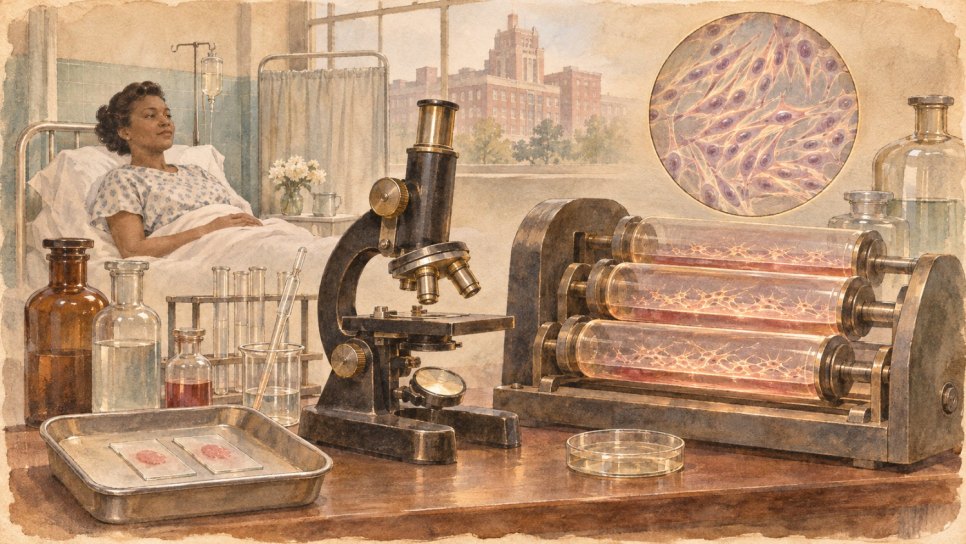
On day 120 we looked at the brief regressions produced by nitrogen mustard, and on day 121 at the yardstick by which such trials ought to be judged. Today we come to responses obtained in children and with a new principle: again temporary, but with a large echo. The scene is a pathology laboratory in the basement of a children's hospital in Boston. The hero of the story begins not with a right idea but with a step taken in the wrong direction; the real lesson lies there.
A vitamin, a hope, a wrong guess
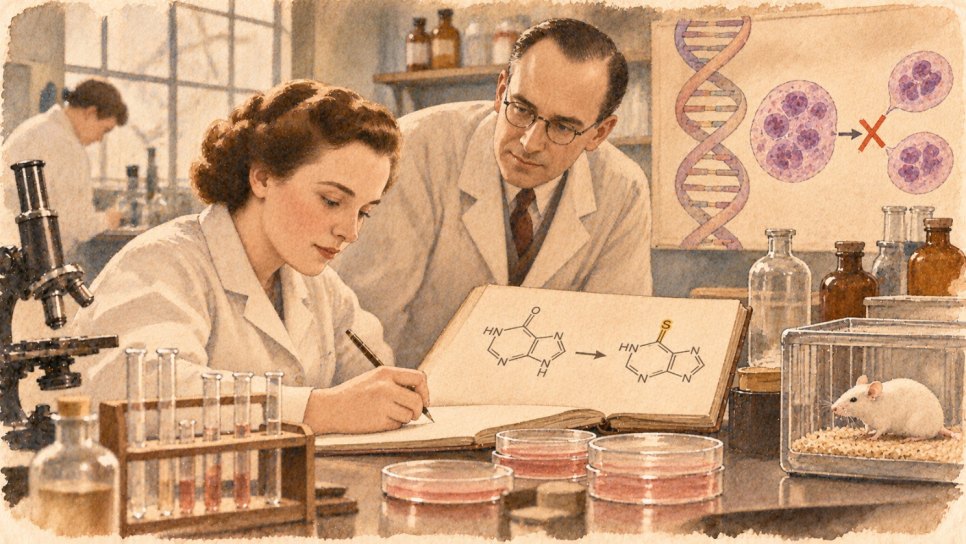
The story begins in India, with a vitamin. Working mostly at the Haffkine Institute in Bombay between 1928 and 1933, Lucy Wills showed that the macrocytic anemia seen in pregnancy and in the tropics could be both prevented and treated with yeast extract (BMJ, 1931). For some time the active factor was called the "Wills factor"; it was later shown to be folate. A sixteen-author paper published in Science on 31 May 1946, whose authors included Y. Subbarow, reported the structure and synthesis of the "liver L. casei factor" (folic acid). Folic acid could now be made in a flask.
At the time Farber was a pathologist at Boston Children's Hospital. According to one account, the folic acid trial rested on British research coming out of India; I have not read Farber's reasoning in a primary source. The result, however, seems clear: according to a Science paper dated 19 December 1947 (Farber and five co-authors), folic acid conjugates had markedly accelerated leukemia. The harm of the first step had been recorded and published.
From this Farber drew the following conclusion (according to one historical assessment): if folic acid feeds leukemia, a substance that blocks the action of folic acid might stop it. This logic was the "magic bullet" tradition we met on day 96, the idea of targeting the chemistry of the cell, applied to a blood cancer.
An opposing molecule in the basement laboratory
The opposite of folic acid was ready: chemists at Lederle Laboratories (American Cyanamid) had synthesized an antagonist resembling folic acid, aminopterin, in 1947 (Seeger, Smith and Hultquist, J Am Chem Soc). The same year Franklin, Stokstad and Jukes of Lederle reported that a similar antagonist accelerated folic acid deficiency in mice and chicks, and that the effect was overcome when enough folic acid was given. According to one source, at Farber's request SubbaRow's team developed antifolates, aminopterin among them.
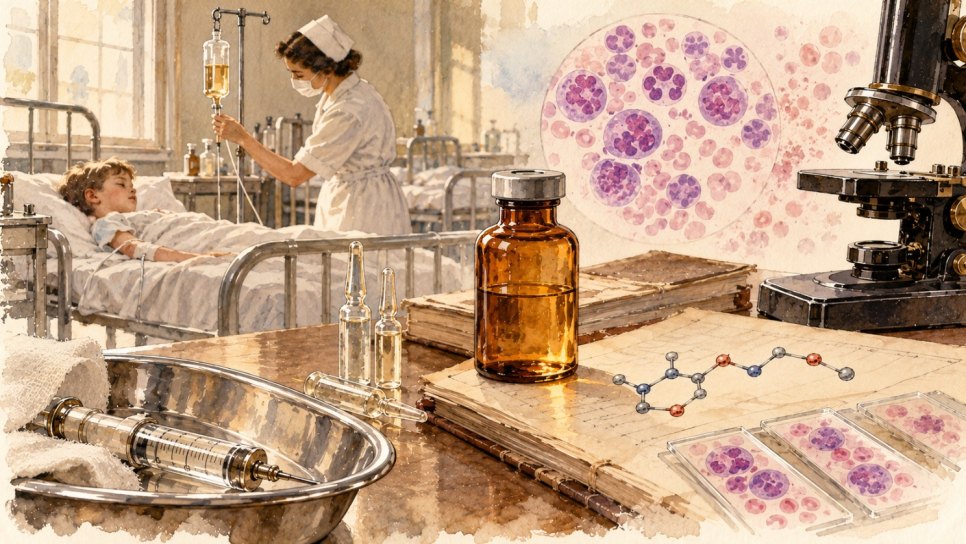
The identity of the first child is contradictory in the sources. In the Boston Globe's 2011 account it is Robert Sandler ("R.S."), about two years old, who lived in Dorchester with his identical twin Elliot. He had been admitted to the hospital in late August 1947; aminopterin injections began on 28 December 1947; by mid-January he was walking again, the bleeding had stopped and his appetite had returned. Another source describes the first child as an eight-year-old boy with a temperature of 41 degrees (106 °F), started on treatment on 16 December 1947. I could not reconcile the two; I have written this in the fact-check box. The Globe also reports that the remission was temporary and that the child lost his life in April 1949.
Sixteen children, ten remissions
The results were published in the New England Journal of Medicine on 3 June 1948 (Farber, Diamond, Mercer, Sylvester and Wolff; volume 238, pp. 787-793). Aminopterin had been given to sixteen children, and ten had a temporary remission: blasts in blood and bone marrow had decreased or cleared, normal blood formation had recovered, the liver and spleen had shrunk, and in one case subcutaneous nodules presumed to be leukemic had regressed. According to one review, the longest complete remission off therapy lasted 47 days. According to another reading, the daily dose had been adjusted between 0.25 and 1.0 mg, two children had no remission and four children lost their lives within a few months; of the five responders described in detail, two were still "under control" 16 and 23 months after onset of the disease.
Absolute effect: ten of sixteen children, about 62 percent, responded. For context: in a 1952 review of untreated cases, median survival was 3.9 months (I am relaying this from a review). The same review says that, given the size of the effect, bias can reasonably be ruled out; yet controlled studies were later needed to work out suitable regimens.
The reception was cold. Dana-Farber's own history page says most of the scientific community did not believe it, and that a young pathologist working in a basement with little money was seen as "presumptuous". On the other hand, physicians telephoned and telegraphed asking for help. Dameshek's group reported remissions in 10 of 32 patients given an antifolate for a week or more, and stated that the drugs were "by no means curative" in leukemia. Farber, for his part, reported about sixty more children in 1949; more than half had important remissions, but there was no evidence to justify the word "cure".
Antimetabolite: an imitator molecule
Aminopterin imitates the shape of folic acid and blocks folate-requiring enzymes. Rapidly dividing cells pay the highest price for this deficiency: leukemia cells, and also the normal cells of the bone marrow. Lederle's animal data showed that the effect could be overcome with enough folic acid; I read this reversibility as a clue that the drug really was aimed at the folate pathway.
Remission means a measurable regression of disease in blood and bone marrow; it does not mean recovery. The historical importance of the paper lies here: leukemia is among the first examples shown so clearly to be a disease that a drug can measurably push back. I hedge the "first" claim: the study is widely regarded as a pioneer in childhood leukemia, but I have not systematically compared all attempts before 1948.
Cost and limits: temporary, severe, incompletely told
The price of aminopterin was heavy: Farber himself stressed that the changes were temporary and came with serious side effects. The sources mention severe stomatitis (sores in the lining of the mouth), internal bleeding and bone marrow aplasia; in one case the marrow had emptied and liver extract was tried. Remissions lasted weeks and months and were not permanent. The summaries I read do not mention a concurrent control group; the comparison is made against historical cases.
The folic acid trial had also accelerated the disease; according to one source it was given to ninety patients, but I could not verify that number in a primary text. In studies with children the yardstick of day 121 weighs one level heavier: a parent's permission is not the same thing as the child's own position. The sources I examined do not mention consent in the 1947-48 trials, and I do not fill that gap.
Finally, the question of credit: who made aminopterin is scattered across the sources. The Globe points to SubbaRow, one review to SubbaRow and Harriett Kiltie, and the chemistry literature to Seeger, Smith and Hultquist; the Lederle chemists do not appear in the author list of the 1948 paper. In stories where the work was shared among many hands, the question of whose name it belongs to often stays open; I write this as an observation, not a verdict.
What remains
- The antimetabolite principle: disturbing the chemistry of the cell with an imitator molecule
- The yardstick of a measurable response (remission) in blood and bone marrow
- Methotrexate: the similar drug that replaced aminopterin, with fewer side effects
What fell or was limited
- The assumption that childhood leukemia is entirely closed to drugs
- The expectation of lasting remission with a single drug
- Aminopterin itself: because of its side effects another molecule took its place
From the wrong direction to the right one. The axis covers 1946-1950; the ticks are yearly. Orange boxes show synthesis and expansion, the red box the reverse result (folic acid accelerating leukemia), the green box the report of remission. The date of the first aminopterin patient in December 1947 is not on the diagram because the sources contradict each other.
What remains in today's protocols
I could not find a verified source on the first echo of this story in Turkey; I am not inventing a local link. I can write a general inference: today methotrexate is regarded as a standard component of treatment for childhood acute lymphoblastic leukemia (according to a historical review). So a drug family that enters a leukemia protocol in many parts of the world traces back to a report on sixteen children in Boston in 1948. Current cure rates (about 80-85 percent according to sources) come not from a single drug but from the combination and supportive-care studies of the following decades.
From 1931 to today
What was confirmed, what conflicts
- NEJM citation: Farber S, Diamond LK, Mercer RD, Sylvester RF Jr, Wolff JA. N Engl J Med 1948;238(23):787-793, 3 June 1948 (Haematologica commentary, PubMed record). I did not open the paper itself; the content comes via the Haematologica commentary (Izraeli 2022) and the James Lind Library review (Spain, Kadan-Lottick). The author name is printed "Slyvester" on some pages.
- Paper title: PubMed and Haematologica say "produced by folic acid antagonist"; the James Lind Library says "prolonged by". I used the first.
- Numbers: 16 children, 10 remissions (Haematologica, Dana-Farber, ASCO Post, Wikipedia). "Longest complete remission 47 days" is from the Haematologica commentary; the daily dose of 0.25-1.0 mg, no response in two children, loss of life within a few months in four children and the five responders described in detail appear only in the James Lind Library; I could not verify these numbers.
- First patient: Boston Globe (2011): Robert Sandler, about two years old, 28 December 1947; James Lind Library: an eight-year-old boy, 16 December 1947. The Dana-Farber page says aminopterin was given to sixteen children in "November 1947". Three dates conflict; I could not reach the primary text. I did not reproduce verbatim the sentence the Globe quotes from the NEJM.
- Folic acid trial: Date and citation (Science 106:619-621, 19 December 1947) from the PubMed record; PubMed has no abstract. "Markedly accelerated" is from the Haematologica commentary. The figure "ninety patients" is only in the James Lind Library and could not be verified; I left out the statement from the same source that "all lost their lives suddenly".
- History of folic acid: Wills's Haffkine Institute period and the BMJ 1931 citation come from Wikipedia's Lucy Wills page. The same encyclopedia's "History of cancer chemotherapy" page says Wills discovered folic acid in 1937; this conflicts with the 1931 date and I did not use it. The synthesis paper (Angier et al., Science 1946;103(2683):667-669) is from the PubMed record; Subbarow is among the authors, and the record gives no institution.
- Source of aminopterin: Seeger-Smith-Hultquist (J Am Chem Soc 1947;69(10):2567) is from Haematologica's citation; I did not open it. "From Lederle" is an inference from the fact that Seeger, Smith and Hultquist are also among the authors of the synthesis paper. Franklin-Stokstad-Jukes (Proc Soc Exp Biol Med 65:368, 1947) is affiliated with Lederle; the page says "an antagonist", and I did not verify that it was aminopterin.
- Credit conflict: The Globe says SubbaRow found the route of synthesis; the James Lind Library says SubbaRow's laboratory developed antifolates at Farber's request; one Wikipedia page names SubbaRow and Harriett Kiltie. SubbaRow's loss of life on 8 August 1948 at age 53 is in Wikipedia only.
- Reception: "Skepticism" and "disbelief" are on the Dana-Farber page and in the James Lind Library; the word "presumptuous" is Dana-Farber's own description. Dameshek's group 10/32 and the ~60 children in 1949 are from the James Lind Library.
- Survival and cure: median 3.9 months (1952 review) and about 85 percent cure (Pui 2009; NIH 2010) are from the James Lind Library; the American Society of Hematology page says about 80 percent as of 2008. Two figures, different sources and years.
- Methotrexate: ASCO Post says "more effective, fewer side effects", the James Lind Library says "comparable effectiveness, fewer adverse effects". I wrote only "fewer side effects".
- Control group and consent: I inferred that there was no concurrent control group from summaries, not from the paper itself. The sources I examined have no information on consent or parental permission in the 1947-48 trials. The gap is left open.
- Out of scope: The Jimmy Fund and the May 1948 radio broadcast are tomorrow; methotrexate, Min Chiu Li (1956) and the multi-drug strategy (1965) come in later days.
The Jimmy Fund (1948)
Where would the money for the basement laboratory come from? About two weeks before publication, in May 1948, a child patient and a name came out on a radio program. Tomorrow I will tell this story, once dates and sources are verified, together with what the patient's name meant and why it had such an echo.
Author's note: In this piece I tried not to write Farber only as a hero. His first step went the wrong way and he published it; the second step gave a temporary but real response. A few of the numbers come not from the primary paper but from reviews that summarize it; I separated which ones in the fact-check box. On who the first patient was and who made the drug, the sources do not agree; I did not pick one and erase the other.
Sources and Further Reading
- Farber S, Diamond LK, Mercer RD, Sylvester RF Jr, Wolff JA. Temporary remissions in acute leukemia in children produced by folic acid antagonist, 4-aminopteroyl-glutamic acid (aminopterin). N Engl J Med 1948;238(23):787-793. doi:10.1056/NEJM194806032382301 (the paper itself was not opened; content from secondary sources).
- Farber S, Cutler EC, Hawkins JW, Harrison JH, Peirce EC 2nd, Lenz GG. The action of pteroylglutamic conjugates on man. Science 1947;106(2764):619-621 (PubMed record; no abstract).
- Angier RB et al. The structure and synthesis of the liver L. casei factor. Science 1946;103(2683):667-669.
- Izraeli S. Haematologica 2022;107(4):782. doi:10.3324/haematol.2022.280670 (historical commentary on the 1948 NEJM paper; source of the Seeger et al. citation).
- Spain P, Kadan-Lottick N. Observations of unprecedented remissions following novel treatment for acute leukemia in children in 1948. JLL Bulletin (jameslindlibrary.org); J R Soc Med 2012;105:177-181. doi:10.1258/jrsm.2012.12k013.
- Boston Globe Magazine. The legacy of R.S., 13 October 2011 (bostonglobe.com).
- Dana-Farber Cancer Institute. Sidney Farber, MD (dana-farber.org/about/history/sidney-farber).
- American Society of Hematology. Curing Pediatric Acute Lymphocytic Leukemia (hematology.org/about/history/50-years/curing-pediatric-all).
- Mukherjee S. İmparatorluğun Kralı / The Emperor of All Maladies: A Biography of Cancer. New York: Scribner, 2010. (Not separately verified for this piece.)
This piece is day 122 of the "365 Days of Cancer History" series and recounts the first reports of aminopterin in childhood leukemia as a historical event. It is popular history; it is not a diagnostic or treatment recommendation. Consult your physician for decisions about your health. Sources have been verified; details that rest only on a secondary source are marked in the fact-check notes.
Was this article helpful?
Your feedback helps us improve our content.