
The Effect of Immunotherapy on Survival in Head and Neck Cancer: A Study of 4 Thousand Patients

In this article
Head and neck cancers are a serious health problem, with more than 600 thousand people diagnosed worldwide each year. They account for approximately 4% of all cancers, and most patients have advanced disease at diagnosis. These cancers include those of the oral cavity, nasopharynx, pharynx and larynx. Early diagnosis is vital: patients diagnosed early can have 5-year survival rates of up to 90%. However, 60% have advanced disease when diagnosed, substantially reducing this rate. Major risk factors include smoking, alcohol use, HPV infection and poor oral hygiene. These cancers occur three times more frequently in men than women.
Immunotherapy Has Changed the Outlook for Head and Neck Cancer
Immunotherapies continue to play a groundbreaking role in advanced head and neck cancer. Medicines approved by the FDA (United States Food and Drug Administration) in 2016, in particular, pembrolizumab (Keytruda) and nivolumab (Opdivo), are immune checkpoint inhibitors that became promising options following platinum-based chemotherapy for patients with metastatic or recurrent squamous cell head and neck cancer whose disease had progressed.
These treatments quickly became standard second-line therapy, prompting researchers and oncologists to ask whether immunotherapy might also work as first-line treatment. Designed to answer these questions, KEYNOTE-048 demonstrated that immunotherapy was also a strong first-line option for these patients.
KEYNOTE-048 established pembrolizumab alone or with chemotherapy as standard first-line treatment for recurrent or metastatic head and neck cancer.
This demonstration of first-line immunotherapy activity can be compared with a study published in 2008 in NEJM that defined the existing standard treatment for metastatic or recurrent head and neck cancer: the EXTREME trial . EXTREME first demonstrated that the platinum + 5FU + cetuximab triplet was superior to the platinum + 5FU doublet, increasing median life expectancy in this population from 7 to approximately 10 months.
Let us compare the findings of these two landmark trials in advanced head and neck cancer:
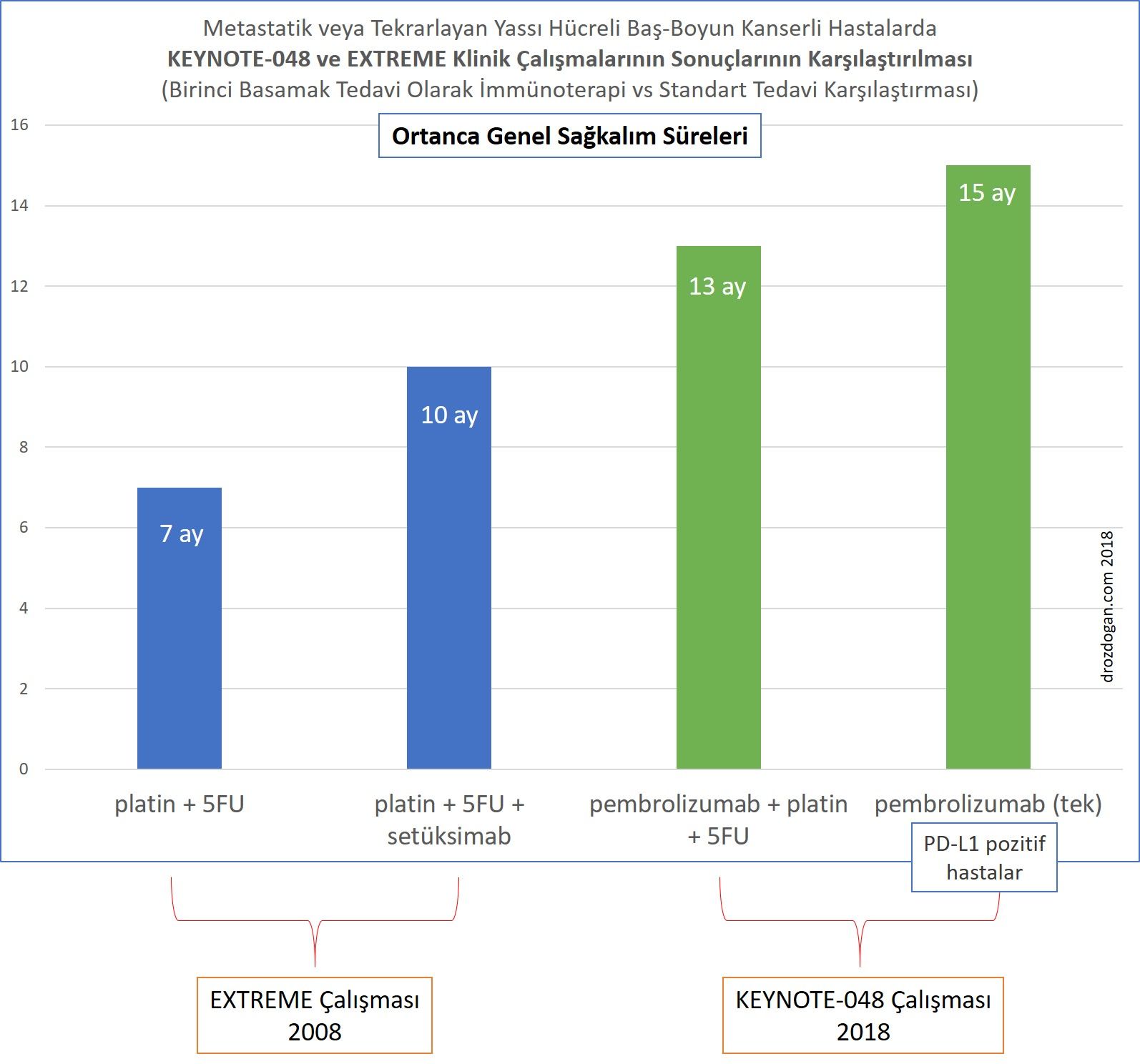
The current optimal first-line treatments for advanced squamous cell head and neck cancer are:
- For PD-L1-positive patients, pembrolizumab plus chemotherapy,
- For PD-L1-negative patients, chemotherapy plus cetuximab.
Unanswered Questions
However, strict clinical trial eligibility criteria and other factors raised concerns about how applicable these findings are to the general head and neck cancer population. Evaluating immunotherapy efficacy and outcomes in routine clinical practice is therefore essential. Although small retrospective analyses have shown survival similar to KEYNOTE-048, important questions remain about the best use of immunotherapy in recurrent/metastatic squamous cell head and neck cancer.
KEYNOTE-048 and other pivotal immunotherapy trials limited treatment to a maximum of 2 years. However, the optimal duration for responding patients remains unknown, as does whether longer or indefinite immunotherapy provides additional benefit or harm. The effectiveness of restarting immunotherapy after a break (rechallenge) also remains uncertain.
A Study of 4 Thousand Patients
JAMA Network Open published a study on August 19, 2024 examining immunotherapy's effects on survival in recurrent or metastatic head and neck cancer in greater depth. Based on a retrospective analysis of patient records in the United States, the study included 4549 patients treated with immunotherapy during 2015-2023.
The study examined:
- Immunotherapy as first- or second-line treatment,
- Stopping treatment after 1 or 2 years, and
- Restarting treatment.
Study Results
-
Median Overall Survival:
- Median overall survival among all patients receiving immunotherapy was 10.9 months.
-
First-Line Versus Second-Line Treatment:
- Median survival was 12.2 months with first-line treatment,
- and 8.7 months with second-line treatment.
-
Survival by HPV Status:
- Median survival was 16.6 months in HPV-positive patients,
- and 8.8 months in HPV-negative patients.
-
Survival by Performance Status:
- Eastern Cooperative Oncology Group (ECOG) performance status of good (0 or 1) was associated with median survival of 13.5 months,
- while patients with poor performance status (≥ 2) had median survival of 5.5 months.
-
Continuing Versus Stopping Immunotherapy:
- Median survival was 40.7 months among patients stopping after 1 year, compared with 57.7 months among those continuing treatment.
- Survival outcomes for patients stopping after 2 years were not yet determined.
-
Restarting Treatment (Rechallenge):
- Patients undergoing immediate rechallenge, after at least 60 days without any systemic treatment, had median survival of 15.7 months,
- compared with 9.9 months for those undergoing delayed rechallenge after another chemotherapy treatment.
-
Overall Conclusion:
- The study found that overall survival with immunotherapy in recurrent or metastatic squamous cell head and neck cancer closely matched clinical trial results.
- Stopping immunotherapy after 1 or 2 years in long-term responders appeared not to adversely affect survival.
- Restarting treatment may provide clinical benefit for some patients.
Commentary
This study stands out as the largest observational cohort, including more than 4 thousand patients receiving immunotherapy-based treatment for recurrent or metastatic head and neck cancer. Its findings largely match clinical trials. For example, median overall survival with first-line treatment was 12.2 months, close to the 12-13 months in KEYNOTE-048. Median overall survival with second- and third-line treatment was approximately 9 months, slightly higher than the 7-8 months seen in CM1414 and KN040.
The study shows that the optimal duration of immunotherapy in long-term responders remains unclear. In clinical practice, stopping treatment after 2 years is uncommon, and no clear adverse effect on survival was observed among those who stopped at that point. The low mortality risk in patients stopping after 2 years instead suggests that they are a selected group with generally favorable outcomes. This finding supports other studies indicating that indefinite immunotherapy does not provide an additional survival advantage. Stopping immunotherapy after 2 years should therefore be considered a reasonable strategy that may reduce long-term side effects and substantial financial costs without adversely affecting survival.
The study also examined the survival effects of restarting immunotherapy (rechallenge). Median survival was 15.7 months among patients restarting after a treatment break, compared with 9.9 months among those who had received another chemotherapy treatment in the meantime. These results suggest that restarting immunotherapy may provide clinical benefit for selected populations. However, because patients undergoing immediate rechallenge were a selected group, survival outcomes should not be compared directly between the two groups.
Overall, the study provides important findings on the optimal use of immunotherapy in recurrent or metastatic head and neck cancer and valuable information to guide clinical decisions about treatment duration and rechallenge.
*
Sources
Was this article helpful?
Your feedback helps us improve our content.




Reader comments
Share your comment
Your name and comment are published only after administrator approval. Your email address is never shown to visitors.
Be the first to comment.