
The first treatment targeting an EGFR exon 20 insertion mutation in lung cancer received FDA approval

In this article
On 21 May 2021, the US Food and Drug Administration (FDA) approved the drug with the active ingredient amivantamab-vmjw, called Rybrevant, as the first treatment for adult patients whose tumors have certain types of genetic mutations and who have locally advanced or metastatic stage non-small cell lung cancer (NSCLC). This genetic alteration consists of epidermal growth factor receptor (EGFR) exon 20 insertion mutations. To receive this drug, patients must previously have received platinum-based chemotherapy.
Amivantamab-vmjw is a bispecific antibody drug administered intravenously. Until now, drugs approved against EGFR mutations were small-molecule medications in the TKI (tyrosine kinase inhibitor) class taken orally as pills.
The FDA also approved the Guardant360 CDx (Guardant Health Inc.) genetic test to test for this mutation.
EGFR exon 20 insertion mutations
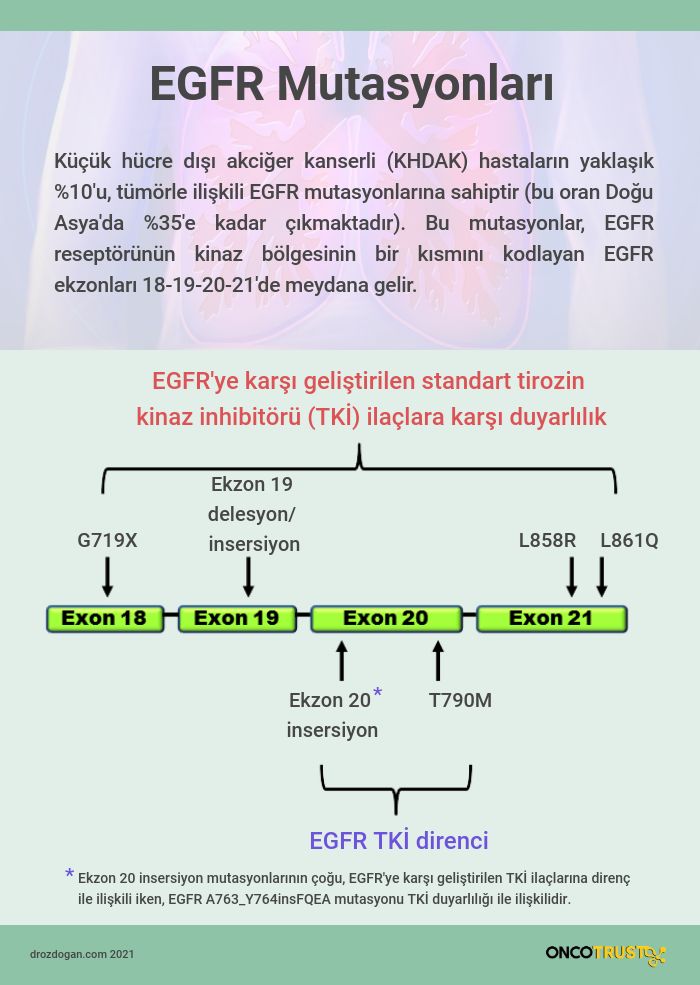
With new targeted treatments developed according to a tumor’s genetic characteristics, precision oncology continues to develop every day. Alongside new treatment options, we also understand lung cancer better. With this approval, patients with non-small cell lung cancer harboring an EGFR exon 20 insertion mutation have a targeted treatment option for the first time.
Lung cancer is the most common type of cancer worldwide and the leading cause of cancer-related deaths, with non-small cell lung cancer accounting for 80% to 85% of all lung cancers.
Approximately 2% to 3% of patients with non-small cell lung cancer have EGFR exon 20 insertion mutations, a group of mutations on a protein that causes rapid cell growth and consequently helps cancer spread. EGFR exon 20 insertion mutations are the third most common type of EGFR mutation.
Turkey Cancer Statistics states that 41,264 people were diagnosed with lung cancer in Turkey in 2020; in this situation, EGFR exon 20 insertion mutations appear to be responsible for lung cancer in approximately 1000 people each year.
The subtypes of lung cancer can be seen below:

FDA approval based on the CHRYSALIS study
Researchers evaluated the efficacy of Rybrevant in patients with non-small cell lung cancer harboring an EGFR exon 20 insertion mutation whose disease had progressed during or after platinum-based chemotherapy. There were 81 patients in the CHRYSALIS study.
The main outcome measured in the study was overall response rate (the proportion of patients whose tumors were eliminated or reduced by a drug).
- In this group, in which all patients received Rybrevant, the overall response rate was 40%.
- Median duration of response was 11.1 months, and 63% of patients had a duration of response of 6 months or longer.
The most common adverse effects of Rybrevant include rash, infusion-related reactions, skin infections around the fingernails or toenails, muscle and joint pain, shortness of breath, nausea, fatigue, swelling of the lower legs, hands or face, mouth sores, cough, constipation, vomiting and changes in certain blood tests. Rybrevant should be withheld if patients develop symptoms of interstitial lung disease and permanently discontinued if interstitial lung disease is confirmed. Patients receiving Rybrevant should limit sun exposure during treatment and for two months after treatment. Rybrevant may cause vision problems. Rybrevant may also cause fetal harm when administered to a pregnant woman; therefore, the pregnancy status of women of reproductive potential should be verified before starting treatment.
The recommended amivantamab-vmjw dose is 1050 mg for patients with a baseline body weight <80 kg and 1400 mg for those weighing 80 kg or more, administered weekly for 4 weeks and then every 2 weeks until disease progression or unacceptable toxicity.
For the treatment of patients with this condition, Rybrevant received FDA Priority Review and Breakthrough Therapy designations. Priority Review directs overall attention and resources toward the evaluation of drug applications that, if approved, would offer significant improvements in the safety or effectiveness of treatment in diagnosing or preventing serious conditions compared with standard approaches. The Breakthrough Therapy designation is designed to expedite the development and review of drugs intended to treat a serious condition where preliminary clinical evidence indicates that the drug may show substantial improvement over existing therapy on a clinically significant endpoint / endpoints.
The FDA granted approval for Rybrevant to Janssen, the biotechnology company that is an arm of Johnson & Johnson.
Sources
Was this article helpful?
Your feedback helps us improve our content.




Reader comments
Share your comment
Your name and comment are published only after administrator approval. Your email address is never shown to visitors.
Be the first to comment.