The Lesson of Nuremberg: Informed Consent (1947)
In this article
The Lesson of Nuremberg: Informed Consent (1947)
On Days 115 and 120 we left the same question open: what did the first patients given nitrogen mustard know, and what had they been told? The sources had no answer, and I did not invent one. Today we look at the question from a courtroom. At the end of 1946 a trial opened in Nuremberg over physicians' experiments on human beings, and part of the judgment delivered in August 1947 became one of the most frequently cited texts in the history of medicine. This piece tells what that text says, where it came from, and what it legally was not; because the history of consent is the history of the long distance between declaring a principle and carrying it out.
9 December 1946: twenty-three defendants
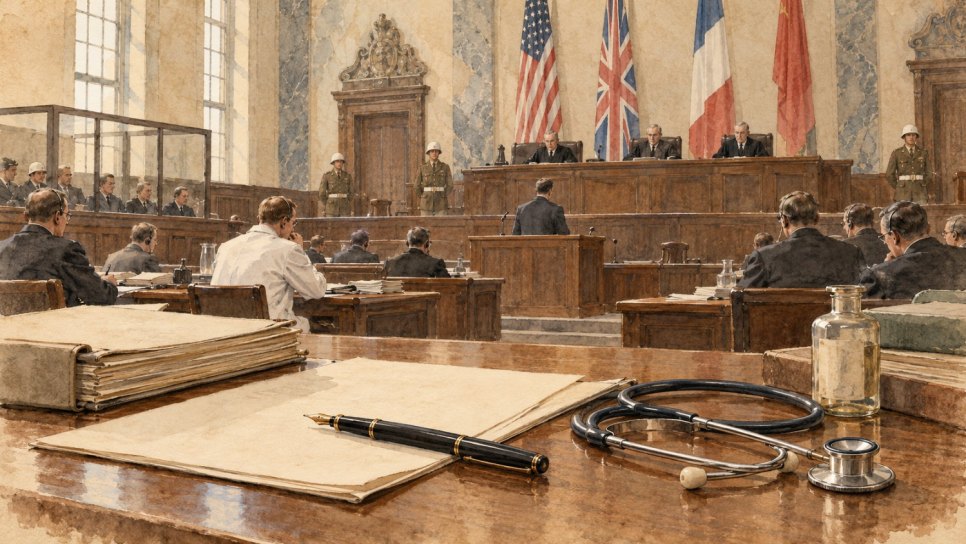
The Doctors' Trial opened on 9 December 1946 before one of the United States military tribunals in Nuremberg. The encyclopedia of the US Holocaust Museum gives the defendants as "23 leading German physicians and administrators"; another source reports that the proceedings lasted 140 days and that the charges covered wartime crimes and crimes against humanity, resting on the programme called "euthanasia" and on experiments carried out on concentration-camp prisoners. I do not go into the details of those experiments here; the subject is the rule the court wrote at the end.
A heading inside the judgment: "Permissible Medical Experiments"
The sources give the date of the judgment as 19 or 20 August 1947 (see the fact-check box). Sixteen of those tried were found guilty; seven were sentenced to be hanged and were hanged on 2 June 1948. But what remained in medical history is the part of the judgment headed "Permissible Medical Experiments": a ten-point list that later became known as the "Nuremberg Code". The first point, as quoted by the US Holocaust Museum, begins: "The voluntary consent of the human subject is absolutely essential", that is, the voluntary consent of the person who is the subject is an absolute requirement.
Six points, ten points
The origin of the Code is sought not in a single courtroom moment but in a document before it. Leo Alexander submitted a six-point memorandum to the United States Counsel for War Crimes on 17 April 1947; the August judgment repeated almost all of those points and extended them to ten. Andrew Ivy is also reported to have been greatly concerned about the arguments of the defense. The sources I read do not speak with equal clarity about whose pen produced the ten-point text; I cannot name an author.
The substance of the ten points is this (my summary): the voluntary consent of the subject; a result useful to society that cannot be obtained another way; a design based on animal experiments and knowledge of the disease; avoidance of unnecessary suffering and harm; no experiment where loss of life or disabling injury is expected (except where the researchers themselves serve as subjects); risk never exceeding the humanitarian importance of the problem; preparation and facilities that protect the subjects; conduct by qualified persons; the subject's freedom to withdraw at any moment; and the researcher's readiness to stop the experiment when harm is foreseen. The first point also lists legal capacity, the free power of choice, and "sufficient knowledge and comprehension" of the subject matter; the duty to ascertain consent rests on the personal responsibility of each person who initiates, directs or engages in the experiment, and cannot be delegated.
Voluntary consent: four conditions
From the first point of the text, as I read it, consent rests on four legs: the person has the capacity to consent, is situated so as to exercise free choice, has sufficient knowledge and comprehension of the matter, and the verification of all this remains with the researcher. If one of the four is missing, saying "yes" does not count as consent.
The term "informed consent" does not appear, in the sources I read, as the text's own wording; the language of the Code is "voluntary consent". I read the term as a shorthand that settled later. This does not narrow the scope of the principle; I am only taking care not to carry the word backwards.
Not a statute, but part of a judgment
The Code's legal force was never settled as a statute. The US Holocaust Museum puts it as "its legal force, however, was not well established"; another source notes that the Code was not directly incorporated into American or German law. The Code was a part of the reasoning of a court judgment, and it seeped into later regulation as a principle.
A view advanced in JAMA in 1996 by the historian Jon M. Harkness lets us look at the story from another side. According to the Cornell Chronicle's report, Harkness holds that the defense tried to show no difference between the Nazi experiments and a malaria experiment on prisoners in Illinois in the US; Ivy testified for the prosecution to rebut this claim and spoke of a document called the "Green report". Harkness argues that the committee never met, that Ivy wrote the report alone, and that it made research on prisoners in the US look legitimate for years. The same source reports that Harkness also lists real differences between the two situations: US researchers had tried to obtain consent, prisoners were not dragged from their cells, and no experiment was designed to cause loss of life. This is one historian's interpretation; I have not read the article myself, and I report it from a news item.
The same news item reports two more things: that in the early 1970s critics used the Code's voluntariness requirement against research on prisoners in the US, and that Harkness says the trial "produced something other than the code", namely a JAMA article that held up prison research as ethically ideal. Harkness also thinks the Nazi physicians would have been convicted even without this rebuttal. None of this means the Nuremberg principle was invalid; it shows that time passed between the principle being stated and US practice changing in line with it.
The price and the limit: the text was not enough
1966 showed that the principle did not take hold through a single court judgment. Henry K. Beecher's article "Ethics and clinical research", published in the New England Journal of Medicine (1966, vol. 274, pp. 1354-1360), showed, as a review summarizes it, that mistreatment of research subjects was not confined to Nazi practices. The same review reports that Beecher saw the Nuremberg Code as a "rigid and legalistic" set of demands, and found the Declaration of Helsinki more broadly useful. The World Medical Association had adopted the Declaration in June 1964 at the 18th General Assembly in Helsinki.
The Code's prehistory is also a question. In Germany the Minister of the Interior had issued a circular on 28 February 1931; according to an encyclopedia page, the text required informed, unambiguous consent in trials of new treatments and prohibited experiments without consent, remained in force until 1945, and there was a "disjunction" between the text and Nazi-era practice. So a written rule and practice could come apart; 1947 tried to turn that gap into a legal text. I do not present this as a "rejected forerunner", because I have not read the 1931 text myself.
The tie to Day 120: the JAMA series of September 1946 was published about eleven months before the August 1947 judgment. Judging it by the 1947 yardstick would be anachronistic, and I do not do so; I only say why the question stayed open. The question was this: would the patient's knowledge and willingness be left to a physician's conscience, or tied to a written yardstick?
What remains
- Voluntary consent counted as a precondition of the experiment
- The subject's right to withdraw at any moment
- The burden of verifying consent resting, non-delegably, on the researcher
What fell or was limited
- The expectation that a text alone would change practice
- The idea that unethical experiment belongs only to one particular regime
- The assumption that the Code was legally binding (it did not settle as a statute)
From written rule to practice. The axis shows 1930-1970; the marks are ten-year intervals. Orange boxes show guideline texts (the 1931 circular, the 1947 section of the judgment, Helsinki 1964), red boxes the trial and exposure (December 1946, 1966). December 1946 and August 1947 are very close and are split between the upper and lower rows.
Research ethics committees in Turkey
I could not find a verified source on when, and by whom, the Nuremberg judgment was taken up in Turkey; I do not draw that link. A Hacettepe document I read (Local Ethics Committees and Turkey; its author and date could not be verified from the copy I have) names the Nuremberg Code as the first guideline on research on humans after 1945 and says the first research ethics committees in Turkey were founded in 1986 at Hacettepe University Faculty of Medicine and the Gülhane Military Medical Faculty. According to the document, what made the committees multiply quickly was the Regulation on Drug Research published in Official Gazette No. 21480 of 29 January 1993; the document's author argues that this regulation is largely procedural and gives little space to ethical principles such as informed consent. That is the author's assessment; I have not read the regulation itself.
From 1931 to today
What was confirmed and what conflicts
- Date of the judgment: the US Holocaust Museum gives 19 August 1947; the Jewish Virtual Library and an encyclopedic page say 20 August; the EBSCO article shows in its body text that the court paused on 19 August for ethical questions, while its date field says 20 August. I wrote "19-20 August 1947"; I did not verify from a primary text which date belongs to which step.
- Start of the trial and defendants: 9 December 1946, 23 defendants and about 140 days (US Holocaust Museum, EBSCO). The phrase "military tribunal" is from the same sources.
- Outcomes: 16 guilty, seven sentenced to hanging, executions on 2 June 1948 (Jewish Virtual Library, EBSCO). The number of acquittals (seven) and the life and shorter prison terms I saw only on Wikipedia; they were not confirmed against a primary text, and I did not include them.
- Alexander memorandum: 17 April 1947, six points; the August judgment repeated and extended them to ten (US Holocaust Museum). Ivy's concern is from the same page; there is no statement that Ivy wrote the points, and I did not write that. I could not verify a claim that the judges were the authors, and did not write it.
- Text of the points: the sentence of the first point is verbatim from the US Holocaust Museum; points two to ten and the details of the first point are a summary from a full-text page. I did not open the volume "Trials of War Criminals before the Nuremberg Military Tribunals" myself.
- Legal status: the US Holocaust Museum says "its legal force, however, was not well established"; the source page of the University of Alberta adds that the Code was not directly incorporated into American or German law.
- "Informed consent": the Holocaust Encyclopedia of the US Holocaust Museum says the Code contains this principle; I read the wording of the first point as "voluntary consent" and took the term as a later shorthand. This is an interpretation.
- Harkness: what is described comes from the Cornell Chronicle (Larry Bernard, 5 December 1996); I did not read the JAMA article (27 November 1996). In that report, Ivy's testimony, the "Green report" and the claim that Ivy wrote the report alone belong to Harkness.
- Beecher and Helsinki: the citation of Beecher's article and the summary of its content are from the review by Harkness, Lederer and Wikler in the Bulletin of the World Health Organization; I did not read Beecher's article myself. That the Declaration of Helsinki was adopted in June 1964 at the 18th General Assembly comes from the title of a WMA document listing.
- The 1931 circular: date, issuing authority and content are from an encyclopedia page; the primary text was not read. The word "disjunction" belongs to that page.
- The Turkey document: from a .doc file on Hacettepe's deontology pages; its author and date could not be verified. The Official Gazette citation of the 1993 regulation is from that document; the regulation itself was not read.
- Out of scope: the Belmont Report (1979) and later regulation will be taken up on later days.
Sidney Farber and Aminopterin (1947-48)
Shortly after the Nuremberg judgment, in a children's hospital in Boston, children with leukemia were given an antagonist of folic acid. It is remembered as one of the first clearly recorded responses to a drug in cancer. Tomorrow we enter that story; I will verify the dates and sources before writing.
Author's note: In this piece I tried not to turn Nuremberg into a heroic tale. The principle of the Code is sound and is still read today; but its legal force remained limited, a written German circular existed before it, and practice did not follow. Most of the individual claims I took from secondary sources, and I separated which in the fact-check box. That I cannot assign the authorship of the text to one person is my silence where the sources are silent.
Sources and further reading
- US Holocaust Museum (USHMM). The Nuremberg Code. Holocaust Encyclopedia (encyclopedia.ushmm.org/content/en/article/the-nuremberg-code).
- Trials of War Criminals before the Nuremberg Military Tribunals under Control Council Law No. 10. Washington, D.C.: U.S. Government Printing Office, 1949-1953 (primary source; I did not read the volume myself and reached the text through a secondary full-text page).
- Jewish Virtual Library. The Nuremberg Code and The Doctors Trial: Introduction (jewishvirtuallibrary.org).
- EBSCO Research Starters. Analysis: Nuremberg Code (ebsco.com/research-starters).
- Bernard L. Historian examines U.S. ethics in Nuremberg Medical Trial tactics. Cornell Chronicle, 5 December 1996 (on Jon M. Harkness's JAMA article of 27 November 1996; the original article was not read).
- Harkness J, Lederer SE, Wikler D. Laying ethical foundations for clinical research. Bull World Health Organ 2001;79(4):365-366 (accompanies the reprint of Beecher's N Engl J Med 1966;274:1354-1360 article).
- Encyclopedia.com. German Guidelines on Human Experimentation (the 1931 circular).
- Hacettepe University, Medical Ethics (Deontology). Local ethics committees and Turkey (deontoloji.hacettepe.edu.tr; author and date could not be verified).
- Mukherjee S. The Emperor of All Maladies: A Biography of Cancer. New York: Scribner, 2010. (Not separately verified for this piece.)
This piece is Day 121 of the "365 Days of Cancer History" series and tells the birth of the Nuremberg Code as a historical event. It is historical-popular content and not diagnostic or treatment advice. Consult your physician for decisions about your health. The sources have been verified; details resting only on a secondary source are marked in the fact-check notes.
Was this article helpful?
Your feedback helps us improve our content.