
Unprecedented Success in Treating Brain Tumor GBM with a Cancer Virus Vaccine

In this article
In cancer, one type of immunotherapy is oncolytic virus vaccines. Designed to target only specific cells, these cancer vaccineshave recently had increasing clinical trialactivity. Results published on 26 June 2018 in NEJM showed that genetically modified poliovirus significantly prolonged survival in patients with recurrent brain tumor GBM-4 (glioblastoma multiforme).
In adults, the most common of the primary brain tumorsis glioblastoma multiforme (GBM). Brain tumors arise from the brain’s main supporting cells, which also support nerve cell function, called glial cells.
Classification of brain tumors
Low-grade tumors
are called grade I and II glial tumors.
High-grade tumors
- Grade III tumors: anaplastic astrocytoma, anaplastic oligodendroglioma, anaplastic oligoastrocytoma, anaplastic ependymoma
- Grade IV tumors: glioblastoma (called GBM or GBM-IV )
are classified in this way.
Standard treatment for newly diagnosed GBM is brain surgery removing as much tumor as possible, followed by adjuvant (protective) radiotherapy and chemotherapy. Although chemotherapy and radiotherapy prolong survival, cancer recurs after initial treatment in most GBM patients. Despite current treatments, the desired success in recurrent GBM had not been achieved.
Method used in the study
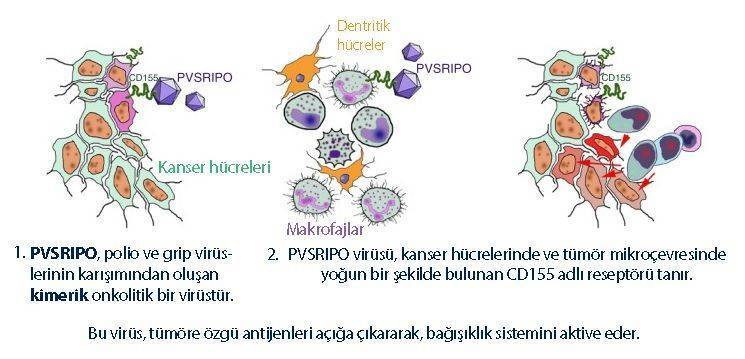
Poliovirus can bind receptors on glioblastoma cells and many solid tumor cells; it can attach well to brain cells and damage them. Using this information, researchers modified poliovirus to target only cancer cells. They removed the gene allowing replication in normal cells and replaced it with a gene from influenza virus. Its potential to affect neurons and cause polio was thereby eliminated.
On GBM cancer cell surfaces is CD155 , a receptor recognized and bound by poliovirus. Genetic modification enabled the virus to replicate only in cancer cells, expose tumor-specific antigens and activate immunity against cancer cells, destroying them.
After successful animal experiments, in 2012, in patients with recurrent GBM-4, this cancer vaccine entered a clinical study. Between May 2012 - May 2017, 61 patients were enrolled. Tumor diameters were larger than 1 cm and smaller than 5.5 cm. A catheter was placed in the brain to deliver virus directly into the tumor. Designed as a phase-1 trial, its primary purpose was to test dose and safety. Patients received virus in 7 administrations, from 10 million to 10 billion oncolytic viruses.
Study results
- The most important result was that at the end of year 3, 21 percent receiving poliovirus cancer vaccine treatment were alive, compared with 4 percent receiving standard treatment.
- Among the 61 treated patients, median survival was 12.5 months, versus 11.3 months with standard treatments alone. At high doses, some patients experienced severe inflammation-edema, dizziness, cognitive difficulties and nausea.
- Although overall results initially appeared less striking, some patients responded very well. Noteworthy effects occurred even at low doses, and in some patients lasted a long time. Two patients aged 20 and 60 receiving this oncolytic virus vaccine have survived nearly 6 years. Their GBM was resistant to other treatments.
So what does this study mean for us?
- We are beginning to see the power of cancer immunotherapies. In recurrent high-grade GBM, a very difficult brain tumor to treat, oncolytic cancer virus vaccines offer exciting developments.
- Researchers recently began a phase 2 study. It will use genetically modified poliovirus combined with a single powder chemotherapy. A separate clinical trial has also begun for childhood brain tumors, and trials in other cancers are planned.
- Many cancer researchers believe this method could revolutionize treatment. Beyond directly targeting cancer cells, oncolytic virus vaccines activate the immune system. Combining these vaccines with immune checkpoint inhibitors may be effective.
This study was conducted through research by the United States Food and Drug Administration FDA and National Cancer Institute lasting 18 years. Genetics and immunology are in their golden age in oncology. CRISPR, CAR-T, adoptive and oncolytic cellular therapies may become the strongest approaches against cancer in the near future. It should be emphasized that cancer treatment is possible only through modern medicine.
Sources
Recurrent Glioblastoma Treated with Recombinant Poliovirus.
NEJM, June 26, 2018.
Was this article helpful?
Your feedback helps us improve our content.




Reader comments
Share your comment
Your name and comment are published only after administrator approval. Your email address is never shown to visitors.
Be the first to comment.