
What Is Dementia? Are Dementia and Alzheimer’s the Same Thing?

In this article
Many people may think that Alzheimer’s Disease and Dementia mean the same thing. However, recent developments in diagnosis and treatment in neuroscience have clarified this. Alzheimer’s and dementia are not the same. Alzheimer’s is a type of dementia.
What is dementia?
Dementia is generally a long-term (chronic), progressive syndrome rather than a disease. It is a general term describing a group of symptoms associated with declining abilities to think, understand, remember, speak and make decisions. Consciousness is not affected in dementia, but cognitive function (the ability to process thought) deteriorates, potentially progressing to a degree that reduces a person’s ability to perform daily activities.
Dementia is one of the main causes of disability and dependence on relatives among older people worldwide. Above age 65, its prevalence is %5-8, doubling every 5 years. It is estimated that one in two people aged 85 or older will have some form of dementia. Dementia is a difficult process not only for those experiencing it, but also for their families and caregivers.
What are the symptoms and stages of dementia?
Dementia begins slowly and often goes unnoticed at first. It gradually worsens and affects everyone differently. Although symptoms may vary considerably, dementia should be considered particularly when:
- Memory
- Communication and language
- Ability to focus and pay attention
- Reasoning and judgment
- and visual perception are affected, with significant impairment in at least two such basic mental functions.
How is dementia diagnosed?
If dementia is suspected, a neurological examination and certain neuropsychological tests, without waiting for symptoms, are useful for early diagnosis. If needed, structural imaging includes brain magnetic resonance imaging (MRI) and computed tomography (CT); functional imaging techniques include positron emission tomography (PET) and functional MRI (fMRI); molecular imaging technologies used include PET, fMRI and single-photon emission computed tomography (SPECT). Although some biomarkers are said to have potential for early diagnosis, there is currently no validated biomarker recommendation for dementia.
Signs and symptoms associated with dementia can be understood in 3 stages.
- Early stage: It is difficult to recognize and often overlooked. Main symptoms include forgetfulness, confusing dates, seasons and time, and getting lost in familiar places.
- Middle stage: Signs and symptoms become more apparent. Life becomes more restrictive. They may include forgetting recent events and people’s names, getting lost at home, impaired communication, needing help with personal care, and behavioral changes including wandering and repeated questioning.
- Advanced stage: At this stage, people are close to complete dependence and immobility and now need care. Symptoms include an increasing need for help with personal care, difficulty walking, difficulty recognizing relatives and friends, being unaware of time and place, and serious behavioral changes that may extend to aggression.

What causes dementia?
Dementia used to be associated with advanced age as though it were a normal part of aging, or was called senile dementia . Although older age is the strongest known risk factor for dementia, it is not an inevitable consequence of aging. Dementia also affects people other than the elderly. “Young-onset dementia,” in which symptoms begin before age 65, accounts for % 9 of cases.
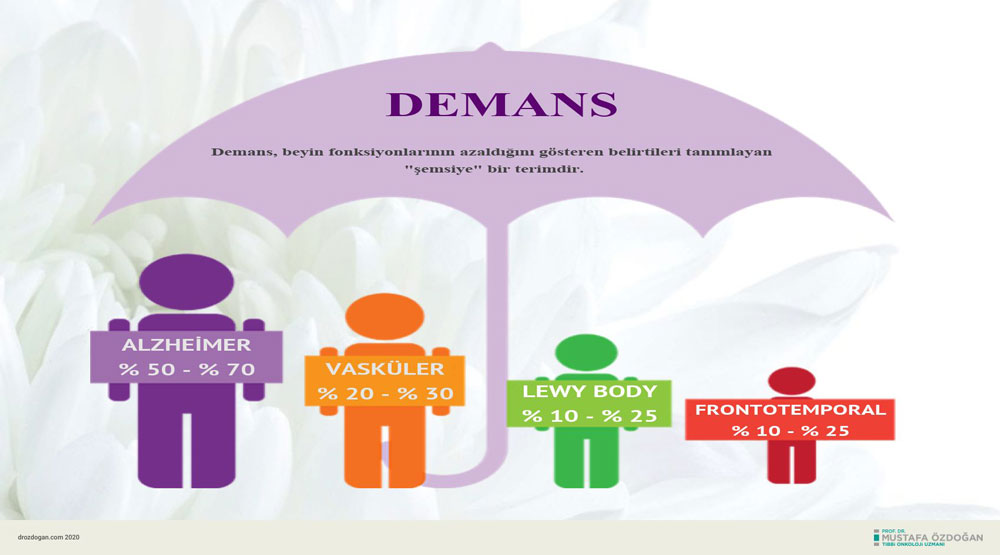
Today, many factors are known to cause dementia. Alzheimer’s disease is one of the most important of these. Alzheimer’s disease may contribute to more than 60 percent of dementia cases.
The second most common cause is vascular dementia due to blocked blood vessels. Other important causes include Lewy body dementia (abnormal accumulation of protein developing in nerve cells), frontotemporal dementia (degeneration of the brain’s frontal lobe), infections affecting the brain, thyroid diseases, diabetes and vitamin deficiencies (such as B12, B1 and B6).

Modifiable / correctable risk factors and prevention
We mentioned that, apart from genetic predisposition, which is seen more often in Alzheimer’s disease, older age may be the most important risk factor. However, the lifestyle we adopt and practice up to old age can also be a risk factor. Some studies have shown that physical inactivity, obesity, unhealthy diets, tobacco and alcohol use, diabetes, and high blood pressure and cholesterol beginning in middle age can increase dementia risk. Additional modifiable risk factors include prolonged sleep disturbances, thyroid problems, vitamin deficiencies, depression, low educational attainment and a limited social environment.
Treatment and care
There is currently no known definitive cure for dementia. However, many clinical studies, particularly in Alzheimer’s disease, are being conducted to improve or halt its progression, and many new treatments, including gene technologies, are being investigated. Drugs such as donepezil, rivastigmine and galantamine may temporarily improve or stabilize memory and thinking skills in some people.
Although dementia progression cannot be stopped, worsening or intensification of symptoms can be slowed. Patients’ quality of life can be improved. Some studies on mental and music therapies have shown improvements in agitation, depression and quality of life. Mindfulness-based stress reduction programs may help reduce stress among caregivers of people with dementia.
Among dietary supplements, there have been studies of ginkgo, omega-3 fatty acids / fish oil, vitamins B and E, Asian ginseng, grape seed extract and curcumin (turmeric) . However, an extensive body of research reported to date provides no convincing evidence that any dietary supplement can prevent the worsening of cognitive impairment due to dementia or Alzheimer’s disease.
In summary, delaying the onset of dementia can currently be considered the best treatment option. It is therefore appropriate to emphasize again the need for healthy lifestyle habits to prevent dementia and the importance of early diagnosis.
Sources
2. National Center for Complementary and Integrative Health, 5 Things To Know About Complementary Health Practices for Cognitive Function, Dementia, and Alzheimer’s Disease
3. National Institute of Neurological Disorders and Stroke, Dementia Information Page
Was this article helpful?
Your feedback helps us improve our content.




Reader comments
Share your comment
Your name and comment are published only after administrator approval. Your email address is never shown to visitors.
Be the first to comment.