Yale 1942: Goodman, Gilman and the First Nitrogen Mustard Trial, Patient J.D. | Day 115
In this article
"J.D." and the Secret Dose: Goodman, Gilman and the First Chemotherapy Trial at Yale, 1942
On Day 114 we set the three tools of 1941 side by side and saw what was missing from the table: a drug that is given into the blood and reaches every part of the body. The story of that drug comes from a place nobody was searching for cancer, from behind the locked door of a laboratory. Today we go to 1942, to a hospital room in Connecticut, where a man lies whose identity would be known for years by only two letters.
A drug nobody was seeking for cancer
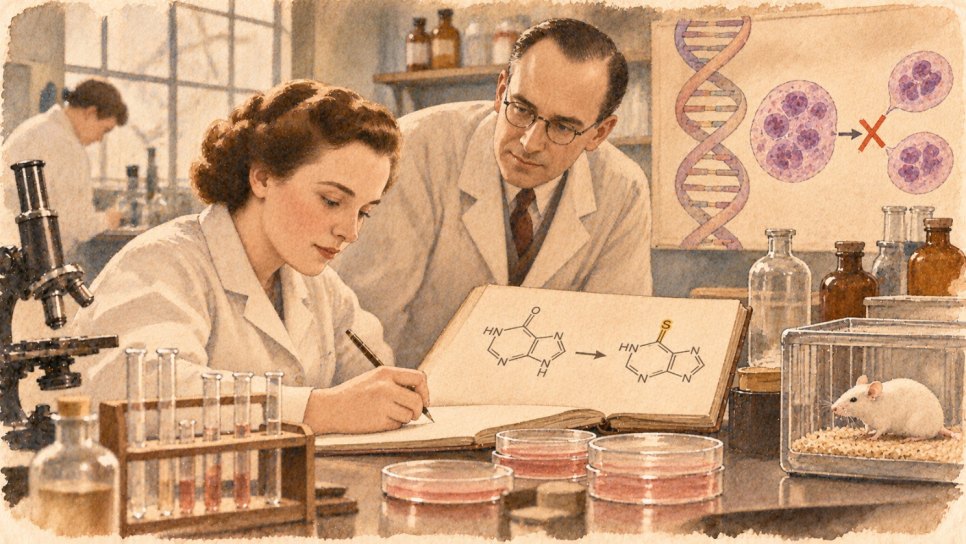
At the start of 1942, two pharmacologists at Yale, Louis Goodman and Alfred Gilman, were carrying out classified work for the US Office of Scientific Research and Development (OSRD). The subject was the effect of sulfur and nitrogen "mustard" compounds on the body. These substances had been known as chemical agents since the First World War; the real question was to understand how a chemical agent harms the body and to look for countermeasures. There were also observations from mustard gas exposure in the First World War that blood cells and lymphoid tissue were affected; those wait in the plan as a separate post, and we do not enter them today.
Goodman and Gilman carried out their work in mice and rabbits. According to Yale's accounts, lymphoma in mice shrank with nitrogen mustard and even showed a "dramatic regression". One mouse that is described gives a small sketch of the pattern: a large tumour first regressed with treatment, then grew back; the second treatment was less effective, the third not at all; even so, treatment had markedly prolonged the mouse's life. The patient story below will resemble the human counterpart of that sketch. The dates of the experiments are not given in the accounts.
To move from laboratory to patient a surgeon was needed. Gustaf Lindskog, an assistant professor of surgery at Yale, recommended a lymphoma patient whose treatment options had run out to the pair. Lindskog later became chair of surgery at Yale; in this post we mention him only as the recommending physician.
A patient's ninety-eight days
An "utterly hopeless" note and an injection at ten in the morning
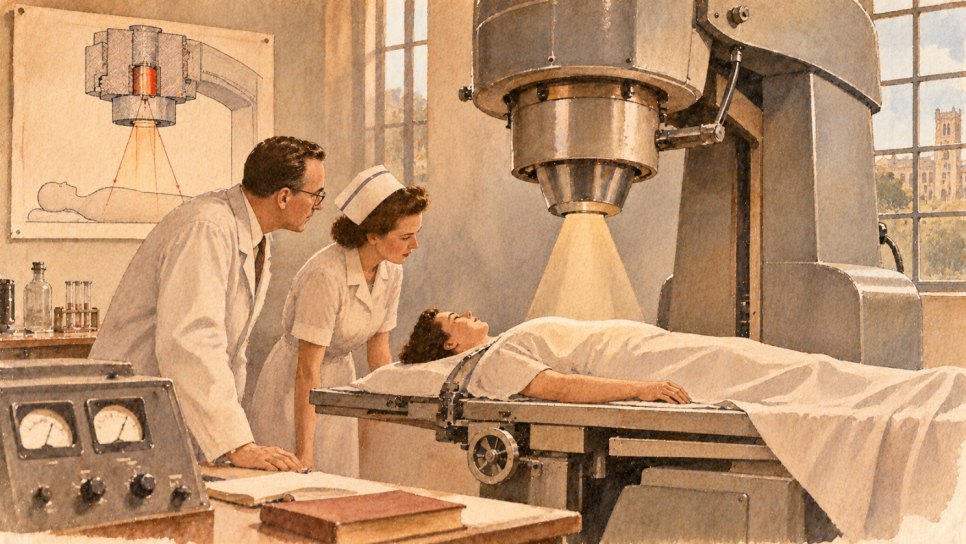
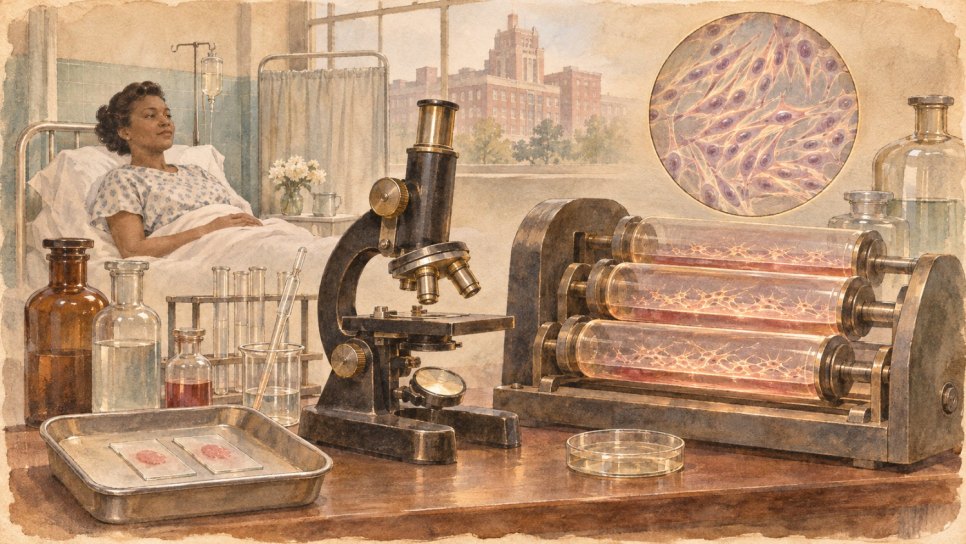
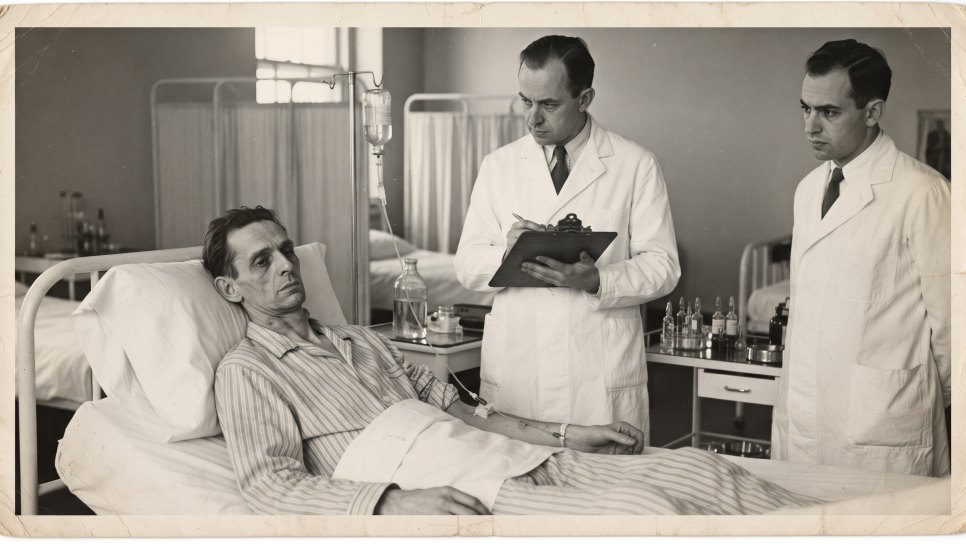
In the records the patient appears only as "J.D." According to Yale's 2011 report he was a 47-year-old man born in Poland, who had emigrated at eighteen and worked at a ball-bearing factory in Meriden, Connecticut. His lymphosarcoma had begun with enlarged tonsils, and radiotherapy in 1941 had given no marked benefit. A record note dated 25 August 1942 described his outlook as "utterly hopeless" and arranged his immediate admission. According to Yale's accounts the first intravenous dose was given on 27 August; one source also gives the hour as ten in the morning. It was followed by nine doses on consecutive days: a ten-day course in all. It is reported that the hospital chart recorded only the dose and the route, not the name of the drug, because the work counted as a military secret, hidden even from those giving care.
On 31 August it was noted that J.D. could sleep more comfortably, eat and move. By 6 September he had improved markedly; but on the same day his white blood cell count had begun to fall. On 27 September all the nodes in his neck and armpits are recorded as gone. Within about a month the cancer could no longer be detected on examination. This is the scene cited as one of the first recorded trials of intravenous chemotherapy: a drug was given through a vein and acted at once on lymph nodes in many parts of the body. But the story does not end there.
In mid-October the lymphosarcoma returned. According to Yale's account the remaining cells had become resistant to nitrogen mustard. The second course had only a short effect; the six-day third course that began on 6 November had little. Bone marrow suppression, bleeding and breathing difficulty developed. J.D. lost his life on 1 December 1942, on the ninety-sixth day of his hospital stay.
Why a lymphoma? The sources do not discuss it; my interpretation is this: nodes in the neck and armpits can be followed by hand and eye, so it was possible to watch a drug's effect day by day. The shrinking and then regrowth of the same nodes was the most concrete sign that the drug was truly doing something in the body. In other words, J.D.'s lymphoma was both a disease and a measuring instrument.
That had a cost too: what could be measured was only the visible nodes. For disease in the bone marrow or elsewhere, invisible on examination, they could not ask the same question. The problem of the "unseen cell" that we met on Day 114 reminded us of itself even in the first response to the first systemic drug.
REMISSION, RELAPSE AND RESISTANCE
Remission is the regression of the signs of disease and of the tumour detectable on examination; it does not mean the disease has disappeared completely. In J.D. the tumour had become invisible on examination, but to read that as a cure would be wrong.
Resistance is when the cells remaining after treatment no longer respond to the drug. The suspicion of resistance that Ehrlich raised on Day 96 seems here to be seen in a human patient: a single drug made part of the cells regress, and the rest did not respond. This observation can be counted among those that prepared the ground for the "multiple drug" idea of the following decades.
THE COST: THE DARK SIDE OF AN EXPERIMENT
This was not a treatment but an experiment. The dose had no precedent; it had been estimated from rabbit studies. The fall in white cell count and the suppression of the bone marrow point to the drug acting not only on tumour tissue but also on the tissue that makes blood. I could not find in this post's sources any information on how J.D. understood the trial, how far he was informed, or whether there is a written record of his consent. The subject of informed consent will come up again on later days of this series (Nuremberg, 1947).
Secrecy was also a cost: the results could not be published until 1946. The patient's records were mislaid in those years, and a 1946 medical journal account, because it rested on personal recollections, contained errors about the patient's treatment, pathology and occupation.
What remains
- That lymphoma can regress with an intravenous cytotoxic drug
- The difference between remission and cure
- The value of record keeping: J.D.'s file was found again in 2011
What fell away or was overcome
- The expectation of a lasting response to a single drug
- Secrecy that hid the drug's name from the hospital chart
- A dose without precedent: estimated from rabbit data for a human
J.D.'s 98 days. The green bar shows the first course (ten doses starting 27 August), the orange bar the third course. The scale is approximate; the dates of the second course are not given in the sources.
The year secrecy lifted, and a late correction
According to Yale's account, after J.D. 67 patients across the country were treated in this way, seven of them at Yale. Goodman and Gilman left Yale in 1943. In 1946, when military secrecy lifted, the results were published in two places: the patient series by Goodman and colleagues in JAMA and the broad review by Gilman and Philips in Science. In 1963 an article titled "the initial clinical trial of nitrogen mustard" appeared in the American Journal of Surgery; it is attributed to Gilman.
But J.D.'s identity and details were relayed wrongly for a long time. Two Yale physicians, John Fenn and Robert Udelsman, searched for the patient's records for about two years; the work was hard because the full name and record number were not known, and only when an archivist corrected record numbers did they narrow it to one patient. Their results were published in 2011 in the Journal of the American College of Surgeons: "first use of intravenous chemotherapy cancer treatment: rectifying the record". Saying "first" in the title is a claim; here I relay it as "the first recorded trial of intravenous chemotherapy".
Official approval came later: mechlorethamine is cited as the first chemical agent approved for cancer, on 15 March 1949. The timeline of this post stops at 1946; 1949 is the subject of a separate post, and when we get there we will check separately the licensing history of the same drug.
The lesson this story leaves today has two layers. First, the 1942 trial showed that a drug able to go beyond the limits of local methods was possible. Second, it showed that the first response of that method was not lasting and that resistance came at once; the later history of chemotherapy was written largely between these two observations.
The first use of nitrogen mustard in Turkey
I could not reach a verified source on when and how nitrogen mustard reached Turkey; so I draw no link and give no date. The general inference is this: the results published in 1946 entered circulation in the international literature, and how long it took them to reach countries and hospitals is a separate research subject. It will be taken up, with its sources, in the part of the series devoted to Turkey.
FROM 1942 TO 2011
WHAT WAS VERIFIED, WHAT CONFLICTS
- Date of the first dose: The plan's date of 27 August 1942 was supported by two Yale sources: a Yale Medicine report and a Yale alumni magazine article (the latter says "10 a.m." and "ten consecutive doses"). Another Yale news item puts the admission on 25 August and the first dose "two days later (about 27 August)". By contrast, another Yale Medicine piece and a review give the treatment as "December 1942"; 1 December is, according to the records, the date J.D. lost his life. I took the August date. I could not read the original article by Fenn and Udelsman; the dates come from these secondary Yale accounts.
- Patient details: The 2011 Yale report says 47 years old and a ball-bearing factory worker; another Yale Medicine piece says a 48-year-old silversmith. The same report says the 1946 account rested on personal recollections and contained errors; I took the 2011 report as the basis.
- Dose: One source says "0.1 to 1 mg/kg, about 2.5 times the dose that later became standard"; another says "0.1 mg/kg". The dose was not entered in the post.
- "96th day": The sources give 1 December as the 96th day of the stay; counting by calendar from 25 or 27 August I could not reach 96 (it comes out between 97 and 99). The post relays the source's wording.
- The "first" claim: The phrase "first recorded intravenous chemotherapy" rests on the title of Fenn and Udelsman. I did not research earlier trials by other routes (for example applied to the skin).
- Citation details: Goodman et al. JAMA 1946;132:126-132 (from a library page); Gilman and Philips Science 1946;103:409-436 (from an indexing page; the page range should be checked); Gilman 1963 Am J Surg 105:574-578 (the author was not shown on the citation page; the authorship rests on attribution); Fenn and Udelsman J Am Coll Surg 2011;212:413-417. I did not read the full text of any of them.
- Mouse experiments: Their dates are not given in any source; no date is given in this post.
- Out of scope: The 1943 event at Bari and the approval of mechlorethamine will be covered in separate posts later.
The Secret of Bari Harbour (2 December 1943)
Today we saw the first patient behind a laboratory's locked door. Tomorrow we go to about a year later, to the Italian port of Bari: to a night on which, after an air raid, a chemical substance is said to have come to light in the middle of a city. I will check the date and details against sources before writing, and I will also verify the story's tie to today's post.
Author's note: J.D.'s story is one of the most often told scenes in the history of chemotherapy, and also one of those most often told with errors. For that reason I took the dates and details only from Yale accounts that confirm one another, and I opened the conflicts in the fact-check box. I note in particular that I could not read the original articles. I also tried not to tell the story of chemotherapy as a "deliverance": the regression in 1942 was real, but it was not lasting and its cost was high.
Sources and further reading
- Fenn JE, Udelsman R. First use of intravenous chemotherapy cancer treatment: rectifying the record. J Am Coll Surg 2011;212(3):413-417. doi:10.1016/j.jamcollsurg.2010.10.018
- Goodman LS, Wintrobe MM, Dameshek W, Goodman MJ, Gilman A, McLennan MT. Nitrogen mustard therapy. JAMA 1946;132:126-132.
- Gilman A, Philips FS. The biological actions and therapeutic applications of the B-chloroethyl amines and sulfides. Science 1946;103:409-436.
- Gilman A. The initial clinical trial of nitrogen mustard. Am J Surg 1963;105:574-578.
- Yale School of Medicine and Yale News. News and history pages on the birth of chemotherapy at Yale (2011 and later).
- Mukherjee S. The Emperor of All Maladies: A Biography of Cancer. New York: Scribner, 2010.
This post is Day 115 of the "365 Days of Cancer History" series and recounts the 1942 nitrogen mustard trial at Yale as a historical event. It is a historical-popular account, not advice on diagnosis or treatment. For your own health, consult your physician. Sources have been verified; details resting only on secondary sources are marked in the fact-check notes.
Was this article helpful?
Your feedback helps us improve our content.