
Avatrombopag Receives FDA Approval for Thrombocytopenia Due to Chronic Liver Disease

In this article
On 21 May 2018, the United States Food and Drug Administration (FDA) approved avatrombopag (brand name Doptelet) for thrombocytopenia (a reduction in platelet count) in adults with chronic liver disease who are scheduled to undergo an invasive medical procedure.
Platelets, known in Turkish as “kan pulcuğu” (blood platelets) , are fragments of a blood cell called a megakaryocyte.

Platelets participate in the clotting process and perform the function of stopping bleeding in the body. In the figure below, on the left: how platelets work in clotting; on the right: a scanning electron microscope image of blood cells is shown.
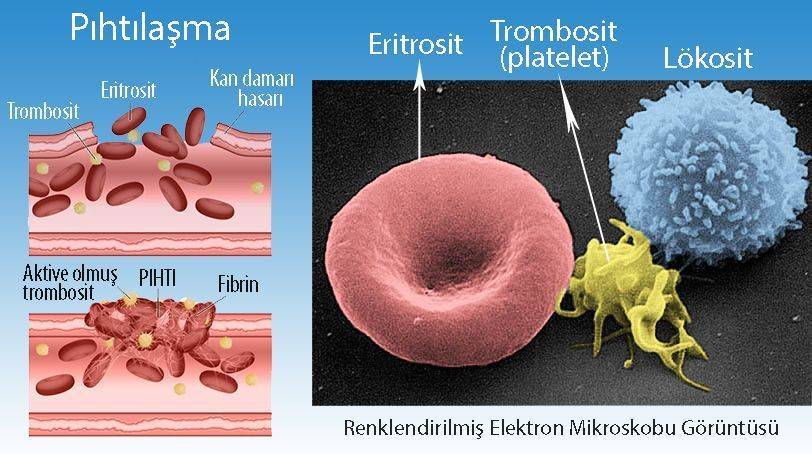
Normally, our blood should contain 150 - 450 thousand platelets in 1 cubic millimeter (1 microliter). A lower-than-normal platelet count in the blood is called thrombocytopenia, while an elevated count is called thrombocytosis.
Thrombocytopenia increases the risk of bleedingaccording to the degree of reduction. Although thrombocytopenia has a single outcome (bleeding), it does not have a single cause; dozens of different conditions can cause it. The different causes of thrombocytopenia are classified into 3 categories: reduced production, increased destruction and abnormal platelet distribution. Among the causes of thrombocytopenia and chronic liver disease, cancer can cause thrombocytopenia through both reduced production and increased destruction.
Studies Leading to FDA Approval of Avatrombopag for Thrombocytopenia Due to Chronic Liver Disease.
The approval is based on two international, identically designed, randomized, double-blind, placebo -controlled ADAPT-1 and ADAPT-2 clinical trials. A total of 430 patients with chronic liver disease and thrombocytopenia received daily avatrombopag (274 people) or placebo (156 people) for 5 days before a scheduled medical procedure. Patients were also stratified according to whether they had liver cancer and the bleeding risk associated with the scheduled procedure (low, moderate or high).
Patients receiving avatrombopag received different doses according to their mean platelet levels at baseline. Patients with baseline platelet counts below 40,000 / microliter (low-baseline platelet group) received 60 mg avatrombopag once daily for 5 consecutive days. Those with baseline platelet counts between 40.000 and 50,000 / microliter (high-baseline platelet group) received 40 mg avatrombopag once daily for 5 consecutive days. Eligible patients underwent the medical procedure 5 to 8 days after the last dose of the study medicine.
The primary efficacy endpoint of the trials was the proportion of patients, or responders, who did not require platelet transfusion or any rescue procedure for up to 7 days following a scheduled medical procedure.
In the low-baseline platelet group, 66% and 69% of patients treated with avatrombopag responded in the ADAPT-1 and ADAPT-2 trials, respectively. These rates were 23% and 35% for patients receiving placebo.
In the high-baseline platelet group, 88% of patients treated with avatrombopag responded in both trials, compared with 38% and 33% of patients treated with placebo.
The most common side effects reported in at least 3% of patients were fever, abdominal pain, nausea, headache, fatigue and peripheral edema (swelling in the legs and arms).
In conclusion , this approval is an important development that could change clinical practice. In conditions leading to chronic liver disease, such as liver cancer or liver metastasis , we used to avoid invasive procedures—for example, biopsy—or take precautions such as platelet transfusion because of thrombocytopenia. Now, in this situation, bleeding risk can be reduced more appropriately with avatrombopag taken by mouth as a pill for 5 days. We will follow this medicine’s approval in Turkey and share developments with you.
FURTHER READING...
Avatrombopag Is a Thrombopoietin Receptor Agonist
Thrombopoietin is a hormone discovered in 1994 whose main function is to control platelet production.
Thrombopoietin, a glycoprotein, binds to the thrombopoietin receptoron the cell surface, regulating megakaryocyte differentiation and thereby platelet production. The thrombopoietin hormone is particularly necessary in the final stage of megakaryocyte differentiation before platelet release.
There is an inverse relationship between platelet count and blood thrombopoietin levels. When platelet count falls acutely, thrombopoietin levels begin to rise rapidly. However, the mechanism responsible for thrombopoietin release is not yet fully understood.
In addition to increasing platelet count, thrombopoietin also increases platelet adhesion (sticking, binding) and aggregation through receptors on platelets.
Avatrombopagis a small-molecule medicine that acts like the thrombopoietin hormone (a thrombopoietin receptor agonist). This synthetic compound belongs to the class of organic compounds known as n-arylpiperazines. These are organic compounds containing a piperazine ring in which the nitrogen ring atom carries an aryl group.
Sources
fda.gov - 21 May 2018
Was this article helpful?
Your feedback helps us improve our content.




Reader comments
Share your comment
Your name and comment are published only after administrator approval. Your email address is never shown to visitors.
Be the first to comment.