
Immunotherapy Pembrolizumab Receives FDA Approval for First-Line Treatment of Advanced Head and Neck Cancer

In this article
On June 10, 2019, the United States Food and Drug Administration (FDA) approved, for metastatic or unresectable recurrent head and neck squamous cell cancer patients receiving first-line treatment, pembrolizumab (Keytruda), an immunotherapy drug.
Pembrolizumab was approved for patients with PD-L1 levels ≥1 (Combined Positive Score [CPS] ≥1), for use combined with platinum and fluorouracil (FU) and as a single agent.
The image below shows a classification of the anatomical sites where head and neck cancers can arise:

The KEYNOTE-048 Study
Approval was based on KEYNOTE-048, a randomized, multicenter, three-arm, open-label, active-controlled clinical trial in 882 patients with head and neck squamous cell cancer who had received no prior systemic treatment for metastatic or recurrent disease.
Patients were randomized in a 1:1:1 ratio into 3 arms to receive one of the following:
- Pembrolizumab as a single agent
- Pembrolizumab, carboplatin or cisplatin, and FU
- Cetuximab, carboplatin or cisplatin, and FU
Patients were also stratified by:
- PD-L1 positivity (Tumor Proportion Score [TPS] ≥50% or <50%),
- HPV status (positive or negative), and
- ECOG performance score (0 vs. 1).
The study's main efficacy measure was overall survival.
The study results showed:
- A statistically significant improvement in overall survival in patients receiving pembrolizumab plus chemotherapy compared with cetuximab plus chemotherapy.
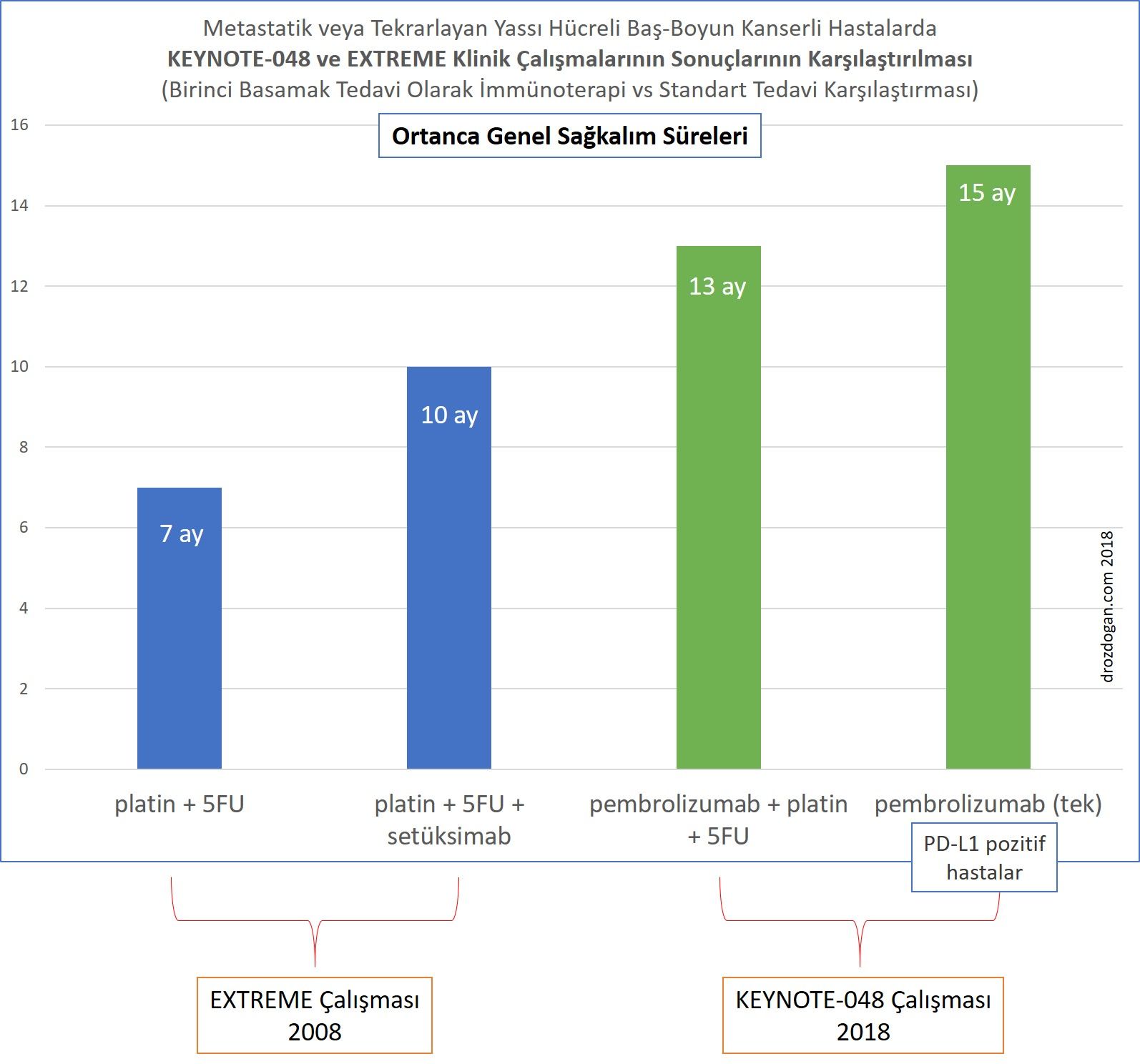
- Median overall survival was 13.0 months in the pembrolizumab plus chemotherapy arm and 10,7 months in the cetuximab plus chemotherapy arm (HR 0.77; 95% CI: 0.63, 0.93; p = 0.0067).
- Results were similar in the PD-L1 ≥20 and PD-L1 ≥1 subgroups.
- Compared with cetuximab plus chemotherapy, pembrolizumab alone significantly improved overall survival in the PD-L1 ≥1 and PD-L1 ≥20 head and neck squamous cell cancer subgroups. In the PD-L1 ≥1 subgroup, median overall survival was 12.3 months with pembrolizumab versus 10.3 months with cetuximab plus chemotherapy (HR 0.78; 95% CI: 0.64, 0.96; p = 0.0171). In the PD-L1 ≥20 subgroup, median overall survival was 14.9 versus 10.7 months, respectively (HR 0.61; 95% CI: 0.45, 0.83; p = 0.0015).
- No subgroup showed a significant difference in progression-free survival between a pembrolizumab-containing arm and the cetuximab plus chemotherapy arm.
Side Effects
In KEYNOTE-048, the most common side effects in ≥20% of patients receiving pembrolizumab alone were fatigue, constipation and rash. In KEYNOTE-048, the most common side effects in ≥20% receiving pembrolizumab with chemotherapy were nausea, fatigue, constipation, vomiting, mucosal inflammation, diarrhea, decreased appetite, stomatitis and cough.
The recommended pembrolizumab dose for head and neck squamous cell cancer is 200 mg as a 30-minute intravenous infusion every 3 weeks for up to 24 months in patients without disease progression or unacceptable side effects.
This study showing first-line immunotherapy activity can be compared with the 2008 NEJM publication that defined the existing standard of care for metastatic or recurrent head and neck cancer: EXTREME study . EXTREME was the first study to show that the triple regimen of platinum + 5FU + cetuximab was superior to the double regimen of platinum + 5FU , increasing median life expectancy in this patient group from 7 months to around 10 months.
Now, comparing the results of these two landmark studies in the history of head and neck cancer:
Related Topic:
- What Is the Best Initial Treatment for Stage 4 or Recurrent Head and Neck Cancer?
Was this article helpful?
Your feedback helps us improve our content.




Reader comments
Share your comment
Your name and comment are published only after administrator approval. Your email address is never shown to visitors.
Be the first to comment.