
The Abscopal Effect: Treating Cancer with the Immune System's Hidden Power – Reality or Hype?

In this article
Our body is a vast, complex, intricate and interconnected battlefield. Large and small battles are fought every millisecond; every second, one battle ends and another begins. Each cell tries to become capable of meeting the conditions needed for its continued existence. During this process, various useful and harmful mechanisms may emerge in our body, and tactics may arise that enable a cell to win its battle. Just as this battle cannot have a side, the fighting cells do not possess the consciousness to take sides. In other words, while our body fights for our health, cells such as cancer cells fight for their own kind. Throughout evolution, our body has often emerged victorious from this natural process. Humanity's struggle against cancer continues, and new “technologies” have emerged with each passing day. These range from modifying immune cells using genetic engineering techniques to devices that ablate tumors by heating or freezing them. Like every war, however, new technologies are developing in this one too, significantly changing its course.
Radiotherapy is a treatment based on the use of ionizing radiation. Alongside surgery and chemotherapy, it has been among the most widely used treatments in efforts to treat cancer over the last 70 years. Radiotherapy sends high doses of radioactive rays to tumor-bearing regions. This “bombardment” seeks to destroy tumors in the targeted region while causing minimal harm to normal tissues. However, in some cases, tumors also shrink in areas not directly targeted by the radiation. What causes this strange occurrence? Do the effects of such localized attacks reach further than we think?
Before discussing this interesting battle story, some background information is needed:
What Is the Abscopal Effect, and What Is Its Mechanism?
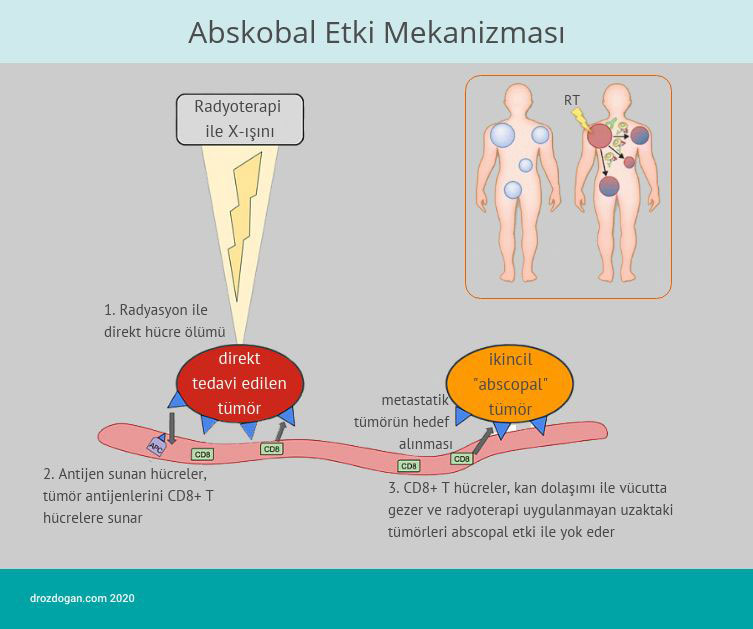
The word abscopal derives from the Latin “ab” (“away, beyond”) and the Ancient Greek “σκοπός” (“skopós,” meaning “target”) (R. H. Mole, 1953) and means “off-target.” It describes something acting on a particular area and, after a time, indirectly affecting another area. In oncology, the abscopal effect can be described as localized radiotherapy stimulating elements of the immune system, putting the body on alert and indirectly leading to the natural elimination of other metastatic tumors.
Several mechanisms have been proposed for how the abscopal effect works (oncolytic virus therapies, oncolytic substances, etc.). A mechanistic map therefore cannot yet be described. The most common proposal is as follows: the cancerous region is bombarded with radioactive rays. When cells in the irradiated area die, they release alarmin molecules that signal danger. When these molecules reach the relevant signaling systems (Damage-associated Molecular Patterns, DAMPs), white blood cells called monocytes accumulate in the area. This accumulation activates dendritic cells, which provide naive TH0, differentiation-ready T cells (white blood cells) with the antigens needed to fight the tumor. This “alarm” echoes throughout the body through the circulatory system, and tumors outside the primary target region that T cells can interact with also shrink.
- Related topic: Can Radiotherapy Act Like a Cancer Vaccine?
In this respect, the abscopal effect's mechanism resembles cancer's metastatic behavior. Metastasis broadly means cancer's migration from its primary site to other sites. Similarly, when alarmins involved in the proposed abscopal mechanism enter the circulation, they reach other regions, from the nearest to the most distant dendritic cells. In terms of causing an action and reaction outside the primary region, this can be regarded as a “metastasis”-like response by the immune system.
To turn this proposal into a metaphor consistent with our opening aphorism: the central outpost of a small city sees that an area is being bombed. An alarm announces the bombing, and soldiers are immediately armed and deployed to the area. To secure the other regions, the same alarm is passed to the remaining outposts, where the same process is repeated. Potential threats are thus prevented.
For a long time, radiotherapy's suppressive effect on the immune system was debated. Recent studies address radiotherapy's stimulatory effects on the immune system. Research on the abscopal effect is ongoing. Current studies focus on turning the abscopal effect from a rare occurrence into a method, optimizing the parameters needed to observe it, and the doses administered and intervals between doses.
Let Us Express the Rarity of the Abscopal Effect in Numbers: A review published in 2018 reported that a retrospective search of the scientific literature found only 46 cases with a clearly observed abscopal effect between 1969 and 2014.
Immunotherapy and Radiotherapy: Discovering New Methods
Immunotherapy is a biological cancer treatment that uses components of the immune system. The immune system naturally tends to find and eliminate cancerous cells, which is precisely what immunotherapy uses. It works by deliberately stimulating the immune system to increase white blood cell patrols, making cancerous cells easier to detect and clear. You can read about the subject in detail here: Immunotherapy and Cancer Vaccines
These two treatments are now being combined. Studies combining immunotherapy and radiotherapy have been among those showing the greatest effectiveness. Data obtained from current tumor models have also helped us understand that radiation has effects beyond directly killing cells in the body, such as the abscopal effect. Efforts to create and successfully administer a combined treatment using immunotherapy and radiotherapy—and even benefiting from chemotherapy—(immuno-chemoradiotherapy) will therefore allow treatments consistent with current scientific developments and the demands of today's fight against cancer to become more widespread.
Before optimizing combined treatment, however, several factors need attention. Several molecules and parameters must be carefully monitored for this treatment to be applied successfully. Examples include CD8+ T cells, type-I interferons and amphoterins (HMGB1) detected by Toll-like receptor 4 (TLR4). Radiotherapy causes cancer cell death by damaging DNA. In addition, radiation-induced activation of molecules such as STAT3 protein (a transcription factor), BCL-XL (a transmembrane cell-membrane molecule involved in the anti-apoptosis system) and VEGF (vascular endothelial growth factor, a protein stimulating angiogenesis and vasculogenesis) can cause system-wide side effects.
In other words, developing a new method requires monitoring the above parameters within the proposed chemical, immunological and radiological treatments, addressing their shortcomings and moving beyond them. Demonstrating the clinical usefulness and reproducibility of the immunological and radiological abscopal mechanisms being tested could also increase this method's effectiveness.
Adaptive Radiotherapy and Speculation
Beyond the chemical, immunological and radiological aspects, a possible combined treatment also has an evolutionary and adaptation-related dimension (see Did You Know Cancer Evolves? Can It Be Prevented?). Adaptive radiotherapy (ART) considers all changes a patient undergoes during treatment and works with parameters that other radiotherapy methods such as YART and IGRT cannot address. Examples include changes in the patient's weight, injuries affecting the treatment area, the dose requirements of cells in that area and cell type... Essentially, this treatment considers the adaptive success not only of the presumed immune system components but also of all cells in the treatment area and other regions where the abscopal effect is observed. Adaptive success varies between cells and regions and also depends on the area's condition, such as toxicity, gas content and fluid content. ART's success rate is therefore not universal and requires collecting certain information and extensive individualized parameter testing.
Unfortunately, very few studies—and comparatively almost none—show ART's influence on the abscopal effect. To comment on these two concepts, we must therefore consult evolutionary biology and draw on science-based inferences. Patient health is naturally very important in radiotherapy, immunotherapy or possible combined treatments established as methods. As adaptive therapy supports the adaptive success of an individual's cells in relation to one another and their environment, it will increase healthy cells' coordination with immune system components and significantly reduce both cancerous cells' metastatic abilities and healthy cells' risk of becoming cancerous. With adaptive therapy's help, this microevolutionary process could be controlled when cancer is observed, eliminated by the treatments mentioned—perhaps without allowing it to recur —and help make treatment-based abscopal effects more common, indirectly expanding the body's outpost's reach and strength. A cancer that would recur would then have difficulty choosing a starting site, and during this time the immune system would (most likely) prevent this potential cancer.
Conclusion
This thought experiment suggests that individuals' condition and the state of their immune systems remain fundamental. In the possible method discussed, the abscopal effect appears usable as a method only when radiotherapy targeting a tumor controlled by adaptive therapy provokes a strong immunological response in the patient's immune system. Although this speculation has a basis, research into the hypothesis must begin and support it with real results. The abscopal effect has opened a door to a new treatment approach, and scientific research teams worldwide are working on it.
However, the abscopal effect remains a hypothesis. Trying to demonstrate it through new studies seems a worthwhile endeavor in light of the phenomena observed. Natural elimination of cancerous cells could help the body gain immunity and perhaps one day open a window offering a cure for cancer.
Sources
2. Yılmaz M, Elmalı A, Yazıcı G. (2019) Abscopal Effect, From Myth to Reality: From Radiation, Oncologists' Perspective, 11(1).
3. Dağoğlu N, Karaman Ş, Çağlar H. B, Oral E. N. (2019) Abscopal Effect of Radiotherapy in the Immunotherapy Era: Systematic Review of Reported Cases, Cureus 11(2).
4. Käsmann et al. (2019) Chemo-/immuno-/radiotherapy combination in treatment of solid cancer, Oncotarget, 10(52): 5387-5388.
5. Durante M, Reppingen N, Held K. D. (2013) Immunologically augmented cancer
treatment using modern radiotherapy, Cell Press, 19(9).
6. Shevtsov M, Sato H, Multhoff G, Shibata A. (2019) Novel Approaches to
Improve the Efficacy of Immuno-Radiotherapy. Frontiers in Oncology, 9(156).
7. Özdemir S, Uzel Ö. (2013) Adaptif radyoterapi, Türk Onkoloji Dergisi, 28(3): 136-141
8. Thorwarth D. (2017) Biologically adapted radiation therapy, Zeitschrift für Medizinische Physik, 28(3): 177-183.
9. Siva S, MacManus M. P, Martin R. F, Martin O. A. (2015) Abscopal effects of radiation therapy: A clinical review for the radiobiologist, Cancer Letters, 356(1): 82-90.
10. Yang Liu et al. Abscopal effect of radiotherapy combined with immune checkpoint inhibitors. J Hematol Oncol. 2018 Aug
Was this article helpful?
Your feedback helps us improve our content.




Reader comments
Share your comment
Your name and comment are published only after administrator approval. Your email address is never shown to visitors.
Be the first to comment.