
Avapritinib Receives FDA Approval for Gastrointestinal Stromal Tumor (GIST)

In this article
On 9 January 2020, the US Food and Drug Administration (FDA) approved treatment for platelet-derived growth factor receptor alpha (PDGFRA) exon 18-mutated, metastatic or surgically unresectable gastrointestinal stromal tumors (GIST) in adults with avapritinib (Ayvakit) .
Avapritinib is the first approved treatment for GIST with PDGFRA exon 18 mutations.
Including PDGFRA D842V-mutated 38 patients, the multicenter, single-arm, open-label NAVIGATOR trial studied PDGFRA exon 18-mutated GIST in 43 patients. Initially, they received daily 400 mg avapritinib, reduced for toxicity to recommended daily oral 300 mg. Treatment continued until progression or unacceptable toxicity. The main endpoint was overall response rate , with response duration an additional endpoint.
- With PDGFRA exon 18 mutations, objective response was % 84: % 7 complete and % 77 partial.
- With PDGFRA D842V mutations, objective response was % 89: % 8 complete and % 82 partial.
- At 10.6 months, median duration was not reached because more than half continued responding.
- Among exon 18-mutated responders, % 61 had responses lasting 6 months or longer.
The most common (≥% 20) adverse effects were edema, nausea, fatigue / asthenia, cognitive impairment, vomiting, decreased appetite, diarrhea, hair color changes, increased tearing, abdominal pain, constipation, rash, and dizziness.
The recommended avapritinib doseis once daily on an empty stomach, at least one hour before and two hours after food, orally 300 mg.
*
FURTHER READING
What Is Gastrointestinal Stromal Tumor (GIST), and How Is It Treated?
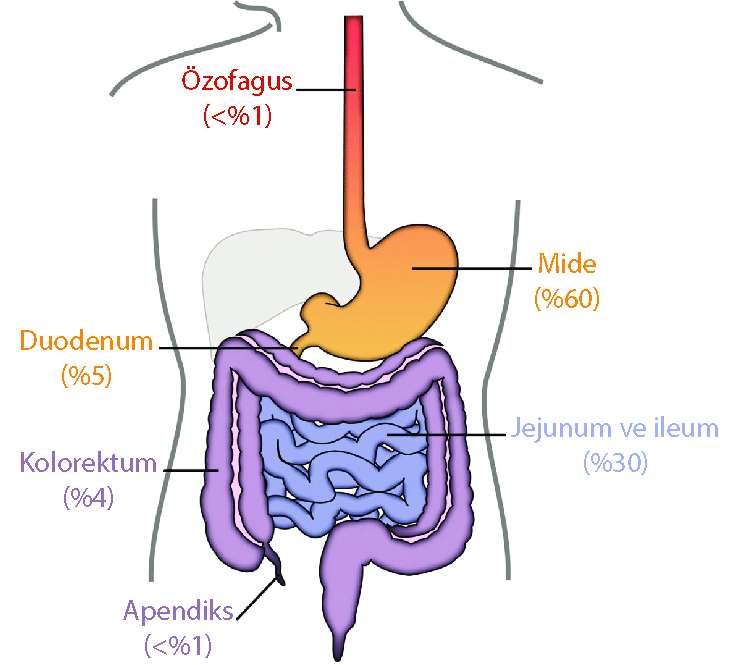
Although rare, GIST is among the most common mesenchymal cancers, with worldwide annual incidence per million of 10-15. It originates from interstitial cells of Cajal, mainly in the gastrointestinal (GI) tract, most in the stomach (% 60).
Below are organs where these tumors occur and their proportions.
Diagnosis uses morphology and ancillary immunohistochemistry and molecular biology. More than % 95 strongly and diffusely express CD117 (c-KIT), beingKIT-positive). Several new immunohistochemistry (IHC) markers have been investigated to improve diagnostic accuracy, particularly in KIT-negative GISTs; these are the markers have been investigated, especially for KIT-negative tumors. DOG1 (Discovered Gist-1) is highly sensitive, identifying most KIT-positive and up to a third of KIT-negative tumors.
Key prognostic factors determining malignancy potential are tumor size (5> cm indicates poor prognosis), and per 5 square millimeters, the mitosis count, plus tumor location. Tumor rupture was recently identified as another adverse prognostic factor.
Molecular biology helps confirm diagnosis and provides prognostic and predictive information on targeted treatment sensitivity. Most GISTs have activating KIT or platelet-derived growth factor receptor alpha (PDGFRA) mutations. Approximately % 60-85are KIT mutation-positive.
Of GISTs, 5-10 are PDGFRA mutation-positive, often localized gastric tumors. Among PDGFRA mutations, % 65-75 occur in exon 18 as D842V.
Overview of GIST Immunohistochemical Staining and Genetic Analysis:
Blue dashed borders indicate CD117 / DOG1 + GISTs. Orange solid borders indicate KIT / PDGFRA-mutated GISTs. Black dashed lines divide GISTs by somatic and germline mutations .

GISTs are exceptional cases for understanding solid cancer molecular biology. The KIT inhibitor imatinibfundamentally changed a solid organ cancer's natural history and is a major milestone in cancer history . Tyrosine kinase inhibitor (TKI) activity, including imatinib, depends largely on particular KIT and PDFRA mutations. TKIs are standard for KIT-positive GIST and, with avapritinib, for PDGFRA mutation-positive disease. New, more active TKIs will make molecular profiling increasingly important for optimal selection.
Approximately % 10 of adult and % 85 of pediatric GISTs lack either gene mutation and are called “wild-type GISTs.” Changes include activating BRAF mutations, inactivating NF1 mutations, genes encoding succinate dehydrogenase (SDH) complex components, and kinase NTRK3 gene fusions. Clinical behavior varies, but even in metastatic disease, slow progression is common.
How Is GIST Treated?
Planning principally considers stage and risk factors. The first image summarizes “early / locally advanced-stage” algorithms. Avapritinib is not approved early, so this approach is unchanged.

*
The second image summarizes “advanced / metastatic-stage” algorithms “before avapritinib.”

*
The third image summarizes “advanced / metastatic-stage” algorithms “after avapritinib and possible future approaches.”

Sources
fda.gov, 9 Jan 2020.
2. Mazzocca A ve ark.
New frontiers in the medical management of gastrointestinal stromal tumours.
Ther Adv Med Oncol. 17 may 2019.
Was this article helpful?
Your feedback helps us improve our content.




Reader comments
Share your comment
Your name and comment are published only after administrator approval. Your email address is never shown to visitors.
Be the first to comment.