
Diagnosis and Current Treatment of Biologically Diverse Neuroendocrine Tumors

In this article
The neuroendocrine system consists of hormone-producing (endocrine) cells and nerve cells. Neuroendocrine cells are found mainly in organs such as the digestive tract, including the stomach and intestines, and the lungs. Neuroendocrine tumors can occur anywhere in the body but most often arise from neuroendocrine cells in the gastrointestinal (stomach-intestinal) tract, lungs and pancreas. They are rare cancers.

Most neuroendocrine tumors cause no symptoms in their early stages and take years to grow. Some types, however, are aggressive and grow rapidly. This makes timely detection and control of the tumor difficult.
Let us take a closer look at some interesting topics concerning neuroendocrine tumors.
Can the Course of Neuroendocrine Tumors Be Predicted?
What is the current scientific thinking about why some neuroendocrine tumors grow slowly while others are more aggressive?
“The degree of differentiation of the cells making up the tumor and the stage of the cancer are the most important prognostic markers, predicting the course of the disease.
Although poorly differentiated, immature neuroendocrine tumor cells and well-differentiated cells share some pathological similarities, they have completely different biological and clinical characteristics. For example, poorly differentiated neuroendocrine cancers are characterized by TP53, RB1 and NRAS gene mutations. In contrast, fully differentiated, mature tumor cells are often characterized by genetic alterations involved in chromatin remodeling, and in many cases these tumor types have no clear oncogenic mutation.
Alongside these differences, well-differentiated neuroendocrine tumors are heterogeneous, displaying different characteristics within the group, and their course depends on tumor grade and the primary site of origin. For example, neuroendocrine tumors in the small intestine grow quite slowly but tend to spread through metastasis to different parts of the body. Rectal neuroendocrine tumors, arising in the final part of the large intestine, tend to be superficial and benign, but generally become more aggressive when they metastasize. Because of these differences, tumors should be evaluated according to their primary site of origin and treatment approaches designed accordingly. We are at a very early stage in identifying the relationship between genotype (genetic makeup) and phenotype (cellular appearance), but epigenetic changes are becoming increasingly apparent as important contributors to tumor formation.”
The Question of Early Diagnosis
Neuroendocrine tumors tend not to cause symptoms early on. However, we know that treatment has favorable outcomes when they are detected early. Where do we stand in the early diagnosis of neuroendocrine tumors?
"Early diagnosis of this tumor type is a complex problem. This is because some types do not progress and therefore cause no symptoms. Given the rarity of clinically significant neuroendocrine tumors, apart from a family history, genetic von Hippel-Lindau syndrome or multiple endocrine neoplasia, there is no routinely used screening protocol to identify asymptomatic or not-yet-symptomatic neuroendocrine tumors.
On the other hand, there are serious problems involving patients with severe symptoms progressing over many years who have not been treated appropriately. Signs and symptoms such as irritable bowel, chronic diarrhea or bowel obstruction may be overlooked because they are thought unrelated to neuroendocrine tumors. Physicians’ awareness of the possible underlying causes of these signs and symptoms is therefore extremely important in identifying the correct treatment."
Common Sites of Disease and Recent Treatment Developments
What are the most common sites of neuroendocrine tumors and the treatment strategies?
"The small intestine is the most common primary site of origin of metastatic neuroendocrine tumors. Somatostatin receptors are expressed in neuroendocrine tumors treated with somatostatin analogues as first-line therapy. These analogues are also an important treatment option in cases involving carcinoid tumors, a subset of neuroendocrine tumors. Carcinoid syndrome is a clinical condition that arises with liver metastases from these tumors. Somatostatin analogues are used both to control tumor growth and to relieve carcinoid syndrome.
At the same time, another approach aimed at reducing tumor volume, debulking surgery, is also considered for patients with metastatic disease to reduce signs and symptoms, including those from the main tumor. For neuroendocrine tumors observed in the liver, radiofrequency ablation (burning treatment) or hepatic artery embolization is frequently performed. Second-line treatment is generally peptide receptor radiotherapy using lutetium-177 (Lu-177) dotatate. We also use somatostatin analogues for metastatic somatostatin-receptor-expressing neuroendocrine tumors in the pancreas.
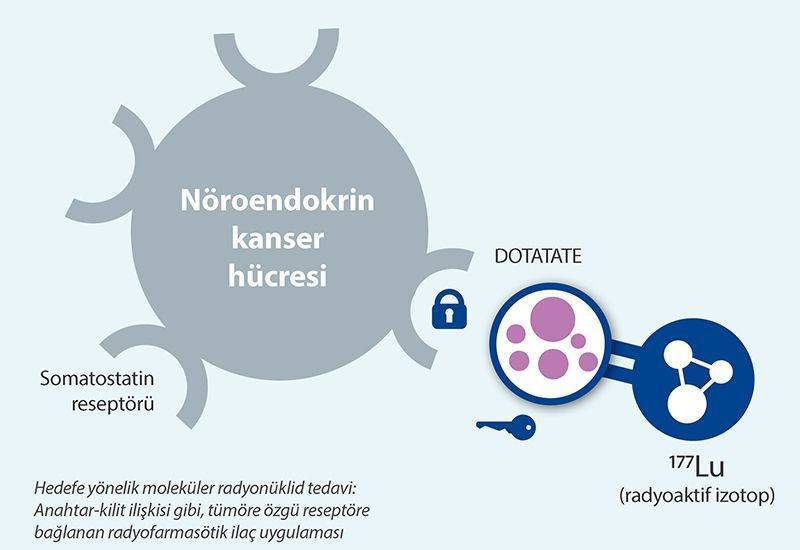
- Related topic: Lutetium 177 Receives FDA Approval for Treating Neuroendocrine Tumors
Everolimus, sunitinib, chemotherapy and Lu-177 dotatate are also considered other treatment options. However, no completed study has compared these different options. This makes it difficult to decide which treatments to use and in what sequence. If the cancer is aggressive, however, we generally prefer the chemotherapies capecitabine and temozolomide.”
Clinical Trials
“We have a large population of patients diagnosed with neuroendocrine tumors and a strong clinical trial portfolio. Studies are investigating lenvatinib with pemprolizumab for progressive (aggressive, advancing) neuroendocrine tumors and comparing cabozantinib with placebo. Another notable study is investigating chimeric antigen receptor (CAR) T cells and their efficacy in neuroendocrine tumors. Another noteworthy study uses a single immunotherapy (PD-1 inhibitor), but response rates were found to be low. However, new data are available on dual immunotherapy with ipilimumab and nivolumab in advanced neuroendocrine tumors. We await the results of clinical trials combining different immunotherapies. Although immunotherapy has not played a major role in neuroendocrine tumors to date, advances in the laboratory and in clinical trials are extremely exciting.”
Sources
Update on Detecting and Treating Biologically Diverse Neuroendocrine Tumors: A Conversation With Jonathan R. Strosberg.
ascopost.com - Last Updated: 8/18/2020
Was this article helpful?
Your feedback helps us improve our content.




Reader comments
Share your comment
Your name and comment are published only after administrator approval. Your email address is never shown to visitors.
Be the first to comment.