
Innovations and Discoveries in Oncology – 2020

In this article
At the dawn of the next 10 years, oncology developments and unmet needs are assessed in this article. What will the new treatments be, and what will they offer patients?
Outcomes for people diagnosed with cancer have changed over the past 50 years. While 5-year survival rates for patients diagnosed in the 1970s were around 30-40%, they had reached 70% by 2010; today's figures are even more optimistic (source 1).
There are 3 main reasons for improving cancer outcomes:
- Public health measures (such as smoking cessation education),
- Improved healthcare (such as screening methods for early diagnosis), and
- New drugs and their combinations.
These developments have turned certain diagnoses once considered terminal (end-stage) into chronic diseases. For example, most patients currently diagnosed with multiple myeloma or prostate cancer have a higher rate of death from conditions other than cancer. Another aspect of these advances in oncology has appeared in the pharmaceutical market: oncology drugs accounted for 143 billion dollars in patented, approved drug sales worldwide in 2019. This figure corresponds to approximately 20 percent of all global drug sales (2). Analysts predict that this growth will continue at an annual rate of 12%, with oncology drug sales reaching 250 billion dollars by 2024.
However, much remains to be done. Pancreatic cancer, glioblastoma (GBM, a brain tumor) and non-small-cell lung cancer (NSCLC, the most common form of lung cancer) still have 5-year survival rates below 50%. These three cancers represent nearly 2.5 million new diagnoses worldwide each year (3). In lung cancer, despite the excitement and advances with immunotherapy, 5-year survival rates in advanced NSCLC are around 25%; before immunotherapy, this rate was around 10% (4).
Moreover, we see substantial geographical differences in outcomes. Recent EUROCARE-5 results report for non-Hodgkin lymphoma (NHL) geographically varying 5-year survival rates: 63 percent in Northern Europe and 50 percent in Eastern Europe. Breast cancer also shows geographical differences in 10-year survival rates: 76% in Northern Europe and 65% in Eastern Europe (5). Although outcomes in China still lag behind countries with advanced healthcare, they have improved dramatically; for example, the 5-year survival rate across all cancers was estimated at around 40% for those diagnosed in 2013, compared with approximately 30% for those diagnosed in 2003 (6). Nevertheless, China has a major opportunity to bring more innovation to the 4 million cancer patients diagnosed each year.
Innovation in oncology has accelerated
In the breast cancer subtype HER2, the first targeted drug was Herceptin – also considered one of oncology's first targeted treatments – approved in 1999. It took 8 years for a second HER2-targeted drug to be approved. By contrast, the first PARP drug entered the market in 2013, and the gap between this PARP inhibitor, which transformed ovarian cancer treatment, and the next was less than 2 years. Globally, the next wave of innovation for patients is advancing at an increasing pace. Immuno-oncology treatments are expected to see continued momentum and innovation, and more than 550 cell and gene therapy agents are in clinical development.
This article, largely a translation of McKinsey & Company's “Delivering innovation: 2020 oncology market Outlook”, examines the current state of the global oncology drug market to identify where oncology investment is taking place, where the greatest unmet need persists, and where competition is most intense. The analysis also identified 5 critical trends that could change the strategic focus of oncology drug leaders, and perhaps even the face of the oncology market.
Oncology is the world's largest therapeutic area, and the drug development landscape is highly competitive
Advances in oncology have substantially improved patient outcomes (Chart 1). However, across academia and industry, extensive investment in oncology R&D reflects our agreement as experts in the field that much remains to be done. Oncology is the focus of the 10 largest pharmaceutical companies, with an estimated 1700 clinical drug candidates in development (approximately one-third of clinical research across all diseases) (7).
For non-small-cell lung cancer (NSCLC), approximately 100 active phase III clinical trials are being conducted in the United States alone, representing 75 thousand patients. Acute lymphocytic leukemia (ALL) requires more than 32 thousand patients to enroll in approximately 25 clinical trials underway in the United States – more than the number of new diagnoses in a single year (8).

In addition to abundant R&D at both large pharmaceutical companies and biotechnology firms focused on numerous clinical products, we have observed oncology-focused acquisitions and partnerships worth billions of dollars. Examples include Pfizer's 2019 acquisition of Array BioPharma for 11 billion dollars and the 3-billion-dollar collaboration between AbbVie and Genmab on bispecific antibodies… Excitement about oncology targets has driven high premiums for these companies. Over the past five years, the average oncology acquisition premium was approximately 100 percent for transactions valued at more than 5 billion dollars.
However, if past trends repeat, only a small proportion of these assets will shape the future market (Chart 2). Developing a new drug in oncology is a highly challenging process, and current success rates (from first use in humans, that is, phase-1, to FDA approval) are only approximately 9.6 percent in oncology, with an average development time of 9.5 years (9) (Chart 3).


The oncology market encompasses a range of different cancers and stages
Although cancer is typically thought of as a single disease, there are 20 common and more than 100 major cancer types whose names people can readily list. Including subtypes and rare tumors, this number exceeds a thousand. However, the following 6 common cancers account for more than half of all cancers: lung, breast, colorectal, prostate, skin, and stomach cancers.
In 2019, breast cancer, multiple myeloma, non-small-cell lung cancer (NSCLC), prostate cancer, and non-Hodgkin lymphoma accounted for 90 billion dollars in drug sales (68 percent of the market). This is expected to rise to 141 billion dollars in sales by 2024 (64 percent of the market), largely because of increased immunotherapy use in NSCLC (10). Although each of these 5 cancer types has a high incidence and unmet needs, most sales come from a small number of drugs (Chart 4).

Oncology drug sales are projected to reach 250 billion dollars by 2024
Oncology's growth is influenced by 4 priority trends:
- Growth potential in existing markets. One example is using newer drugs, initially approved for advanced cancers, in earlier stages. This will increase the proportion of patients benefiting from a new cancer drug and, naturally, the drug's use. Key cancer types in this context include multiple myeloma, HER2- and hormone-positive breast cancer, prostate cancer, kidney cancer, ALK-positive lung cancer, and EGFR-positive lung cancer.
- Treatment outcomes remain below the desired level. For most advanced cancers, 5-year survival is below 50%. This highlights a large unmet need for R&D into more effective treatments. The first cancers that come to mind in this context are colorectal cancer, liver cancer, pancreatic cancer, and NSCLC without a targeted treatment option.
- Large patient groups without satisfactory treatments, even though their cancers are not the most common. For most cancers in this group, 5-year survival in advanced stages is below 30%. Although these cancers are not among the 5 most common, chemotherapy remains standard treatment because innovative treatments are not yet available. The first cancers that come to mind here are soft tissue sarcomas, gastrointestinal stromal tumors, triple-negative breast cancer, small-cell lung cancer, ovarian cancer, uterine cancer, and esophageal cancer.
- Niche cancers. Drug developers may choose to target common cancer groups outside the 10 most common cancers. Although unmet need is very high for some diseases, such as the aggressive brain tumor glioblastoma (GBM), developing and commercializing effective treatments requires a new approach because their biology is less well understood or these cancers are primarily resistant to many types of treatment. The first cancers that come to mind here include T-cell cancers, thyroid cancer, and glioblastoma.

Current new trends may shape oncology for years
Despite the pharmaceutical industry's successful track record in oncology, extensive unmet need must still be addressed. 5 groundbreaking developments will continue to influence an already changing oncology innovation landscape.
1. New cell and gene therapies
Over the past five years, we have seen growing excitement about new techniques, including cellular therapies, viral vectors, RNA therapy, and stem cell therapies. In oncology, two chimeric antigen receptor T (CAR T) cell therapies, Kymriah and Yescarta, have been approved in acute lymphocytic leukemia (ALL) and diffuse large B-cell lymphoma (DLBCL) with unprecedented efficacy. Although the number of CAR-T applications worldwide remains modest – given to only a few hundred patients – spending on CAR T-cell therapies is expected to exceed 6 billion dollars in 2024 (11).
Cell and gene therapies cause significant disruption to existing healthcare approaches, with more complex manufacturing and supply-chain processes, especially for autologous therapies (using a person's own stem cells). These treatments also involve longer preparation times, more demanding treatment protocols, and – because many treatments have the potential for a one-time cure – more complex market-access considerations. There are high expectations that the cell and gene therapy fields will realize their promised potential and long-term benefits.
2. Precision medicine
Precision medicine, delivering the right drug to the right patient at the right time, is advancing rapidly. Oncology is a pioneer of precision medicine: more than 160 oncology biomarkers had been approved by 2019, and more than 90 percent of pivotal clinical trials target molecular targets (12).
Cancers are increasingly divided into subtypes, with genetic biomarkers rather than histological (microscopic) appearance now defining these subtypes. More cancer-causing genetic changes can be detected through tests and targeted with next-generation drugs every day. For example, beyond the three most common mutations in NSCLC (those related to the ALK and KRAS genes and the EGFR protein), there are many rarer cancer-driving mutations whose frequency does not exceed 3-4 percent (13).
For many advanced solid (organ) cancers, comprehensive genetic testing has now become a standard part of treatment planning. Ways of increasing the adoption of genetic testing may include collaboration with test providers and governments, as well as physician education. At present, familiarity with oncology genetic testing is quite limited, even among physicians.
3. Accelerating the drug development process
As more pharmaceutical companies focus on oncology, competition for key targets has become increasingly intense. We estimate that nearly 80 percent of new clinical trials involve a treatment similar to one already on the market or face 4 or more clinical competitors (14). Greater competition has shortened drug development processes, and competing treatments quickly follow the first approval. Success in this environment requires exploring new drug development approaches, including placing greater emphasis on earlier clinical trials. FDA approvals are now granted based not only on phase-III study results but also on phase-II studies. Recent FDA approvals based on a biomarker, regardless of the organ in which the tumor originated, illustrate this: MSI-H or dMMR mutations and TMB-high tumors treated with pembrolizumab (Keytruda), and larotrectinib (Vitrakvi) for NTRK mutations are examples.
4. Immuno-oncology combination treatments
Cancer treatment was reshaped for many cancers when ipilimumab (Yervoy) first received FDA approval for the aggressive skin cancer malignant melanoma in 2011. These immunotherapies, called “immune checkpoint inhibitors”, are now FDA-approved in 16 different cancer types and, in some circumstances (MSI-H or TBM-high), regardless of the organ of origin.
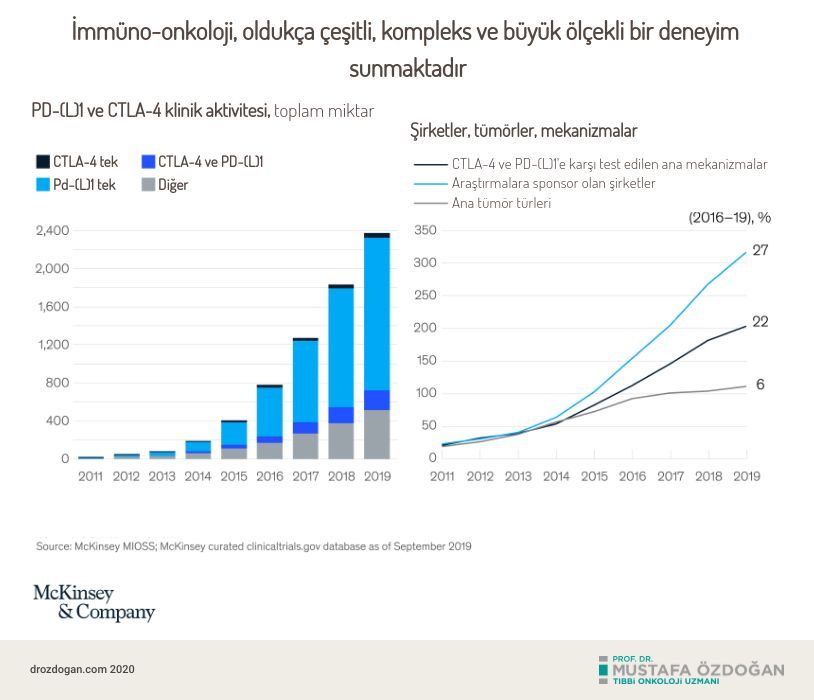
The best-known immune checkpoints targeted in drug development are PD-1, PD-L1 and CTLA4, but pharmaceutical companies have invested heavily in investigating more than 200 other immune (immune system) mechanisms beyond these checkpoints (Chart 7). In addition, using immunotherapy drugs or drug candidates in combination is the subject of many studies. However, widespread use of combination treatments makes study design more complex, particularly if neither combination drug is already approved or if the additional costs of a combination partner must be paid for clinical trials.
5. Access to new drugs / bringing them to patients
The evolving drug discovery landscape requires pharmaceutical companies to fundamentally consider how they will deliver drugs to physicians and patients. Treatment planning has become much more complex, and patient groups have become smaller; for example, within NSCLC, there are numerous cancer-driving mutations, each with its own targeted treatment, such as ALK, ROS1, BRAF, NTRK, EGFR, HER2, and MET.
Beyond identifying the right treatment, pharmaceutical companies increasingly offer "white-glove" services to support patients undergoing demanding treatment protocols (white glove is a name given to making it easier for patients in clinical trials to reach the oncology team than usual, receive better care, and have greater satisfaction with treatment).
The number of FDA-approved CART-cell therapies is expected to rise from 2 in 2019 to 24 in 2024. These new treatments face a combination of manufacturing and commercial challenges. Approximately 75 percent of all CAR T-cell therapies are autologous (using the patient's own blood/bone marrow cells), which means that they require a costly single-batch manufacturing approach. At the same time, CAR-T-cell and other cellular immunotherapies can be manufactured at only a small number of centers and require a high-level commercial model to bring these new treatments to patients, providers, and payers.
A care model that makes a difference but remains out of the spotlight: Electronic Patient-Reported Outcomes
Electronic Patient-Reported Outcomes (electronic Patient Reported Outcomes, ePRO) means adding a patient's directly reported health status to electronic health records without interpretation by a physician or another healthcare professional. Studies in recent years have shown that integrating ePRO into the oncology treatment plan has the following benefits:
- identifying and controlling symptoms,
- quality of life,
- communication,
- treatment satisfaction,
- fewer emergency department visits and hospital admissions,
- better treatment adherence, and
- even longer survival (15).
Beyond discovering a new drug, Electronic Patient-Reported Outcomes, which allow patients to be followed daily/weekly through web-based applications, may make it possible to “listen to patients' voices”. ePRO appears to be the key to patient-centered care. In the coming years, we will also witness ePRO being integrated into oncology practice through appropriate strategies.
Conclusion
Overall, we hope that oncology will continue to have meaningful, transformative potential for patient outcomes. Many cancer types continue to have substantial unmet needs. Looking at both the number of new drugs being tested and the investments made by the pharmaceutical industry, major innovations await us. Precision medicine and new methods, including cellular therapies, are being tested continually to extend patients' lives and improve quality of life. However, realizing this potential will require pharmaceutical companies to work in new ways as they accelerate processes, develop combination treatments, and, perhaps most importantly, find effective ways to bring these treatments to market.
Sources
2. Product sales, EvaluatePharma® July 2020, Evaluate Ltd.
3. Cancer. who.int/news-room/fact-sheets/detail/cancer 12 September 2018
4. Edward B. Garon, Matthew David Hellmann, Enric Carcereny Costa et al. Five-year long-term overall survival for patients with advanced NSCLC treated with pembrolizumab: Results from KEYNOTE-001. ASCO 2019 - LBA9015.
5. Is Europe doing better in cancer care since the 90th?: The latest findings from the EUROCARE-5 study, European Cancer Congress, Vienna, Austria, September 25–29, 2015, eurocare.it.
6. Peter Baade et al., “Changing cancer survival in China during 2003–15: A pooled analysis of 17 population-based cancer registries,” The Lancet, May 2018, Volume 6, Number 5, pp. 555–67, thelancet.com.
7. Compounds in clinical development (Phases I–III) excluding reformulations and biosimilars, Pharmaprojects, 2019, pharmaintelligence.informa.com.
8. Accessed on Clinicaltrials.gov, October 24, 2019. Includes interventional trials where recruitment status is one of the following: recruiting, active, not recruiting, or enrolling by invitation.
9. McKinsey analysis of success rate based on oncology development projects excluding reformulations and biosimilars between 2008 and 2018; time-to-market based on average time in phase for successful phases based on oncology development projects excluding reformulations and biosimilars between 2010 and 2018; see Pharmaprojects, 2019, pharmaintelligence.informa.com.
10. Product estimates, EvaluatePharma® July 2020, Evaluate Ltd.
11. Vanessa M. Hubbard-Lucey, Jun Tang, and Jia Xin Yu, “The global pipeline of cell therapies for cancer,” Nature, May 30, 2019, nature.com.
12. Vanessa M. Hubbard-Lucey, Jun Tang, and Jia Xin Yu, “The global pipeline of cell therapies for cancer,” Nature, May 30, 2019, nature.com.
13. Vanessa M. Hubbard-Lucey, Jun Tang, and Jia Xin Yu, “The global pipeline of cell therapies for cancer,” Nature, May 30, 2019, nature.com.
14. Pharmaprojects | Informa December 2017. McKinsey analysis based on number of novel assets pursued by MOA (based on primary target), excluding novel assets with undisclosed MOA; see Pharmaprojects, 2017, pharmaintelligence.informa.com.
15. Symptom Monitoring With Patient-Reported Outcomes During Routine Cancer Treatment: A Randomized Controlled Trial. JOURNAL OF CLINICAL ONCOLOGY.
Was this article helpful?
Your feedback helps us improve our content.




Reader comments
Share your comment
Your name and comment are published only after administrator approval. Your email address is never shown to visitors.
Be the first to comment.