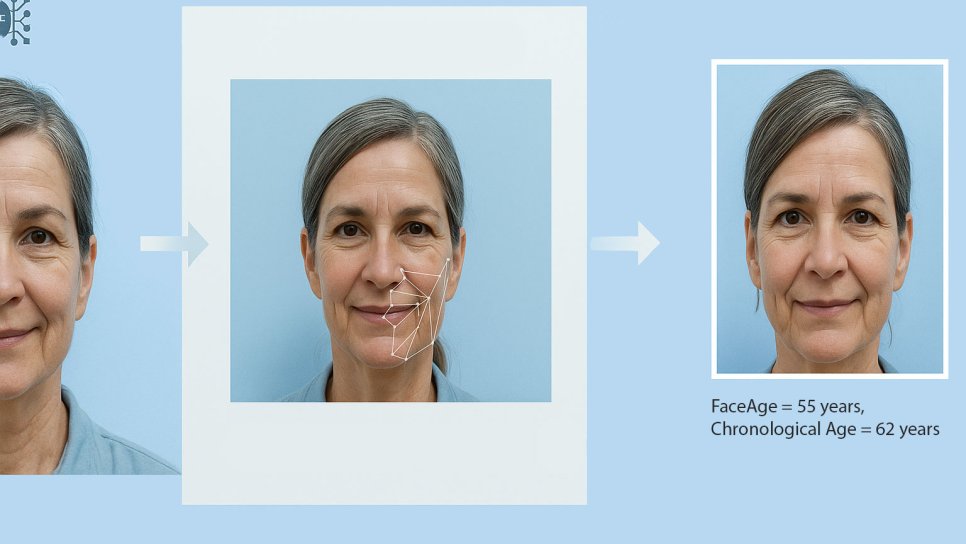
Can a Simple Photograph Help Predict Cancer Survival? The FaceAge Artificial Intelligence
Face Age: A Deep Learning System in Cancer Diagnosis
Published on May 8, 2025 in The Lancet Digital Health, this study shows that the deep learning system called FaceAge can predict biological age from facial photographs and improve survival predictions in cancer patients.
In clinical practice, the “first impression” of a patient may influence a doctor’s decisions, but it remains subjective and only provides a rough estimate of biological age. There was a need for a quantitative and standardized measure. FaceAge aims to fill this gap by generating a measurable “face age” from a single facial photo.
Summary: Compared with non-cancer individuals, cancer patients appear on average about 5 years older in facial photographs. Face age is independently associated with survival across multiple cancer cohorts. When AI is applied in palliative care, the accuracy of doctors’ survival predictions improves by about 6%. In other words, with AI support, prediction accuracy rises from 74% to 80%.
📷 Clinical Decision-Making with Photos and Face Age
FaceAge generates an age prediction from a facial photo taken with a standard webcam/smartphone, adding an objective layer to the doctor’s subjective performance assessment. Patients whose face age is younger than their chronological age tend to have better outcomes after treatment.
🧠 How Was the Model Trained?
- Training: IMDb–Wiki dataset with 56,304 facial images.
- Technical validation: UTKFace dataset with 2,547 images.
🏥 Clinical Testing (US & Netherlands)
- Total: 6,196 cancer patients (facial photos taken at the start of radiotherapy).
- Reference: Cohort of 535 non-cancer individuals.
- Analysis: Kaplan–Meier, Cox regression; multivariable adjustments applied.
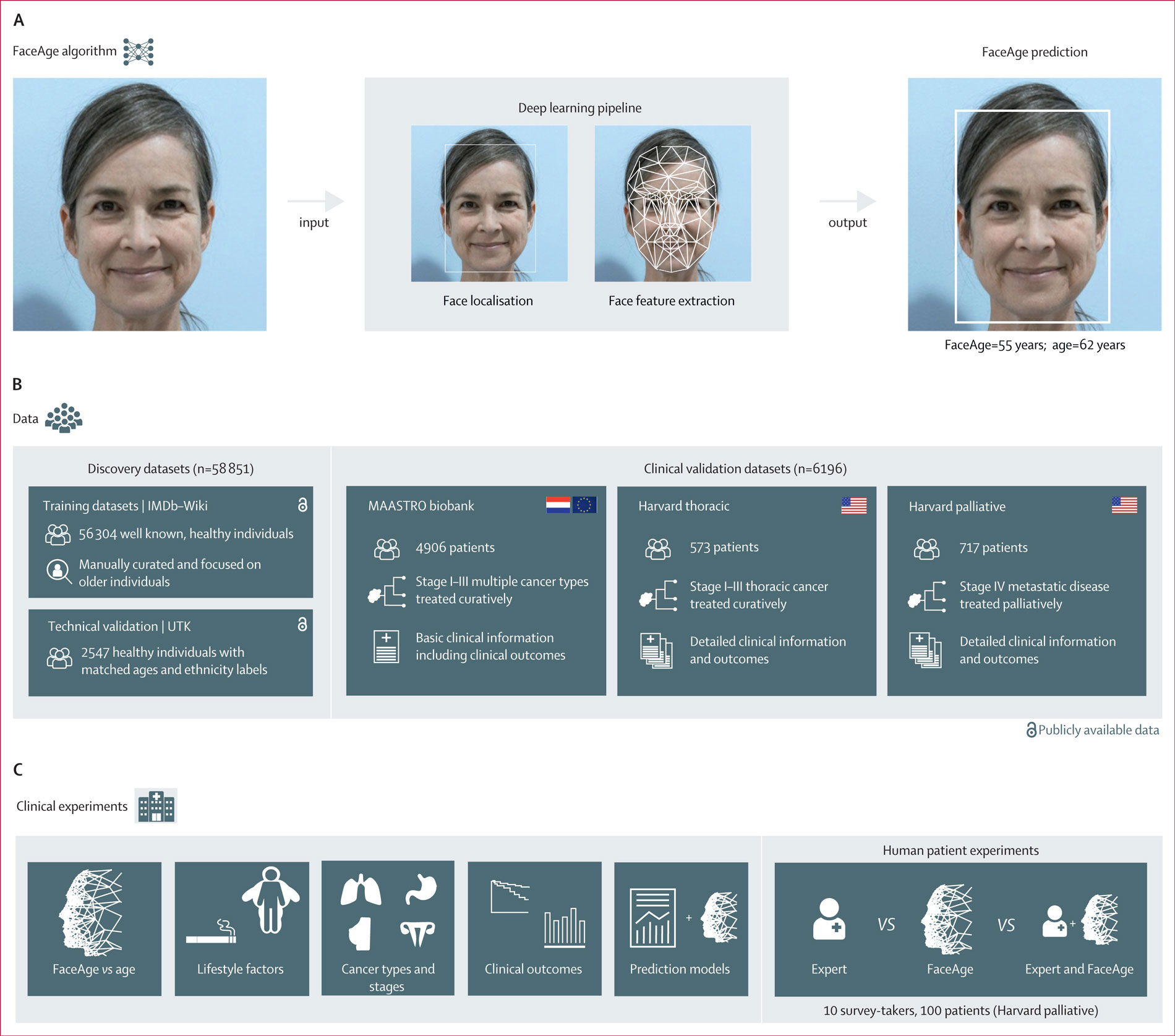
Image description: The FaceAge algorithm uses deep learning to predict biological age from facial photographs and assess survival in cancer patients. The study compared discovery data from 58,851 healthy individuals with clinical data from 6,196 cancer patients. Findings suggest that appearing older than one’s chronological age is associated with worse survival.
📊 Study Results (Key Numbers)
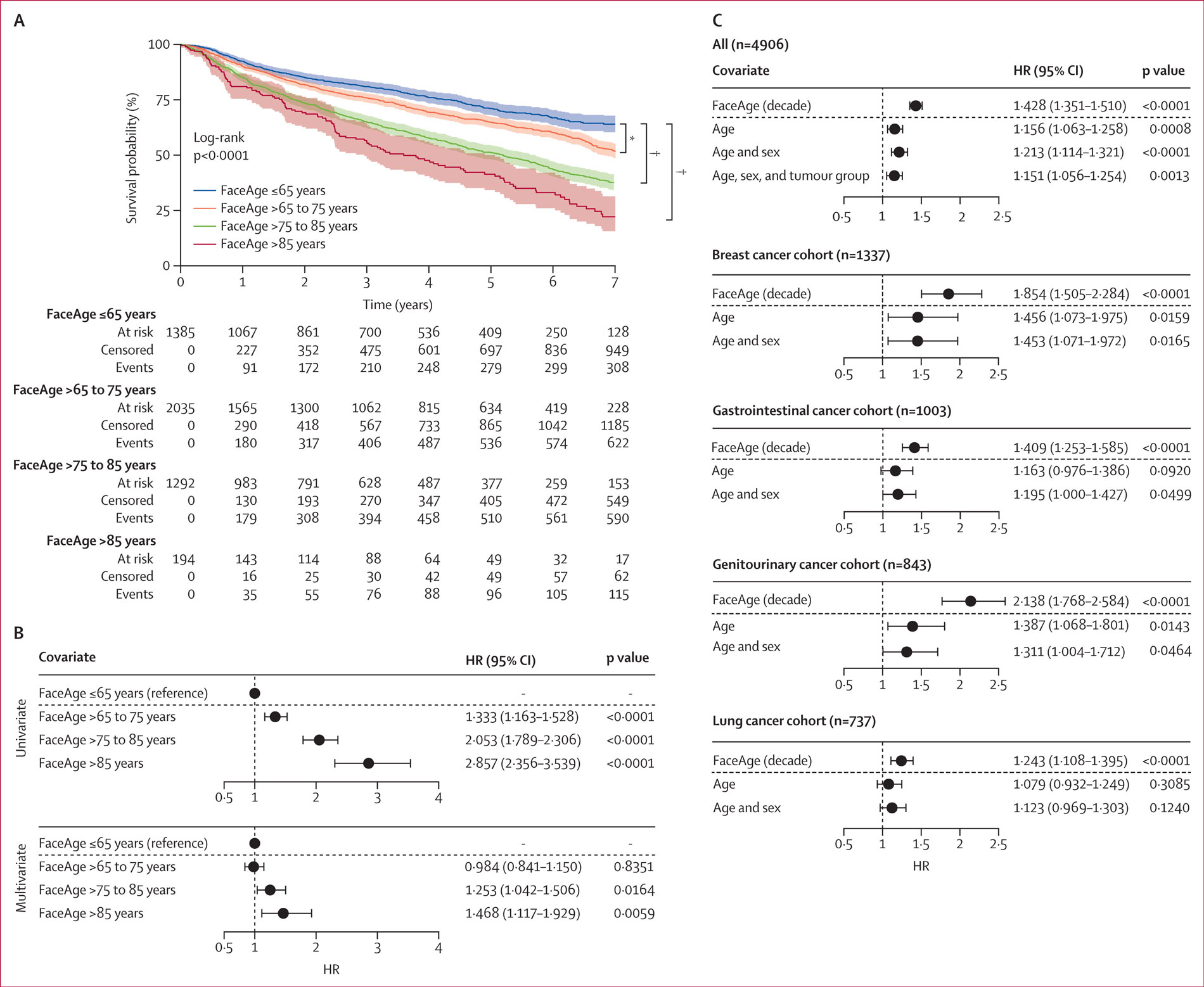
📊 Figure: Relationship Between FaceAge and Survival
(A) Kaplan–Meier curves: Patients are stratified by AI-predicted facial age (FaceAge). Higher FaceAge groups show markedly shorter survival (log-rank p < 0.0001). For example, the FaceAge >85 years group has substantially worse 7-year survival than the ≤65 years group.
(B) Univariate and multivariable analyses: The reference group is FaceAge ≤65 years.
- Univariate: in the FaceAge >85 years group, mortality risk is 2.857-fold higher (HR 2.857; p<0.0001).
- Multivariable (adjusted for age, sex, tumour group): the risk remains 1.468-fold (HR 1.468; p=0.0059).
(C) Subgroup analyses: Prognostic value of FaceAge across cancer types:
- Breast cancer (n=1337): per-decade increase in FaceAge → HR 1.854 (p<0.0001).
- Gastrointestinal cancers (n=1003): HR 1.409 (p<0.0001).
- Genitourinary cancers (n=843): strongest association; HR 2.138 (p<0.0001).
- Lung cancer (n=737): HR 1.243 (p<0.0001).
🔹 Age difference: Compared with age-matched healthy individuals, cancer patients appeared on average 4.7 years older (P<0.0001).
🔹 Survival relationship (FaceAge ↑ → risk ↑):
- All cancer types combined: 15% higher mortality risk (HR 1.151; P=0.013)
- Thoracic cancers: 11% higher risk (HR 1.117; P=0.021)
- Palliative care patients: 11% higher risk (HR 1.117; P=0.021)
🔹 Clinical benefit: In palliative care, doctors’ 6-month survival prediction accuracy improved from 74% to 80%, representing a 6% absolute improvement (P<0.0001).
👉 In summary: Looking older than one’s actual age is linked with worse prognosis in cancer. By capturing this biological aging signal, the FaceAge algorithm significantly strengthens doctors’ ability to predict survival.
🧬 Molecular Analysis
CDK6 (Cyclin-Dependent Kinase 6) is a critical enzyme regulating the cell cycle, playing a major role in cellular proliferation and aging mechanisms. The study highlighted the following findings:
- Negative correlation between FaceAge and CDK6 expression: Patients who appeared older than their chronological age had lower CDK6 levels.
- Chronological age (calendar age) showed no significant correlation with CDK6 after multiple statistical corrections.
What does this mean?
- Lower CDK6 levels may indicate reduced cellular regeneration and an accelerated biological aging process.
- Thus, an older-looking face may not just be a cosmetic issue but could reflect underlying cellular and molecular aging.
- Chronological age does not always reflect true biological aging; however, FaceAge may reveal this gap.
In summary, the inverse relationship between FaceAge and CDK6 expression supports the idea that AI-based facial age prediction may capture not only clinical but also biological and molecular aging processes.
📌 Quick View: Methodology and Impact
| Component | Summary |
|---|---|
| Training Data | IMDb–Wiki (56,304 images) → UTKFace (2,547) technical validation |
| Clinical Cohort | Total of 6,196 cancer patients; reference group of 535 non-cancer individuals |
| Main Outcome | Facial age ↑ → worse survival; in palliative care AUC improved 0.74 → 0.80 |
| Molecular Findings | Inverse correlation with CDK6; no significant link with chronological age → facial age may serve as a molecular biomarker of aging |
🔍 Clinical Significance
- Objectifies: Adds a standard metric to the physician’s subjective first impression.
- Improves stratification: Provides independent prognostic information across multiple cancer groups.
- Supports decision-making: Enhances prediction performance, especially in palliative care planning.
⚠️ Limitations & Ethical Concerns
- Training biases: Overrepresentation of celebrities in IMDb–Wiki and possible cosmetic/digital alterations.
- Generalizability: Requires validation in broader and more diverse clinical cohorts.
- Risk of misuse: Potential inappropriate use of facial age in areas such as insurance; requires a regulatory framework.
📝 Conclusion
FaceAge has the potential to generate a clinically meaningful biomarker from a readily accessible facial photograph. With larger and multi-center validations, it can be safely integrated into clinical decision-support workflows.
FaceAge, a deep learning system to estimate biological age from face photographs to improve prognostication: a model development and validation study
Bontempi, Dennis et al.
The Lancet Digital Health, Volume 7, Issue 6, 100870