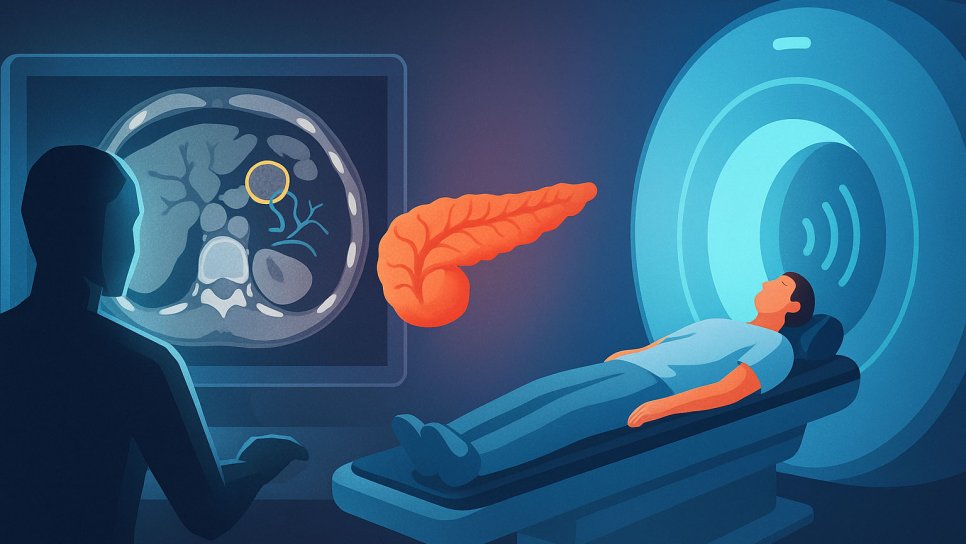
Early Detection of Pancreatic Cancer: MRI for New-Onset Diabetes, AI for Legacy CT Scans
In the PANCANAI study, AI reviewed CT scans taken ≥1 year before diagnosis and detected cancer signals in 53.9% of cases — meaning cancer left detectable footprints long before symptoms.
The screening paradigm is changing!
Pancreatic ductal adenocarcinoma (PDAC) remains one of the most silent and lethal cancers to date. At the time of diagnosis, over 75% of cases are already at an unresectable stage, and the 5-year survival rate remains below 12%. The lack of routine screening makes early detection rare. However, two studies published in July 2025 may change this trajectory: one using artificial intelligence (AI) applied to archived CT scans, and another utilizing metabolic risk–based MRI screening.

1. PANCANAI: Can AI Detect Tumor Shadows on Old CT Scans?
Publication: Investigative Radiology, June 24, 2025
Lead Author: Laura Degand, University of Copenhagen
This retrospective study evaluated 1220 CT scans from 1083 biopsy-confirmed pancreatic cancer patients (2006–2016). A pre-trained AI model (PANCANAI) analyzed lesion morphology and main pancreatic duct (MPD) dilation.
Key Findings:
- Sensitivity at time of diagnosis: 91.8%
- Sensitivity ≥1 year prior to diagnosis: 53.9%
- Sensitivity for Stage I cases: 82.9%
- By contrast phase: Portal: 92.1%, Arterial: 90.9%, Delayed: 83.5%
Interpretation:
The AI model was able to detect signs of pancreatic cancer in about half of the CT scans acquired more than a year before diagnosis — suggesting a detectable “radiomic fingerprint” long before symptoms arise.
2. PANDOME: Can MRI Detect Cancer in High-Risk Diabetic Patients?
Publication: The Journal of Clinical Endocrinology & Metabolism, July 2025
Lead Author: Dr. Richard Frank, USA
This prospective study enrolled 109 individuals aged ≥50 with either new-onset diabetes (NOD) or deteriorating diabetes (DD) and screened them using MRI.
Definitions:
- NOD: Elevated HbA1c in the past 12 months
- DD: Long-standing diabetes (>2 years) with a >2% rise in HbA1c over the past 6 months, unexplained by weight gain or non-compliance
Key Findings:
- 50% of participants had pancreatic cysts (~6 mm average size)
- 7 patients underwent EUS; 4 required biopsy
- 1 Stage IB PDAC diagnosed in the DD group
- DD group had:
- Higher HbA1c (P = .02)
- Greater weight loss (P = .0038)
- Higher insulin needs (P < .0001)
ENDPAC Score:
- 75% of DD group scored as high-risk (vs. 35.6% in NOD group)
Interpretation:
Metabolic deterioration in diabetes may signal subclinical PDAC. This study is the first prospective evidence suggesting that MRI-based screening could detect early-stage cancer in high-risk diabetic populations.
A Meaningful Step Forward in the Early Detection of Pancreatic Cancer
Pancreatic cancer has long evaded early diagnosis, owing to its asymptomatic progression and the absence of effective screening tools. However, the findings from the PANCANAI and PANDOME studies suggest a shift in this paradigm. Whether through retrospective analysis of imaging archives using artificial intelligence, or prospectively targeting high-risk individuals based on subtle metabolic changes, both approaches represent substantial progress in identifying the disease before it becomes clinically apparent. These studies not only validate new tools but also redefine who should be screened and how. Taken together, they mark an important milestone on the path toward earlier detection — a path that holds the promise of improving survival in one of the deadliest malignancies known to medicine.
1. Degand et al. Investigative Radiology, 2025. DOI: 10.1097/RLI.0000000000001209
2. Frank et al. J Clin Endocrinol Metab, 2025. DOI: 10.1210/clinem/dgaf319